
Image Credit: Rosa Luxemburg. Changes made. Both Pictures are Public Domain.
By Ben Robinson
“Women’s freedom is the sign of social freedom”- Rosa Luxemburg
With this formulation, Rosa Luxemburg positioned women’s liberation not as a side issue or a goal achievable within capitalism, but as the ultimate barometer of a society’s revolutionary transformation. This article examines the limits of liberal feminism’s politics of representation through Luxemburg’s critique of reformism, and considers what that critique might offer a feminism capable of confronting the contemporary manosphere. It first traces the material conditions underpinning the manosphere appeal, before addressing the challenge posed by radical and cultural feminism that economic transformation alone cannot dismantle patriarchal relations. It concludes by considering how material and cultural struggles might be organised together, extending Luxemburg’s understanding of collective struggle into contemporary feminist politics.
Liberal Feminism and the Politics of Representation:
Liberal feminism’s theory of change rests on a wager: that representation can produce transformation. Women’s presence in boardrooms, cabinets, courtrooms and laboratories does not merely reflect equality but produces it by breaking the informal and formal networks of exclusion that kept those spaces male, and by altering over time what the culture takes to be a natural holder of authority. It rests on the premise that institutions can be transformed, at least in part, by changing who occupies them. While Sheryl Sandberg, former Chief Operating Officer of Meta, gave this theory its most commercially successful expression in her book, Lean in: Women, Work, and the Will to Lead, the theory outlined well predates this work. It framed women’s underrepresentation at the top partly as a problem of confidence, negotiation, and ambition, correctable at the level of individual choices by women making different choices within existing institutions. The underlying logic extends well beyond Sandberg’s individualist prescriptions. It also informs the political case for gender quotas on company boards, anti discrimination law and parental leave reform: that changing access to institutions, and the rules governing participation within them, can gradually transform their distribution of power.
The feminist reforms of the last half century have greatly changed the material conditions of millions of women by passing equal pay legislation, anti-discrimination laws and the mainstreaming of workplace sexual harassment as a legal category. A young woman entering the British workforce today enjoys rights and protections beyond what women of a century ago ever saw. These are victories which were hard fought, hard won and worth defending. Nor is the theory empty. A workplace in which women hold real power is a workplace in which sexual harassment is harder to bury, hiring panels are harder to stack informally, and a girl watching the news sees leadership as thinkable in a way it was not for her grandmother. On this account liberal feminism does not need to overturn capitalism to do its work; it only needs capitalism’s institutions to become, internally, less discriminatory in their distribution of the positions it was already creating. This ambition is not trivial, and it has not been without real victories. These are substantial legal, cultural, and material victories. However, the question is not simply whether liberal feminism has changed women’s lives, but whether these changes can transform the economic relations and cultural assumptions that continue to structure inequality.

Sheryl Sandberg, Annual Meeting 2012 of the World Economic Forum. Image Credit: CC BY-SA 2.0.
The question worth asking, therefore, is not whether representation is good, but whether it can answer two problems at once. The first is material: a hollowed out labour market that produces insecurity across gender lines. The second is cultural: the common sense through which that insecurity is increasingly narrated, in which women, rather than the economic order, are held to blame. Liberal feminism assumes that greater access to existing institutions can gradually transform the attitudes and norms embedded within them. It can be argued that representation fails on both counts, and that Luxemburg’s critique of reformism helps explain why. The failure is clearest in the manosphere, a reactionary movement that has learned to speak the language of grievance more fluently than liberal feminism now does. Its rise is not only an economic story; it is a cultural one, and any feminism that cannot meet it on both fronts has nothing to say to the men it recruits.
Luxemburg’s Critique of Liberal Feminism and Revisionism:
Liberal feminism’s theory of change has a precursor in the history of the left, namely in Eduard Bernstein’s revisionism. Bernstein, a German social democratic political theorist, argued in the late 1890s that German social democracy should stop waiting for capitalism’s collapse and concentrate on securing concessions through trade unions, parliament, and social legislation, on the assumption that enough reform would one day tip over into transformation. In Reform or Revolution, Rosa Luxemburg, a Polish-German Marxist theorist and revolutionary socialist active also in the German SPD, diagnosed a fatal complacency in his view: the belief that capitalism would be legislated into justice, piece by piece, without confronting what it was. Luxemburg’s objection was not that reform could offer no victories for workers; it was that reform mistaken for revolution leaves the underlying structure not just intact but strengthened, having proven itself capable of absorbing its own critics. This parallel may be imperfect. Where Bernstein’s subject was class, liberal feminism’s is sex, and where Bernstein at least presented his theory as a road to socialism, liberal feminism makes no such claim. Nevertheless, the two share a logic of change: that a structure can be altered from within by gradually changing who benefits from it. This is the logic Luxemburg’s critique was written to answer.
But the point of the comparison is not simply that liberal feminism is reformist; it is that Luxemburg’s critique helps name two distinct failures. The first is the one already described: liberal feminism pursues reform within existing economic relations and mistakes access to patriarchal structures for a change in them. The second follows from the first. Liberal feminism treats problems that are both material and cultural as one that economic position will resolve: put women in authority and norms will follow. It therefore has no adequate answer to a grievance that is economic in its origins and cultural in how it is lived and voiced. This failure is the one radical and cultural feminists have pressed hardest, arguing that patriarchy is more than a byproduct of the economy. Whilst this article will return to their challenge, the former failure is easier to demonstrate, and will be discussed first below.
In 1912, addressing the question of women’s suffrage more directly, Luxemburg drew a distinction between what she deemed bourgeois women (the wives and daughters of the capitalist class) and proletarian women, in a refusal to treat their grievances as equivalent. Bourgeois women might chafe against male privileges she argued but they share their husband’s stake in the system these privileges sit inside; give these women the vote, she predicted, and most would fall into line with conservative reaction as soon as their formal rights were secured because their politics ran through their class position first and their sex second. She further drove home this distinction noting the absurdity of the capitalist order’s own logic on this point: a paid performer profiting her employer counted, under that logic, as a productive worker, while the domestic labour of proletarian mothers, on which the whole reproduction of the working class depended, counted as nothing at all. Her point was not that women’s formal equality didn’t matter, it was that formal equality secured within an unchanged class structure changes who holds the grievance without changing what produces it.
This is precisely the mechanism she identified in Bernstein 13 years earlier, that reform is easily absorbed by the system it was meant to unsettle. Liberal feminism’s contemporary subject is not Luxemburg’s leisured bourgeois lady, but a woman in professions that did not exist in 1912; yet the structure Luxemburg named survives the substitution. A feminism whose horizon is representation within existing economic relations- more women on boards, in cabinets, in STEM- is a feminism that has, like Bernstein’s socialism, mistaken access to the machine for a change in what the machine does. It does not consider the material order producing both women’s continued subordination and, on the other side of the same coin, the downward mobility of men that the online right has learned to narrate as feminism’s fault.
The Emergence of the Manosphere:
Into this landscape has come the manosphere, a modern problem rather than a late echo of an older quarrel: a reactionary movement that has learned to speak the language of grievance more fluently than liberal feminism itself now does. This movement has not invented its audience from nothing; it has attached itself to something real – the erosion of stable pathways into work, housing, and adulthood that once defined male coming of age – and offers young men a story about who is to blame: Diversity, Equity, and Inclusion (DEI) schemes favouring women, women’s sexual ‘hypergamy’, feminism’s emasculation of men.

Jordan Peterson at the 2018 Student Action Summit. Image Credit: CC BY-SA 2.0.
It is worth pausing on a fact that complicates any tidy account of the manosphere in that it has no single author, is not one grifter, platform, or algorithm’s fault. It is a resurgence of sexist parlance and attitude distributed across everyday speech in workplaces, school playgrounds and comment sections, in no way a single figurehead is responsible for it and no single deplatforming would undo it. A grievance that could be traced to one bad actor would be an ideological accident, correctable by better moderation or a sharper media literacy curriculum. A grievance this evenly distributed arising independently across a generation of young men tracks something structural; not a spreading idea but a material condition in which many young men independently found themselves living inside, for which the manosphere merely arrived first as an explanation.
To see how the grievances of men and women converge, the culture war theatre must be set aside and the balance sheet of neoliberalism’s last four decades must be examined. The routes into relatively stable industrial employment that had provided many working class men with a recognisable path into adulthood (manufacturing, construction, unionised trades) were not dismantled by DEI schemes or feminist hiring targets; they were offshored, automated and financialised. On the other side of the same ledger, the work which has expanded as the UK’s economy shifts further towards services, has been disproportionately filled by women, and disproportionately insecure: more than one million people in the UK are on zero hour contracts, and women make up three quarters of the care sector.
These are not separate stories but are one story of the recomposition of capital as neoliberalism sputters on, which has rendered both the male industrial worker and the female care worker equally expendable. The man who blames his declining prospects on feminism’s emasculation of male work and the woman who blames stagnant wages on patriarchal holdovers, are both describing, in different dialects, the same thing: the withdrawal of capital away from skilled and stable labour. Both the manosphere and liberal feminism paint the quarrel as lateral, when, in fact, it is their shared enemy that is lateral.
Liberal feminism has had no answer to this except a moral one. Its inability to offer a structural response is not incidental, but a consequence of its own limitations. It takes the atomised individual of neoliberal society as its unit of analysis, and a politics built on that unit cannot speak to men who experience their decline as a collective. Worse, it shares the manosphere’s premise, both treating good positions as a scarcity that someone must lose for them to gain, differing only on whether that someone is a man or a woman.
Here Luxemburg’s distinction between reform-as-endpoint and reform as byproduct of struggle earns its keep. Luxemburg did not oppose concessions; she opposed mistaking them as the thing itself. Extending that logic to the present, in a way in which she did not herself elaborate in detail, the shape of a non-reformist feminist reform comes into view; not more women on boards, but sectoral bargaining rights for the feminised precaritised sectors where exploitative zero hour contracts, not the glass ceiling, act as the operative mechanism of subordination; not Sandberg’s exhortation to negotiate harder as an individual, but wage floors and job security attached to the sector, rather than the individual’s leverage within it. What each of these demands has in common is that none is won at men’s expense: they raise the floor; they don’t just reallocate the ceiling.
The manosphere’s account needs this scarcity to be natural: women’s gains only read as men’s losses if a fixed quantity of security is being carved up between them. But the scarcity is a political outcome, the product of four decades of capital’s withdrawal from stable work, not an order of male and female entitlement. Here the manosphere’s story comes apart on its own terms. Liberal feminism, which proposes to redistribute precarity rather than abolish it, cannot say so.
The Material and Cultural Challenge to Liberal Feminism (and the Manosphere):
The challenge flagged earlier -that Liberal feminism treats material and cultural problems as just economic- now has to be met directly. The most serious objection to this framework and the material resolution itself comes not from liberalism but from radical and cultural feminism, and it deserves to be stated in its strongest form. On this account patriarchy is not a reflex of capitalism but a system of domination with its own history, institutions, psychic investments and modes of production, one far predating capital and surviving each mode of production it has encountered. The manosphere,on this reading, does not rise from economic grievance but is a reassertion of male sexual entitlement and a cultural phenomenon reproduced through language, family, sexuality, and violence. Sectoral bargaining may raise the wages of care workers but cannot teach a teenage boy that women are not property; it cannot dismantle the everyday misogyny that survives prosperity, the ideological devaluation of care even when the work is well paid or the sexual violence that crosses class lines. A materialism that cannot answer this objection is not worth defending and falls into its own version of Bernstein’s error: that the correct economic reform will carry the cultural register behind it as a matter of course.
The answer is not to deny patriarchy’s relative autonomy, as Heidi Hartmaan, American feminist economist, does, instead, the word ‘relative’ must be taken seriously, not conceded in passing. The manosphere’s central fantasies are not reducible to wage stagnation, they are sexual and hierarchical, not merely economic and its most enthusiastic recruits are not always the most economically desperate. Luxemburg’s materialism was never purely economistic. Her critique of Bernstein was not that he paid too much attention to culture but that he mistook reforms which strengthened capital as part of a road to revolution. Her theory of the mass strike is a theory of consciousness: the struggle for material demands was also the school in which workers learned to see themselves as a class. The economic and the ideological were not separate elements in her thought; they were dialectically related, each shaping and being shaped by the other.
The fate of the Zhenotdel makes the case concretely. Some Bolsheviks believed that with the abolition of private property and the socialization of household work that women’s subordination would be dissolved. The Zhenotdel was founded in 1919 to organise women and contest patriarchal norms in the new socialist society. When dissolved under Stalin in 1930, the party did not simply stop contesting patriarchy but actively re-entrenched it. The 1936 abortion ban and the tightening of divorce law were not neutral residues of Tsarist attitudes; they were new political settlements, sponsored by a state which had abolished the property relations liberal feminism has never touched. A revolutionary project which had nationalised industry and collectivised agriculture still watched patriarchy reassert itself once the front created to combat it had been dissolved.
The lesson is not that patriarchy floats free of class relations; it is that ideology must be organised against, deliberately and continuously on its own terrain. The vacuum left by a defeated material logic is filled by whatever ‘common sense’ was sitting there unopposed. This is the point in which materialism, held too simply, risks becoming its own version of Bernstein’s error: the assumption that the correct economic reform will carry the cultural register behind it as a matter of course. The Soviet experience discredits the assumption that reform carries culture behind it automatically. Whilst this does not discredit materialism itself, it does discredit materialism held too simply- the economism Luxemburg herself never practised.
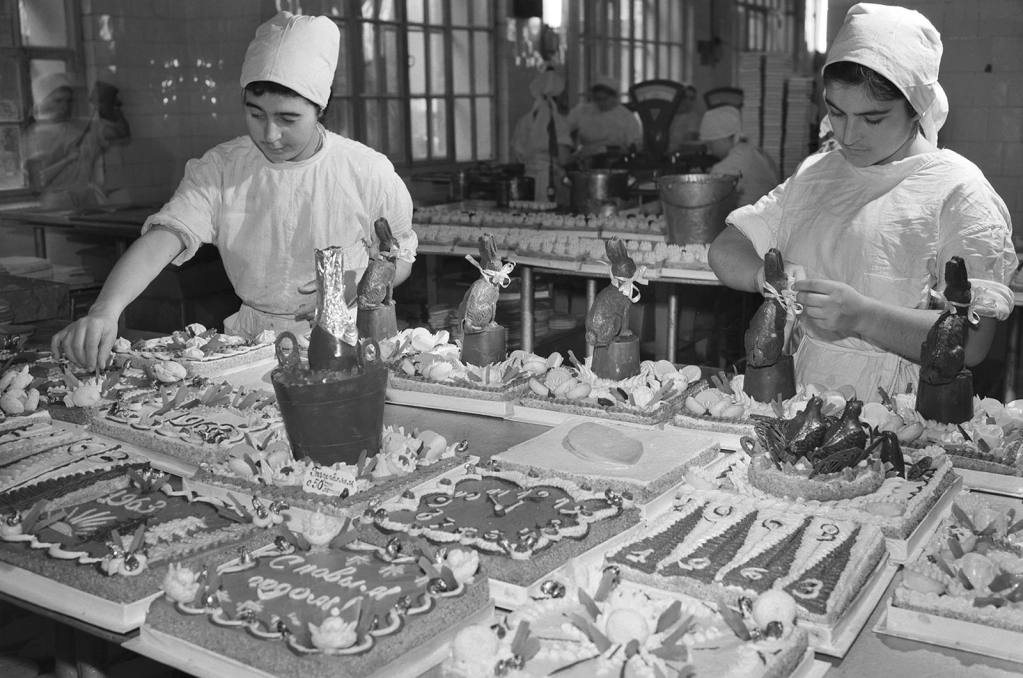
Women in a Bolshevik Factory. Image Credit: CC BY-4.0.
Luxemburg’s Answer to the Question of Freedom:
It is from this point that the shape of Luxemburg’s answer is revealed, extended beyond what she herself wrote. Organising on both fronts at once actually requires, concretely, not as a rhetorical balance but as a single practice: sectoral bargaining and wage floors attached to the job rather than the individual, fought for and narrated explicitly as an assault on the material scarcity the manosphere requires to make its case at all. This is paired with feminist organising inside those same unions, popular education on consent and masculinity, and a deliberate contestation of the fixed pie narrative that both the manosphere and liberal feminism have accepted as the horizon of the possible. The struggle for the first is the school for the second: when care workers organise they not only raise wages, they produce a collective subject capable of naming patriarchal devaluation for what it is. When young men are organised into unions rather than sorted by an algorithm into manosphere content, the material grievance and the ideological one are met by the same movement at the same time.
This is also what freedom means in Luxemburg’s thought, and why she understood women’s emancipation as inseparable from the wider struggle for social freedom. Freedom is not the removal of barriers to individual advancement, which is the best representation that can offer. Freedom is the collective capacity of people to shape the conditions of their own lives, and it is learned in the struggle to win it, as the mass strike was the school in which workers learned to see themselves as a class. On that measure, women’s freedom is a sign of social freedom because it cannot be had while the conditions that set men and women against each other remain unchallenged.
Freedom of this kind cannot be measured by the number of women in boardrooms, and it also demonstrates the relationship between feminism and the manosphere in sum. The manosphere is not feminism’s mirror image, nor a backlash against it, instead it is a rival answer to the same question of who is to blame for the loss of security, and it gains its audience wherever liberal feminism offers only representation in reply. A feminism confined to access cannot defeat the manosphere, because both movements depend on the same premise; that the problem is economic, and therefore someone from the other gender must lose their position for their ‘side’ to gain. Only a feminism that contests this economic scarcity and organises men and women against it together, can leave that story with nothing to explain. Luxemburg’s charge against Bernstein was that gains left unconfronted, assumed rather than fought for, get absorbed back into the structure they were meant to unsettle: that was true of capitalism in 1899; it was true of a patriarchal ideology in a workers’ state in 1930, and it is true of the present: the manosphere being what fills the space where a gain was assumed and the struggle was not fought. This is what will be true of any feminism, of any political tendency, that wins one argument and assumes the other comes free.





Leave a Reply