
Image Credit: Owain.davies CC 4.0 changes were made
By Dylan Newell
“[…] may no such storm
Fall on our times, where ruin must reform.” – Cooper’s Hill by John Denham
I. Introduction
In these times of political crisis, the old moderate is desperately seeking to forestall the new radical. Yet, the Reform party continues to poll second, and the Green party is poised for continued popularity like never before in its history. Meanwhile, in the US, President Trump runs his MAGA administration mostly unimpeded, and his Republican party polls in the midterms relatively unscathed. All this combines to mean the political fringe of a decade ago, Farage, Trump, the radical left, are no longer to be dismissed under easy, condescending terms like ‘populism.’
Still, in seeking to articulate some critique of this new radicalism, both moderate wings have lazily resorted to the political demons of the last century. For the left wing moderate, they demonise Reform as ‘fascist;’ for the right wing moderate, they demonise the Greens as ‘socialist.’ For their own radicals, neither wing has thought up any attack angle other than the flaccid critique: ‘their policy goals are unrealistic.’
As a right-wing moderate, I naturally take an interest in understanding (and forestalling) the new radical, but I do not agree with such cynical, propagandic trumpery. The Greens seem somewhat socialist in ideology, but I may be biased to think so. More acutely, when I consider the possibility of a fascist Reform or MAGA, I cannot simply ignore the glaring differences in policy and provenance.
First, and this may be the most cynically important, ‘fascist’ is not a convincing or particularly effective term. Online, where Godwin’s Law virtually dictates bringing up Hitler on a regular basis, using the term ‘fascist’ plays into the very hands of the person one seeks to defame. A new political strategy is the ‘rage bait:’ win over voters by characterising your side as rational and the opposing side as emotional. For the unideological voter, one that just wants rational and considerate politics, they will primarily vote based on who is acting ‘rationally.’ A thousand smug articles hyperbolising Donald Trump’s bad acts makes continued MAGA dominance more likely. Importantly, describing someone as a ‘fascist’ makes it incredibly easy to be characterised with the ‘emotional’ side.
Secondly, and much more relevantly to an ideological discussion, it seems when one describes the current right-wing radical as ‘fascist’ they are making comparisons of discrete actions rather than ideology. Of course, one can talk of the similarities between ICE and Nazi paramilitaries; ‘Alligator Alcatraz’ and a concentration camp; executive overreach and fascist dictates; January 6th and a fascist coup, but Trump (and the majority of followers) do not justify such radical acts through fascism. While fringe MAGA supporters are genuine fascists, the implication that therefore the rest are secretly fascist is a disservice to the truth. Similarly, just because American political parlance is so easily imported into the UK does not mean it correlates to the Reform party. In either case, radical immigration policy and a preference for strongman unitary power, as opposed to a separation of powers, does not necessarily mean fascism. At the absolute least, the popular ideology of MAGA and Reform (what the average supporter believes) is not fascism, and, if we seek to understand the popularity of the new radical, that is what’s relevant.
The ideology of this new radical right is something far more novel, and far more intertwined with contemporary political context, than fascism. Both communism and fascism are distinctly 20th century concepts, and they are deeply unpopular contemporaneously as a result. I shall agree it is possible the new radical is a renormalisation of old, fascist, concepts, but I shall put forward the contrary argument: this new political force is not an old bogeyman. This article argues that MAGA and Reform combine to, and represent, a new ideological force: Western Revanchism. To understand the provenance of this ideology, however, I must first reinterpret our understanding of the classical liberal and the classical conservative.
II. The Concept of Supremacy
For our purposes, the most relevant difference between liberalism and toryism is that of supremacy. Related to sovereignty, supremacy is an ideological term (rather than a technical term) for what is held superseding in politics. While a nation-state may have a sovereign parliament, a sovereign constitution, those are ultimately technical implementations of the nation-state’s supreme ideal. For the liberal, the individual’s interests supersede, they can be said to support the supremacy of the individual. For the tory, the state’s interests supersede, they can be said to support the supremacy of the state.
This then technically means that the liberal supports the interests of individuals in justifying the state, such as from a sovereign constitution, while the tory supports a self-justifying state, such as from a sovereign parliament. These supremacies can also be understood by how the liberal and the tory describe liberty. For the liberal, liberty is constraining the state so we may be unconstrained individuals. For the tory, liberty is what the state does not seek to act on.
It may seem that toryism is indefensible: it appears an autocracy, but it does not have to be so. In the same way that Hobbes’ Leviathan does not necessitate a totalitarian state, the tory supports the supremacy of the state not the totality of the state ― the state is the foremost concern, not the only concern. While it can be argued that toryism may entail totalitarianism, it is also often the case that the totalitarian state is antithetical to the continued supremacy of the state. Totalitarian states often fail themselves, and they often hold something else supreme over which the state must make total sacrifice. For Stalinist Russia, that was the party and the worker. For Nazi Germany, that was the party and the race. In both, the supremacy of the state was not looked after for the belief it could be sacrificed to another supremacy. A true belief in the state for its own sake, for the sake of a commonwealth, would be reluctant to embark upon triumph or self-destruction, like Nazi Germany did, unless the state faced destruction regardless. Likewise, a tory is habituated to interpret state supremacy through tradition and moral obligation, neither allows one to lightly interpret state supremacy for terrible aims.
Whatever the case, I will have to concede state supremacy appears prone to folly, or prone to abuse. I will admit it does seem quite easy, then, to support the liberal, and individual supremacy, for the belief it puts everyone on a surer footing. It’s an attractive proposition, but the keen may already notice an essential problem with liberalism and individual supremacy: the individual’s interest usurps the state’s interest. That may, of course, be very good. The very idea of popular sovereignty is contingent on how satisfied we are, individually, with the state. It seems beyond any sense of mandate for the state to act against our individual interests, or at least a tyranny of the majority. Yet, I’d argue this causes an essential problem.

The Destruction of Leviathian by Gustave Doré (1865)
Perversely, individuals in a state are often interested against their state. Even in a representative democracy, free of corruption and personal interests, the pure state interest does not agree with everyone. This is because, as a matter of obvious human character, some people prefer their natural power and security to what power and security the state can offer them: in order for one individual to be secure and benefit from the state, another must lay down what would otherwise be in their natural interest. The disbenefiting individual may accept that such scenarios are in the common interest, or they may revert to their natural powers and fight for their natural interests. This is an individual which Hobbes calls an ‘outlaw.’
However, this outlaw may not choose to fight against the state so openly: not every individual who makes war against the common interest is a criminal per se. An individual may, instead, seek ways to subvert the state within the law and order of the state. For the tory state, such a subverting individual must first confuse the commonwealth’s interest with their own. For the liberal state, these subverting individuals must simply clad their claims in the principle of the supremacy of the individual. In common language, they can claim ‘free speech’ or ‘right to x’ or any other individual absolute, often noble and just in abstract, but corruptible by the subtleties of our muddled language.
As a consequence, the liberal state, through enabling some of these individuals making war and insecurity, shall enable war and insecurity itself. More individuals, realising that corruptive individuals are successfully obtaining their natural interests against the common interests, will likewise follow. In severe terms, the natural end of the essentially liberal state is the failed state. And in the failed liberal state, the state shall fail to ensure the good which brought about its end: the interests and security of the individual. This essential problem of liberalism represents the problem from which this new radical right ― Western Revanchism ― shall soon be known to flourish.
III. Attempts to Solve the Essential Problem of Liberalism
In order to understand how liberalism is no longer conducive to a stable state, it must be first known by what means the historical liberal was able to make stable states, in spite of its essential problem. Past the English Civil War, past the French Revolution, much of the 18th, 19th, and 20th centuries saw liberal states flourish. For those intervening centuries, solutions to the essential problem of Liberalism were credible. First, there is the interpretation solution: ‘An individual’s supremacy may be interpreted to be self-defeating, and therefore void, if it harms the state’s ability to ensure the individual’s supremacy.’ Second, there is the client solution: ‘The state shall placate the individual by treating them as its client, advancing an individual’s growth and empowerment outside of the state.’
The interpretation solution is readily practised in a system of constitutional courts, often favourable towards a state’s security (if not state interests.) The client solution can be readily seen through the liberal state’s historical desire for expansion, resources, and free trade.
As to the client solution, it is no coincidence that the exponential rise of imperialism took place with the rise of the liberal state. While state and enterprise colonialism had taken place slowly before the Enlightenment, what the client solution caused was rampant exploitation to the extent of each individual’s dissatisfaction. For the individuals within a state, such growth and empowerment would be impossible if not for the state’s exploitation of others. It is not the state, or capitalism, that necessitated continual growth for everyone ― that would be the supremacy of the individual.
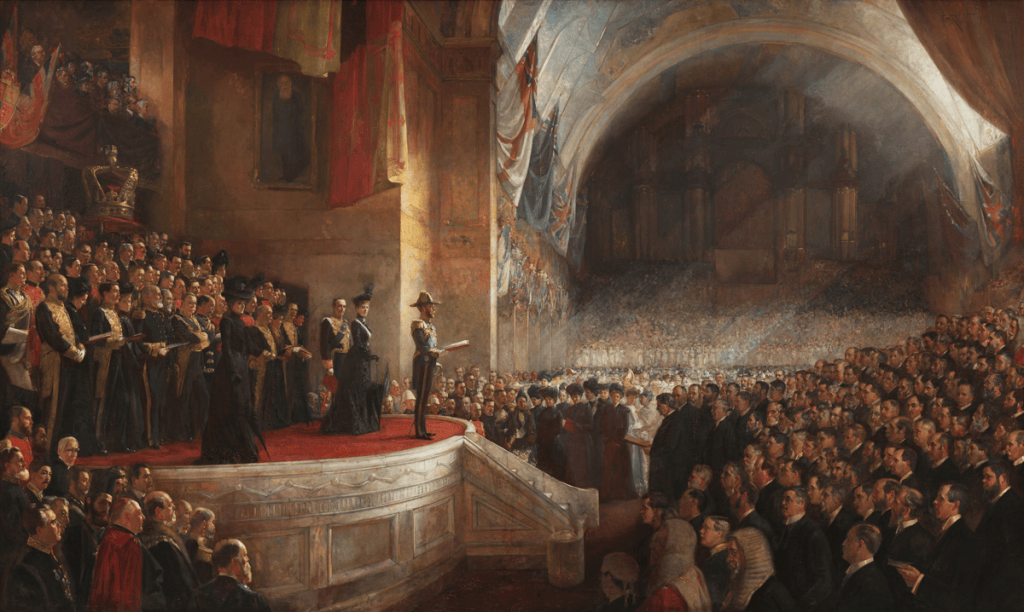
The Big Picture by Tom Roberts, showing the opening of the first Australian Parliament in Melbourne (1903)
I think it is plain that by now state clientelism has unravelled, or taken new form, and its inherent contradiction, the liberal imperial project, was eventually confronted. No longer does the individual owe to the state’s exploitative projects a large portion of their prosperity. Likewise, free trade has logically turned against the simultaneous benefit of the individual and the liberal state: the illiberal state, which the individual shall prefer to do business with, shall always have the free trade advantage. From that advantage, the illiberal states shall be empowered and pose a threat to the liberal state, meaning such practice is also a piece of elastic ready to rebound as an existential threat.
The liberal, not wishing to exploit others, or empower the illiberal, is now returning to the essential problem of liberalism within a state, where the state may benefit the state or the individual but not both. A new form of the client solution, practised in neoliberalism, has been the globalisation of the state into an ‘inter-state.’ If the individual requires the state to provide for their interests in the inter-state order, they shall be satisfied with the state’s handling of their interests.
In this way, one could argue, could it be the case that the liberal has critically misunderstood the political project? Rather than asserting the individual as supreme in a carte blanche, then trying their best to solve the inevitable consequences by any means, it seems to me politics is much less absolute. For me, we must have an open mind that some of our liberty, and our rights, may need to be given over to the commonwealth of the state ― a security on which we all depend ― we can then often retain the responsible rights of liberalism without giving over to its more ruinous assertions. Similarly, we can also confront the interests and interplay of demographics and polities, a problem largely ignored by the liberal ideological framework. I think such politics would be very hard in states which have sanctified individual interests as sovereign ― the US has forever put off actual discussion of its individual supremacy by sanctifying a sovereign constitution ― but I think it should be easier, or has already been happening, in our state of parliamentary sovereignty.
IV. The Popular Post-Liberalism of Western Revanchism
Returning, neoliberalism hoped that, after the destruction of liberal imperialism, a liberal inter-state order could be formed which would once again allow each state to serve the interests of their individuals. Also, that a reduction in state ― to an extent previously thought impossible ― could be offset by such a globalising order. Much talk has been made that inter-states, such as the European Union, were primarily made to prevent another world war. While that is a reason, I think a more expansive reason was to try and prevent common dissatisfaction (of the Nazi and Marxist sort) over the poorer positions in liberal-imperial clientelism. Neoliberalism was a necessary consequence of liberal imperialism, as a solution which produced existential threats, dying off.
Yet have we not recently seen the dysfunction of neoliberalism? As the fascist and the communist of the early 20th brought an end to the liberal imperial edifice, it could very well be the Western Revanchist of the early 21st century will bring an end to the neoliberal inter-state edifice. Before I prognosticate on the Western Revanchist project, I should describe by what ideology the Western Revanchist is desirous to reform ― at the very least ― the neoliberal project.
To me it seems Western Revanchism is the popular element of our essential Liberalism problem: ‘the state, and the neoliberal inter-state, has failed to properly provide for the supremacy of the individual, that we once accomplished, and now must give way.’ I must digress that an easy way to understand the philosophical nature of an ideology is to consider what position its leaders come from. Thereby, in the French Revolution, the proliferation of lawyers underpinned a belief in law over state. Similarly, in Western Revanchism, the proliferation of businessmen and bankers underpins a belief in liberal power over liberal order. The leaders of this new ideological force became used to the advantages liberalism afforded them, or previously did, but are now in sharp disbelief that the liberal order fails to afford them, and the popular vote, the satiation of their individual interests. In that way, they believe the current method of individual supremacy, not the supremacy of the individual itself, must be corrected.
Why should the Western Revanchist, or the ex-liberal, be so disaffected with the current liberal project? I don’t think it requires much explanation to understand why, for, as much as any state intends to hold the individual supreme, it is ultimately interpreted by a state elite. This is the true significance of the interpretation solution ― that the constitutional courts (and other institutions which interpret the ideologies of the state) become the new vehicles for an arbitrary state. This is triflingly evident in the American Supreme Court’s long history of pro-WASP (White Anglo-Saxon Protestants) judgements. Throughout the past few decades, it has also become evident through the Supreme Court’s metropolitan activism judgements. Nowadays, it likewise becomes evident by the American Supreme Court’s pro-MAGA stance. I don’t intend for this to be a particularly scathing critique of constitutional courts, obviously any good institution is going to be beholden to a zeitgeist, but it shows that the Hobbesian view, of liberty being decided by grace of the state (sometimes against the interests of the individual) has never really left us.

Donald Trump Delivering Remarks in Las Vegas (2026)
But Western Revanchism is not Hobbesian and is still a particularly liberal view, with a belief that the sacredness of individual supremacy has merely been misguided. To them, the only liberally-coherent explanation for this is a misguided state, and, since the elite guide the state, the state elite must be evil. This becomes suspiciously close to being confirmed when, as an unrelated consequence of neoliberalism, the inter-state order falls on hard times. We have all suffered the aftermath of the 2008 Financial Crisis, the 2010 Eurozone Debt Crisis, the War on Terror, the concomitant Refugee Crisis, the inter-state dysfunction of the COVID years, the 2022 Invasion of Ukraine, plus many more crises besides. In sum, this is the era of neoliberal crisis and malaise; it makes logical sense that the Western Revanchist, used to liberal prosperity, would maintain the essential liberal project but seek to chastise a palpable interregnum of the past few years ‒ enabled by bad actors. The Western Revanchist, more than anyone, is hoping for a renewed western liberal power, because, at the very least, they knew that was once upon a time possible. It reminds me of Citizen Kane – not too coincidentally Donald Trump’s favourite film – where Kane is chastised for his elitist beliefs: ‘You’re not going to like that one bit when you find out your working man expects something as his right not as your gift.’ In sum, that is the warning of the Western Revanchist.
V. Conclusion
But, I don’t think the Western Revanchist’s desire for a return of liberal power is feasible: does anyone truly think the current Revanchist rending of the neoliberal order is a prosperous reform upon a new liberal interpretation? In popular sentiment there may be longing, but in action, it seems, reform takes the form of ruin. Its scarcely believable now that NATO could be ignored in favour of Board of Peace-style cronyism, or that (as was once said) the European Union could be replaced by new trade deals abroad, or that this desire to tear down so that things may reform will not be co-opted by the dictator and the propagandist for terrible means ― to some anticipatory people it already has. To polemicise, it truly does seem to me that Western Revanchism is essential liberalism at its final, cornered stage. No longer able to functionally use the solutions it has so historically relied upon, it has finally turned the essential problem of liberalism against the liberal state, and it can only, unaltered, give rise to ‘blood and ruins.’
I will leave you as we started, with the prescient verse of John Denham in Cooper’s Hill. It puts forward the sentiment for toryism, against an unmitigated liberalism, better than I ever could. This extract starts after Denham’s description of a stag hunt, which he now uses as a metaphor for the Magna Carta:
‘[…]
This a more Innocent, and happy chase,
Than when of old, but in the self-same place,
Fair liberty pursued, and meant a Prey
To lawless power, here turned, and stood at bay.
When in that remedy all hope was placed
Which was, or should have been at least, the last.
Here was that Charter sealed, wherein the Crown
All marks of Arbitrary power lays down:
Tyrant and slave, those names of hate and fear,
The happier style of King and Subject bear:
Happy, when both to the same Centre move,
When Kings give liberty, and Subjects love.
Therefore not long in force this Charter stood;
Wanting that seal, it must be sealed in blood.
The Subjects armed, the more their Princes gave,
The advantage only took the more to crave.
Till Kings by giving, give themselves away,
And even that power, that should deny, betray.
“Who gives constrained, but his own fear reviles
Not thanked, but scorned; nor are they gifts, but spoils.”
Thus Kings, by grasping more than they could hold,
First made their Subjects by oppression bold:
And popular sway, by forcing Kings to give
More than was fit for Subjects to receive,
Ran to the same extremes; and one excess
Made both, by striving to be greater, less.
When a calm River raised with sudden rains,
Or Snows dissolved, o’erflows the adjoining Plains,
The Husbandmen with high-raised banks secure
Their greedy hopes, and this he can endure.
But if with Bays and Dams they strive to force
His channel to a new, or narrow course;
No longer then within his banks he dwells,
First to a Torrent, then a Deluge swells:
Stronger, and fiercer by restraint he roars,
And knows no bound, but makes his power his shores.’



Leave a comment