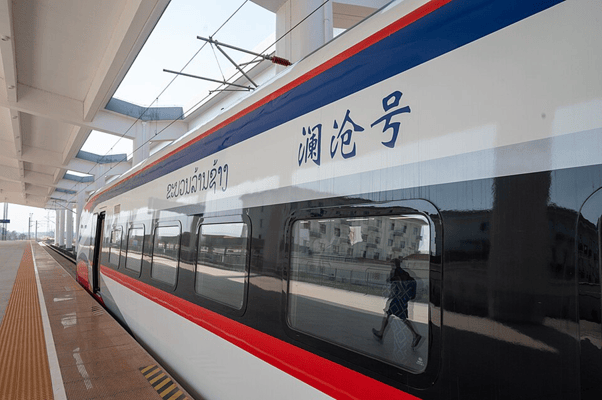
Waiting train at Vientiane railway station. Image Credit: Dominik Landwehr, CC BY-SA 4.0.
By Khemchart Buakhao
Introduction
The rise of China in the 21st century has significantly altered the global political economy, with Beijing describing this shift as moving towards a ‘multipolar vision’ that prioritises the developmental needs of the Global South. Central to this vision is the Belt and Road Initiative (BRI), a massive infrastructure development project aimed at fostering increased global economic interconnectedness through investments in roads, bridges, ports, and energy corridors across Asia, Africa, and Europe. In Southeast Asia, the Laos-China Railway (LCR) stands out as the most ambitious example of this strategy; it is a high-speed rail line spanning over 1,000 kilometers from Kunming, China, to Vientiane, Laos, designed to reduce travel time and boost trade significantly. The project aims to transform Laos from a ‘landlocked’ country into a ‘land-linked’ hub by improving access and connectivity to regional markets. However, beneath the surface of this strategic partnership lies a complex security and economic dilemma: do these new connectivity technologies genuinely empower recipient countries by enhancing their sovereignty and development, or do they primarily serve as tools for external influence, potentially increasing dependence on China and altering regional power dynamics?
This article contends that although the LCR presents a tactical solution to Laos’s geographic challenges by improving regional connectivity, it also fundamentally questions the traditional Weberian notion of exclusive territorial sovereignty. By applying the concept of the ‘gatekeeper state’, it becomes evident that the Lao state no longer functions as a unified institutional actor solely managing its external interfaces. Instead, the railway has fostered a situation of ‘fragmented gatekeeping’, in which authority over fiscal flows, logistical operations, and resource extraction is increasingly delegated to Chinese state-led entities, such as China Railway Group and its affiliated companies. This transformation does not indicate outright state failure. Still, it signifies a reconfiguration of power dynamics, in which sovereignty is decoupled from strict territorial control and instead centered on overseeing decentralised technological infrastructure and complex financial networks operating across multiple jurisdictions.
The following analysis is divided into these key parts:
The Theoretical Framework:
- Synthesising the gatekeeper state with China’s multipolarity.
- Refining sovereignty to understand Global China’s impact on the Global South.
The LCR Case Study:
- Evaluating the ‘solution’ of connectivity versus the ‘problem’ of asymmetric dependency.
Theoretical Framework
To analyse the political economy of the LCR, this article moves beyond classical realist interpretations of state power. Traditionally, the Weberian concept defines the state as a monopoly holder of the legitimate use of physical force within a given territory. However, in the context of Global China, this monopoly is increasingly challenged by large-scale projects like the LCR, which seek to bypass traditional state control mechanisms and involve international actors, private firms, and cross-border economic interests.
The primary framework guiding this study is the ‘gatekeeper state’ theory by Frederick Cooper, historian of colonialism and African Studies. Cooper argues that postcolonial states often derive their authority not from comprehensive internal governance but from their ability to manage the interface between the domestic and international arenas—specifically, by controlling the ‘gates’ to customs, international aid, and resource extraction.
To fully grasp the LCR’s impact, we must refine Cooper’s ‘gatekeeper state’ theory for the digital age by incorporating the evolution of technological infrastructure. Historically, the gatekeeper state’s authority was centralised at physical ‘gates’—such as ports, border checkpoints, and customs facilities—that physically controlled the movement of goods and people across borders. However, in environments characterised by heavy foreign intervention, gatekeeping authority is no longer exclusive to the state. Instead, non-state actors, including multinational corporations, transnational institutions, and digital platforms, increasingly participate in controlling access and influence across these strategic interfaces.
In the case of the LCR, this process is facilitated by China’s Economic Statecraft, which leverages infrastructure lending programs such as the BRI and advanced technological networks to create ‘technologies of resistance’ or, more accurately in this context, ‘technologies of integration’, which effectively serve to assimilate China into the local system of power.
The LCR introduces several advanced ‘technologies of integration’, including automated logistical systems powered by Internet of Things (IoT) sensors, 5G-enabled communication networks that facilitate real-time data exchange, and AI-driven infrastructure management systems that optimise resource allocation. These digital assets function as virtual gates—digital hurdles that bypass or augment traditional state control mechanisms—shifting sovereignty from physical checkpoints to decentralised, interconnected technological platforms.
This transition is what creates a phenomenon of ‘fragmented gatekeeping’. In this new landscape, authority is no longer exclusive to the state but is shared across a diverse network of actors, including Chinese state-backed enterprises, digital infrastructure providers, and transnational logistical managers. Sovereignty is decoupled from fixed territorial control and reconfigured into the management of cross-border data exchanges and cyber infrastructure. As a result, the Lao state’s role as a gatekeeper is permanently broken; it increasingly depends on external entities to operate the systems that shape its current connectivity and security.
The ‘multipolar vision’ promoted by Beijing is therefore not merely a diplomatic catchphrase; it represents a fundamental challenge to the Western-led Liberal International Order. By presenting itself as a strategic partner to the Global South, China leverages infrastructure-led development to propose an alternative pathway that prioritises ‘developmental rights’ over ‘liberal norms’. In this framework, the LCR serves as a tangible example of a ‘Sinocentric spatial fix’—a strategic process whereby China exports its surplus industrial capacity to regions like Southeast Asia, thereby restructuring regional political economies into interconnected networks of dependency and influence, ultimately reinforcing China’s geopolitical and economic positioning in the region.

Railway Crossing. Image Credit: Khamla Phimmasone, Mapillary.com, CC BY-SA 4.0.
The Laos-China Railway as a ‘Solution’
In China’s multipolar vision, infrastructure is viewed as a primary strategic solution to address the development challenges faced by the Global South. For Laos, a country historically marginalised due to its landlocked geography and limited access to international markets, the LCR represents a significant strategic breakthrough, enabling it to bypass geographic isolation. Completed in 2021, the LCR has transformed Laos’s regional role from a mere ‘buffer state’ to a vital ‘land-linked’ logistics hub in Southeast Asia, substantially reducing transit times and transportation costs.
This ‘solution’ operates through what Audrey Kurth Cronin, Director of the Carnegie Mellon Institute for Strategy and Technology, might describe as ‘open technological innovation’ in the sphere of infrastructure, integrating standardised Chinese rail technology and logistical systems into the host state’s territory to bypass old, inefficient trade barriers. From a ‘gatekeeper state’ perspective, the LCR serves as a massive expansion of the state’s ‘gate.’ It enables the Lao government to generate new external revenue streams through transit fees paid by Chinese and international freight carriers, boost resource exports—including potash, copper, and rare earth minerals—to China and Southeast Asia, and increase Chinese tourism, which has become a major contributor to the country’s domestic service sector, notably in hospitality, transportation, and retail industries.
However, this ‘solution’ is not merely a neutral provision of public goods. In fact a critical re-engagement with dependency theory reveals this is not a ‘win-win’ partnership but a structure of asymmetric dependency. Unlike the 20th-century dependencies built on raw material extraction, 21st-century dependency under Global China is rooted in technological and fiscal tethering. By linking Lao revenue streams to Beijing’s regional influence through loan agreements and joint ventures, the country finds itself fiscally dependent on China.
As detailed in the 2024-2025 fiscal reports, revenue generated from the railway has become a ‘lifeline’ for the Lao elite, indicating a systemic reliance on external financial flows and technology transfer.
Moreover, the debt incurred from a project as massive as the LCR reinforces this ‘fiscal lifeline’ effect, diminishing the recipient state’s incentive to expand its own domestic tax-to-GDP ratio and effectively locking the elite into a system of external reliance. This pattern mirrors historical dependencies observed in other gatekeeper states, where external borrowing fosters long-term sovereignty constraints and economic dependency.
The Laos-China Railway as a Problem
Therefore, while the LCR effectively tackles the practical issue of connectivity, it also creates a significant security dilemma that threatens the traditional foundation of the Lao state. The main concern is the weakening of the Weberian monopoly on the legitimate use of force and regulatory authority, as the state no longer retains exclusive control as the ‘gatekeeper’ of its own territory. As Cooper argued, a gatekeeper state’s power is centered at the boundary between internal and external domains. However, when this critical boundary—in this case, the railway corridor—is managed through a complex partnership with Chinese state-led corporations and capital investments, the traditional regulatory authority of Laos is effectively circumvented, reducing the state’s ability to enforce laws and maintain security along the corridor independently. This shift could have profound implications for Laos’s sovereignty, security, and regulatory control in the long term.
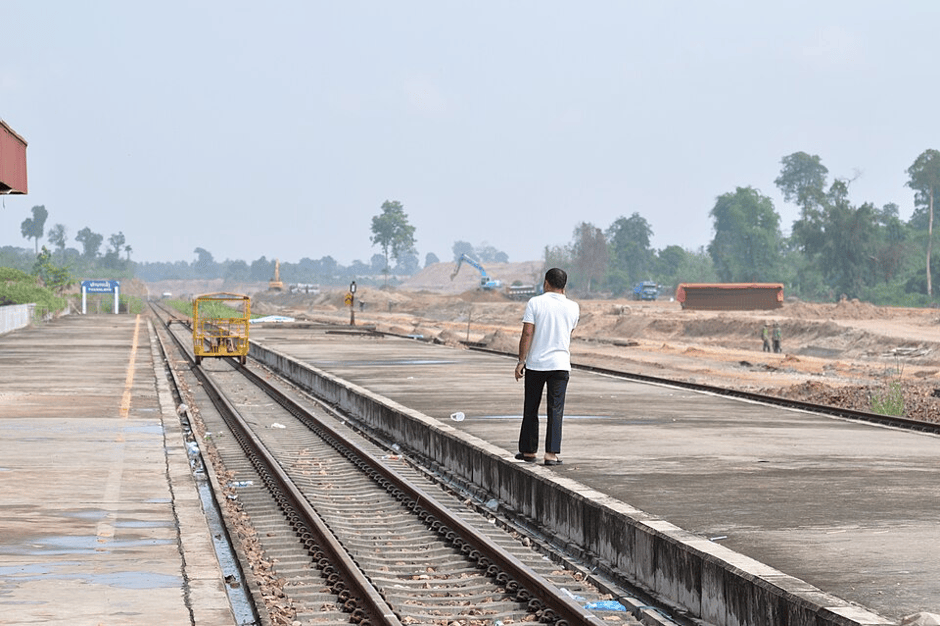
A railway line near Vientiane (Laos) under threat of closure, following approved construction of a high speed rail from Kunming (China). Image Credit: Shankar, S. S. CC BY 2.0.
The financial architecture of the LCR provides a stark illustration of how Economic Statecraft reshapes the internal political economy of a recipient state. In 2026, the fiscal burden of the LCR has become a central feature of Laos’s macro-economic landscape, with debt-to-GDP ratios reaching critical levels primarily due to infrastructure lending. This is not merely a financial issue; it is a structural one that mirrors the logic of the gatekeeper state.
Furthermore, the asymmetric dependency arising from the LCR’s debt structure creates a persistent state of fiscal instability. Since the Lao state derives a significant portion of its economic survival from external rents—in this case, transit fees, resource concessions, and Chinese tourism— focus on domestic revenue streams has been diminished. Consequently, the state’s administrative capacity remains selectively focused on managing these external flows, leaving the broader internal governance fragmented and underdeveloped.
Additionally, the debt-to-GDP ratio—amplified by substantial infrastructure loans intended for transportation, energy, and telecommunications projects—means that a centralised state institution no longer manages Laos’s digital and physical security systems. Instead, they operate as a decentralised infrastructure controlled by external entities. This shift results in a landscape characterised by ‘fragmented gatekeeping’, in which innovations designed to address issues caused by Laos’s landlocked geography inadvertently reinforce a weakened state with contested authority, undermining sovereignty and regional stability.
For some, the transformation of Laos from a ‘land-locked’ to a ‘land-linked’ nation could be seen as representing a tactical shift in regional power dynamics. By leveraging its position as the primary transit point for Chinese goods heading to the Gulf of Thailand and beyond, the Lao state—despite its asymmetric dependency—gains new forms of geopolitical leverage over its immediate neighbors, Thailand and Vietnam.
However, this leverage is inherently paradoxical. As analysed in the theoretical framework, this new status is built upon a foundation of ‘fragmented sovereignty’, where authority is no longer centralised within a single governing body. And, unlike the traditional gatekeeper state that controls physical access to establish legitimacy, the modern Lao landscape has become a layered process, primarily because the management of the LCR is through the Lao-China Railway Co. (LCRC)—a joint venture where Chinese state-owned enterprises (SOEs) hold a majority stake. Under this framework, SOEs like the China Railway Group do not act as traditional private firms but as sovereign proxies that manage critical infrastructure within Lao territory.
This arrangement facilitates a form of ‘fragmented gatekeeping’, where the authority to regulate trade, security, and logistics along the rail corridor is shared with, or delegated to, Chinese entities. For instance, the control over logistical data and signaling systems represents a move towards ‘digital gatekeeping’, where the ‘gate’ is no longer a physical checkpoint manned by Lao officials, but a technological interface managed by Chinese technical experts. This decoupling of sovereignty from territorial dominance ensures that even while the state remains the formal legal authority, the actual power to manage access and resources is distributed across a network of transnational actors.
Thus, while Laos gains tactical importance in the regional supply chain, its structural autonomy is diminished as it becomes a site of contested authority where Chinese logistical managers and digital infrastructure providers hold significant regulatory sway. In the age of digital and physical connectivity, strategic ‘solutions’ like the LCR often create lasting ‘problems’ of broken statehood and contested authority.
The implementation of the LCR does not merely reshape the domestic political economy of Laos; it also poses a significant challenge to the Association of Southeast Asian Nations’ (ASEAN) centrality. While China presents its ‘multipolar vision’ as a partnership with the Global South, its strategic preference for bilateral infrastructure deals—like the BRI—effectively bypasses the multilateral consensus-building mechanisms of ASEAN. This creates a ‘hub-and-spoke’ model where Kunming serves as the central node, connecting Southeast Asian capitals directly to the Chinese economy rather than fostering intra-regional integration.
In this context, the LCR serves as a ‘Sinocentric spatial fix’, redefining regional connectivity according to Beijing’s standards and logistical preferences. Earlier this year, the success of the railway in Laos had already exerted pressure on neighboring states, particularly Thailand, to accelerate their own high-speed rail connections to avoid being marginalised in the new regional order. This dynamic demonstrates how ‘fragmented gatekeeping’ operates at a regional level: the authority to define connectivity is no longer a collective ASEAN effort but is increasingly dictated by the technological and financial power of the BRI corridor.
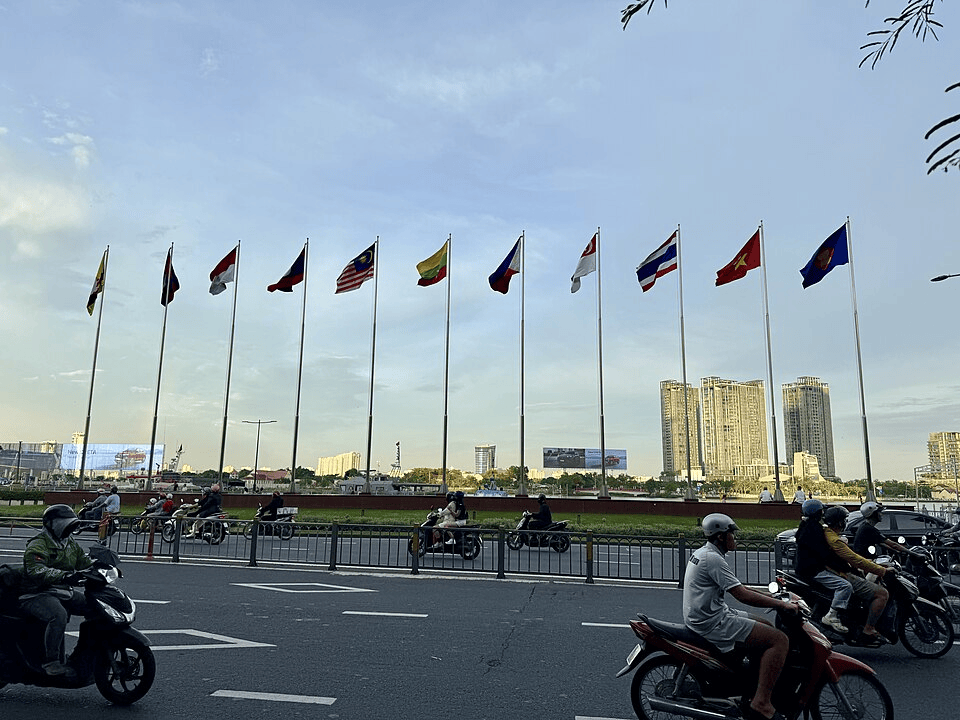
The flags of ASEAN and its member states. Image Credit: Nat4Eben, CC BY-SA 4.0
Conclusion
In conclusion, the integration of the LCR into Southeast Asia’s political economy serves as a definitive case study for the paradox of modern connectivity. This article has argued that while China’s ‘multipolar vision’ successfully offers a tactical ‘solution’ to the geographic and developmental constraints of the Global South, it simultaneously creates a structural ‘problem’ of fragmented sovereignty. By synthesising Cooper’s ‘gatekeeper state’ theory with the contemporary realities of Global China, we see that the traditional Weberian monopoly on force and regulation is being dismantled not by state failure, but by a deliberate reconfiguration of power through infrastructure and debt.
The LCR illustrates that in the 21st century, sovereignty is being decoupled from territorial dominance and recentered on the management of technological and fiscal networks. The concept of a physical ‘gate’—once a barrier manned by a centralised state authority—has transformed into a complex, multi-layered process involving Chinese state-led investments, digital logistical platforms that operate across borders, and transnational managerial networks that coordinate economic and political influence across regions. Consequently, the state’s gatekeeping functions have been fractured and Laos is evolving into a site of contested authority.
Ultimately, the case of Laos demonstrates that the democratisation of high-level technology and the expansion of the BRI have made the original gatekeeper model insufficient. Sovereignty has shifted from a fixed territorial concept to a flexible, technological one—a transformation that traditional international security frameworks are ill-equipped to address. As Laos approaches the end of 2026, the LCR stands not merely as a transportation corridor but as a symbol of this new era of ‘fragmented gatekeeping’, where the pursuit of economic development increasingly intertwines with ongoing structural instability, geopolitical tensions, and fractured statehood.
References
ACLED (2026) Armed Conflict Location & Event Data Project: Myanmar Analysis Report 2026. [cite_start]Available at: https://acleddata.com/curated-data-files/myanmar-2026 (Accessed: 25 March 2026).
ADB (2024) Lao PDR: Economy. Asian Development Bank
Brautigam, D. (2020) A Critical Look at Chinese ‘Debt-Trap Diplomacy’. SAIS-CARI Caballero-Anthony, M. (2014) ‘Understanding ASEAN’s Centrality’, The Pacific Review, 27(4)
Cooper, F. (2002) Africa since 1940: The Past of the Present. Cambridge: Cambridge University Press.
Cronin, A. K. (2020) Power to the People: How Open Technological Innovation is Arming Tomorrow’s Terrorists. Oxford: Oxford University Press.
Hillman, J. (2020) The Emperor’s New Road. New Haven: Yale University Press IMF (2024) Lao PDR: Article IV Consultation. Washington DC: IMF
Wallerstein, I. (1974) The Modern World-System. New York: Academic Press





.jpg)
.jpg)

Leave a comment