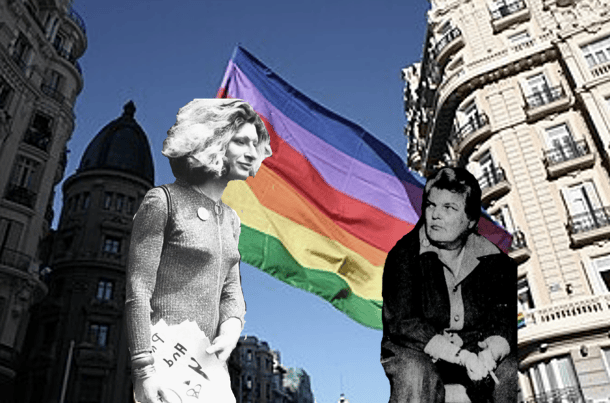
Image Credits: Sylvia Rivera CC BY-SA 4.0, LGBTQ+ Flag CC BY 3.0, Del Martin (public domain). Changes made to all pictures.
By Rachel Vernon
Introduction
From the years 1955 to 1970, political, cultural, and social spheres dichotomized LGBTQ+ people as ‘perverse beings’ apart from the rest of society. Two contrasting activist groups emerged in the fightback against this oppression: the Daughters of Bilitis (DOB), a cautious and conservative lesbian organisation, versus the protestors involved in the Stonewall Uprising, a dramatic clash of violence and queer identity that erupted spontaneously one night. Whilst both the DOB and Stonewall focused on fostering pride in the LGBTQ+ community, they showed great divergence in other strategies; where the DOB was non-violent and assimilationist, Stonewall protestors were violent and transgressive.
But why did these activists take such radically different paths and use such radically different strategies – and what does this mean for our understanding of early queer activism?
To gain a deeper understanding of these activists and the strategies they used, I will frame my analysis around the theories of social authoritarianism, dynamic interaction, and gender performativity, respectively. Ultimately, it seems that the opportunities and strategies utilised by early LGBTQ+ activists were deeply shaped by how they interpreted their persecution.
Context:
Across the 20th Century, a gay moral panic gripped the United States. Homosexuality was classified by psychologists as a ‘sociopathic personality disturbance’, also marking a ‘gender inversion’ – the idea that gay people were trapped in the ‘wrong body’. Socio-political culture weaponized this rhetoric to persecute non-normative sexualities and genders, with the police exploiting vague laws to arrest individuals not wearing three pieces of gender-assigned clothing for sexual deviancy. This stigma refracted into a wider social culture, with the media characterizing homosexuality as a subversive sickness. Even in the private sphere queer people found themselves victimised: being gay could cost a person their job, home, and even family. In this era of heterosexism, to be visibly gay was to be persecuted -violently and non-violently, by the state and political powers, and within one’s most personal relationships too. Unlike other minority groups, LGBTQ+ individuals had no history or geography (community spaces) where they could escape their oppression.
Under these conditions, it would be extremely dangerous and risky for queer individuals to fight for their rights. Against all odds, two distinct activist groups emerged.
In 1955, Del Martin and Phyllis Lyon, keen to improve the lesbian image, formed America’s first lesbian rights group, the DOB, which found its membership predominately amongst the white middle-class. From 1956, it would distribute the first national lesbian periodical in the US, the Ladder. An FBI file held on the DOB listed them as dangerous simply because they advocated for the ‘lesbian homosexual [to be accepted] into society’. Thus, operating under an era of intense hostility, they found it difficult to mobilise an isolated and scared community, who had no history of activism.
Across the 20th Century, the beginnings of a connected queer community emerged in gay bars: a refuge shrouded from the judgement of wider society by the dark and secret nighttime. But even in these spaces, working-class queers found themselves persecuted by frequent police raids, one of which would catalyse the Stonewall Uprising (nightly riots from the 28th of June to the 3rd of July 1969 outside the Stonewall Inn, a popular gay bar). These activists were following in the footsteps of Black Power, New Left, and anti-Vietnam war protests. Whilst this particular uprising was unorganised and spontaneous, the protestors were still undeniably activists, making heat-of-the-moment tactical, and profoundly impactful, decisions that produced the first mass public challenge to homophobia in America.
Strategy One: To Change Social Attitudes
Lynette Chua, Professor of Law at the National University of Singapore, argues that repression can be characterised as socially authoritarian, when, even in a democracy, ‘hierarchy’s top rungs’ use covert mechanisms to ‘[dominate]’ over marginalized individuals. We can apply this theory to the repression queer individuals faced in the decade beyond the McCarthy era; homophobic persecution was not just institutional, being outsourced to the very core of society in the enclaves of the church, jobs, and families. Conditions were so oppressive that nobody felt they could attempt to change them. Dr Lillian Faderman, the ‘mother’ of lesbian history, argues that queer individuals also ‘internalized the hideous stereotypes’ mobilized against them, developing ‘an inferior sense of self’, which rendered them unable to see equality as a right they even deserved. There was absolutely no external support for gay liberation and low internal levels of mobilisation. While these social and psychological barriers remained in place, legal or political change would have seemed impossible, leading both activists to focus their strategies on changing societal attitudes.
The DOB sought to provide positive representation to foster pride internally in the hope that this would open up more opportunities for activism. As an NGO, they had the ability to set up media resources like the Ladder, which published fictional and non-fictional works written by lesbians, as well as details of DOB activities. The June 1966 edition featured Ernestine Eckstein, VP of the New York chapter, on the front cover. A lengthy interview with her vividly celebrates queer love and her work for the DOB, with Eckstein describing homosexual relationships as ‘very creative’. In this sense, the Ladder issued a challenge to the hegemonic media portrayal of lesbians as perverse, allowing lesbians to engage with a cultural narrative that uplifted their identity and celebrated their sexuality. It was such efforts to combat social authoritarianism that helped the DOB to increase the willingness of lesbians to participate as activists, expanding from 17 paid subscribers in 1956 to 4,000 by 1971.
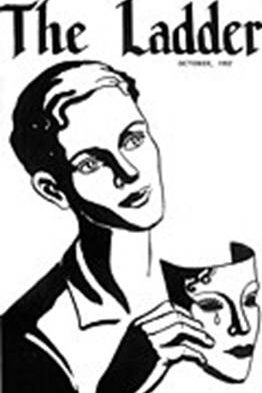
October 1957 edition of the Ladder. This image is in the public domain.
Contrastingly, at Stonewall, the grassroots activists’ only tools were their bodies and voices; they used chants and slogans to mobilise a collection of people with little history of activism. After the police raid on the Stonewall Inn, July 3rd 1969, instead of slipping off into the dark like usual, the booted-out patrons formed a crowd outside – it was amongst this crowd that an uprising would spontaneously emerge. In this sense, we can see that social authoritarian pressures can also mobilise action, depending on how individuals subjectively interpret, and thus how they decide to respond to, structural violence. As queer individuals witnessed the brutal treatment of their friends by police, they finally viewed their rights as something worth fighting for; patrons of the bar were shoved into a police wagon and chants of ‘gay power’ began to ring out in defiance. This unplanned, yet still deeply political strategy, created a sense of unity that opened the opportunity for rebellion. John O’Brien describes how Stonewall made him finally feel that he was not alone – ‘I had found my gay brothers’; he had found something worth fighting for. Additionally, their chants demonstrate how other movements had expanded the opportunities for social protest in the 1960s, drawing on the political significance of ‘Black Power’ (‘gay’ power) to express a similar sense of pride in being a marginalised identity. Thus, whilst the Stonewall protestors may not have issued a clear or direct challenge to state power itself, their strategies still served a fundamental purpose, with historian Martin Duberman and journalist Andrew Kopkind arguing a ‘material metaphor for the emergence, visibility, and pride’ attached to gay identities emerged that night: a pride that could mobilise action.
In this sense, enclaves of social authoritarianism limited opportunities, making it essential for both top-down organizations and bottom-up insurgent activists to focus on strategies that would foster pride in a downtrodden and isolated community.
Strategy 2: To Be Non-violent or Violent?
The oppression queer people faced was all pervasive: the State’s tools being covert mechanisms of surveillance, outsourcing overt violence and legal persecution to the police, and outsourcing overt condemnation to wider society at the public and private levels. Professor of Sociology at the University of Arizona, Jennifer Earl, argues that such levels of insidious repression, heavily targeted at marginalised individuals, could foster two reactions amongst activists: either crippling communities with fear, or radicalising them into action at the micro-level. In this sense, we can see a dynamic interaction between repression and resistance, which leads activists to perceive their oppression differently, and thus see alternate opportunities, explaining the differing strategies of the DOB (non-violent) and Stonewall activists (violent).
The DOB found that queer people were often too paralysed from a fear of persecution to act, meaning they did not have the resources for mass political action. This limited them to non-violent activism in the written realm, or private gatherings, aiming to build a community in which people felt safe to turn up to; they pledged secrecy to their members, membership was open to heterosexual women too, and the Ladder quoted ‘an attorney who stressed that lesbians had “nothing to fear in joining DOB”, referencing the 1953 Supreme Court ruling that publishers did not have to reveal their purchasers. This strategy of anonymity aimed to assure people they could mobilise safely, remaining camouflaged outside the activities of the organisation. Moreover, social activities (bowling nights, parties, and Gab ‘n’ Java gatherings) were held to foster small groups of community and safety that created opportunities for lesbians to talk about their personal issues, making them feel validated. This strategy reflects Chua’s argument that chances to air out grievances can help NGOs increase their resources, by connecting marginalized individuals to a community, thus altering how they interpret their oppression; not as something that makes them alone, but as something that unites them to others.
Contrastingly, the Stonewall Uprising illustrates how repression (police brutality) can incite strategies of violent resistance. The police faced insurgent attitudes from Stonewall activists before the riot even broke out; ritual humiliations, such as the examination of trans and drag queen patrons in bathrooms, were met with resistance, leading to their arrests. Historian David Carter describes how the crowd forming outside witnessed an arrested drag queen being ‘clubbed’ by an officer after she ‘smacked’ him with her purse, with activists chanting “Police brutality! Pigs!” in response – they were radicalised. The masses began to launch ‘pieces of glass, fire, bricks, cobblestones’ as the police hid inside the Inn.
Arguably, the scenes of repression catalysed the spontaneous eruption of violence, as activists began to interpret their repression as illegitimate. This connects to Political Philosopher Frantz Fanon’s argument that the use of violence is fundamental to the process of freedom. He argues that being treated as inferior causes an accumulation of anger, which psychologically forces the marginalised to act violently to release this stress; he believed that the humanity of the oppressed could only be restored when they saw their oppressor defeated. Consequently, violent strategies broke out amongst the Stonewall activists to heal the psychological trauma inflicted by immense levels of oppression.
Therefore, how activists interpret resistance is crucial in shaping strategies. Whilst the isolation of the gay community limited opportunities for the DOB, forcing them to focus on non-violent and community building strategies that encouraged participation, Stonewall activists were radicalised at the micro-level, with repression itself catalysing a communal outrage that roused up insurgency.
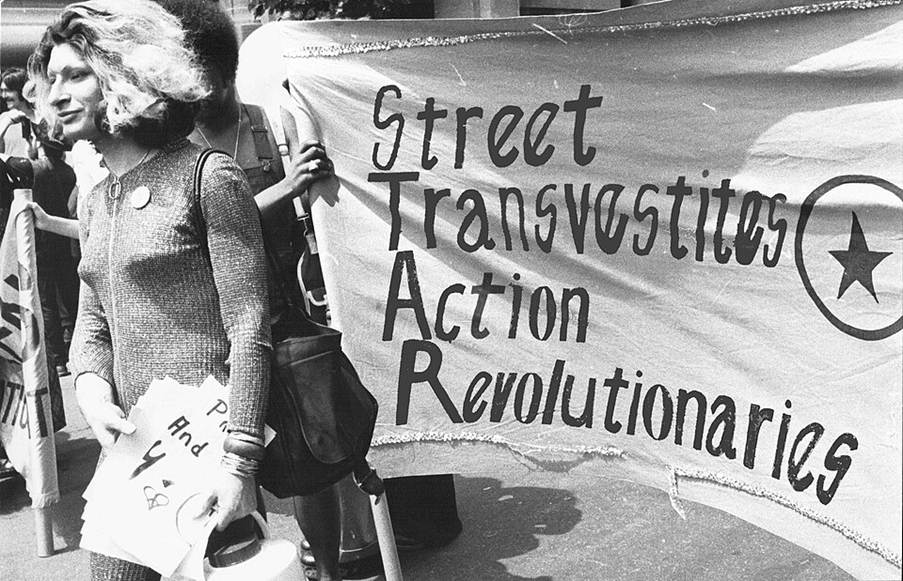
Sylvia Rivera. Image Credit: CC BY-SA 4.0.
Strategy 3: To Fit In or to Stand Out?
Historian Betty Luther Hillman identifies how gender transgressions, such as gender-nonconforming dress codes, were closely associated with gay culture and were perceived as an extreme threat to the heterosexist hegemony. Whilst the DOB, scared of social backlash, pursued a strategy of sameness, gay bars provided working-class queers with the opportunity to perform gender as source of liberation, staunchly challenging repressive gender binaries.
Gender-normative representation became a central tactic of the DOB as they believed this would give ‘respectability’ to the LGBTQ+ rights movement. Within lesbian bar culture, butch and femme identities operated as a means of identification and gender performance, but the transgressive dress-codes of these roles aggravated significant public backlash, meaning distancing themselves from working-class bar culture became essential to survival for DOB organisers. In its first edition, the Ladder promised its readers it would counsel them on appropriate dress and behaviour to ensure that they could adjust to heterosexual society. This strategy can be seriously criticised; instead of advocating to reform society, Sociologist Kristin Esterberg argues that the DOB ‘[endorsed] an attempt to change the individual to suit society’, thus almost blaming their oppression on gay people themselves. Yet it is crucial to acknowledge that this strategy was mobilised from a sense of over-whelming fear – the DOB was desperate to escape their torment and their vulnerabilities. Ultimately, this assimilationist policy would lead to the decline and end of the organisation, as it was viewed as too conservative by the post-Stonewall LGBTQ+ activists.
Contrastingly, activists at Stonewall harnessed the performativity of gender transgressions as a means of liberation, with their celebration of class and gender identity being the driving force behind insurgent action. Carter highlights a moment in which twenty queens (effeminate gay men) formed a kick line against ten armoured police smacking them with nightsticks. During this onslaught of brutality, the queens did Rockettes kicks and sung the following chant:
‘We are the Stonewall Girls.
We wear our hair in curls.
We wear no underwear.
We show our pubic hair…
We wear our dungarees
Above our nelly knees!’
Excerpt from: David Carter (2010) Stonewall: the Riots that Sparked the Gay Revolution. New York: St. Martin’s Press, pp.190-1.
For Philosopher and Gender Theorist Judith Butler, gender is a performance: something people do to fit into the cultural expectations of society, not what they inherently are. Extending beyond this, Emer O’Toole, Associate Professor of Irish Performance Studies at Concordia University, identifies performativity as gender expressions which deliberately defy the expectations of performance. Such performativity is clearly evident in the identity, and actions, of the queens; breaking gendered dress-codes was an arrestable offence, meaning the gay men’s effeminate presentation was automatically a source of political resistance. Moreover, Carter emphasises how the camp humour of the kick line was a ‘spoof’ of the police ‘machismo’, ‘making fun of their authority’. In this sense, O’Toole argues gender performativity acts as an ontological slip, providing LGBTQ+ activists a ‘permission to [challenge]’ which is ‘denied to everyday queer [people]’. For Carter, whilst the police tried to ‘intimidate protestors’ with their ‘machismo’, the Stonewall activists were made up of individuals ‘whom society had branded as deficient in masculinity – and hence courage’. Yet, through their subversion of heterosexist boundaries, we can see how the queens entered an empowering performance, which produced opportunities for activism.
As an organisation largely made up of white middle-class lesbians, the DOB had the privilege of social camouflage; aside from their sexual identity, they could easily fit into the heterosexual world, evading police brutality. Instead, their concerns were largely socio-economic, tying them more to the feminist movement than male homophile groups. In contrast, Carter argues that the Stonewall protestors who ‘fought the hardest, and… risked the most’ were predominately working-class, ethnically diverse, effeminate men, whose appearance meant violent discrimination was always inescapable. In this sense, Stonewall protestors harnessed ‘camp’ gender transgressions as a method of resistance.
Therefore, the DOB and Stonewall activists had opposite understandings of gender transgressions. The DOB, who associated standing out with persecution, encouraged activists to assimilate. Conversely, gender performativity imbued the defiance of Stonewall activists with an inherently political and radical courage.
Conclusion
The era of 1955-1970 was one of all-pervading homophobic persecution, and it was how activists reacted to their experiences of this repression that would define their opportunities and strategies. Social authoritarianism and insidious violence created a climate of fear that DOB activists could not escape; they pursued strategies that focused on building solidarity and improving mobilisation without threatening the heterosexist hegemony. In contrast, Stonewall activists were radicalised by their witnessing of brutality, resulting in strategies that sought to harness their anger and blatantly resist and challenge homophobia – they were not afraid to risk it all.
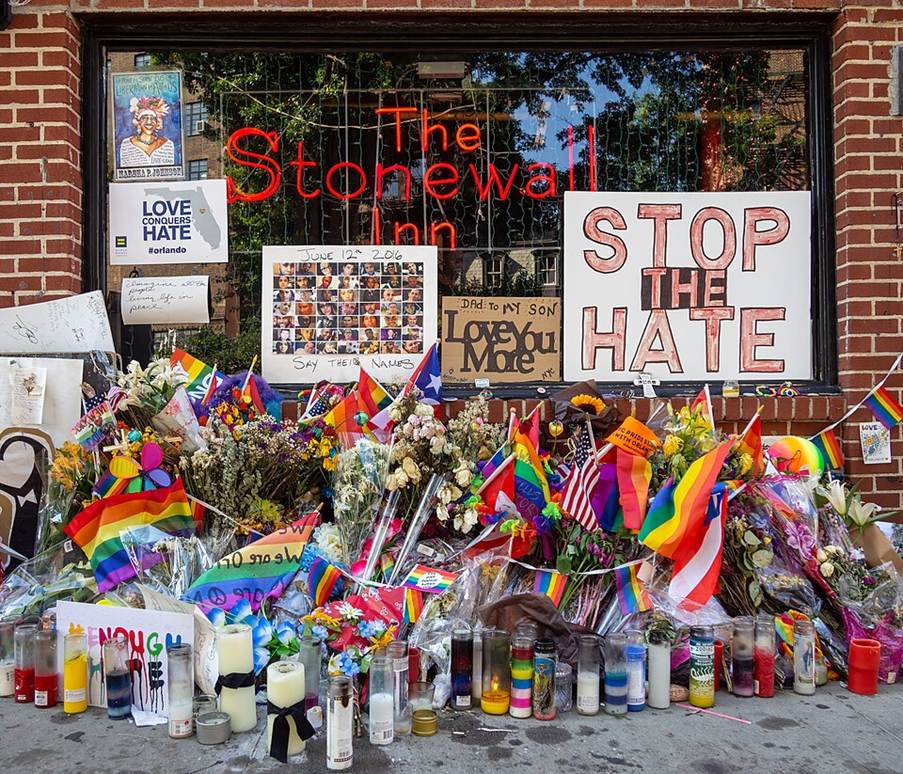
The Stonewall Inn (2016). Image Credit: CC BY-SA 4.0.



Leave a Reply