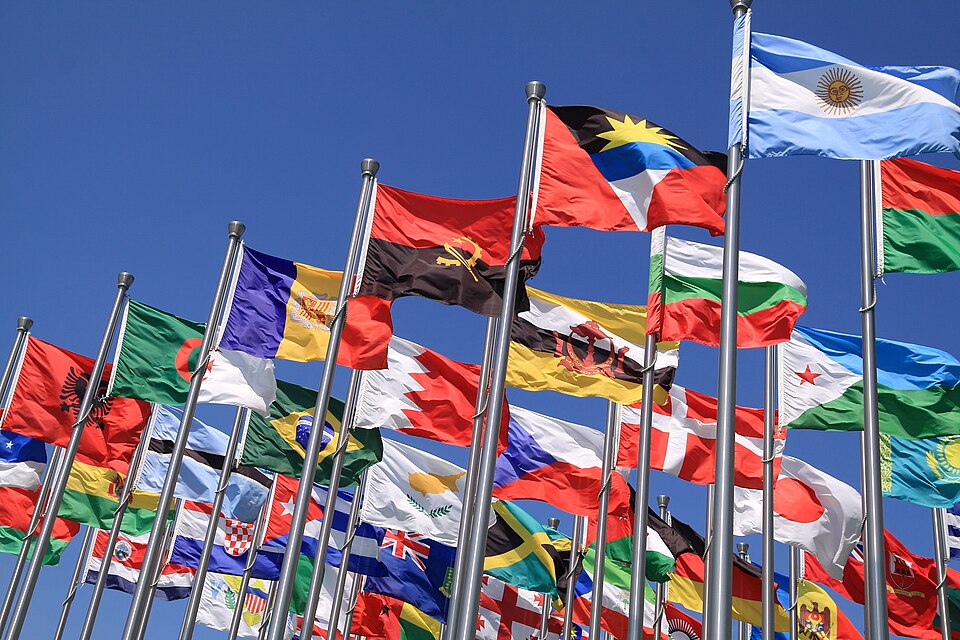
Image Credit: Ypostizzi. CC BY-SA 4.0.
By Sofiia Mashchenko
Introduction
There is a longstanding debate in international relations theory about the factors that shape state foreign policy behaviour. Realist theorists emphasise the role of power dynamics and material capabilities. By contrast, constructivists focus on the ability of actors to shape their behaviour according to the meanings they give to the international system. In this article, I draw on neoclassical realism, a synthesis of these two traditions, which builds on Alexander Wendt’s (founding father of constructivism; currently Professor of International Security at the Ohio State University) claim that identity “generates motivational and behavioral dispositions” of actors, while also adopting a unit-level analysis consistent with realism. I show that state identity influences foreign policy by driving international behaviour that generates and sustains ontological security and through the imposition of role expectations on the state, which delineate a range of role-appropriate actions resulting in a broadly consistent foreign policy over time. However, I also show that foreign policy outcomes ultimately emerge from the interaction between identity as an intervening variable, systemic constraints, and other intervening factors. Specifically, identity indeed shapes foreign policymaking insofar as the context provided by the state’s material capabilities and its position in the international anarchy, as well as domestic factors such as elite perceptions, allows the realisation of policy preferences. To make this analysis vivid, I draw on case studies from both East and West: Serbia, Russia, and the US (and its enemies)
Why Neoclassical Realism?
Before discussing the reasons why identity has the capacity to influence foreign policy, it is necessary to make clear several ideas. First, ‘state identity’ (hereafter, identity) is described, by Kuniko Ashizawa of the Elliot School of International Affairs, as “the image of individuality and distinctiveness” developed by the state through its interaction with external actors and its domestic environment, encompassing understandings of what it is, what it represents, its preferences, and how it defines itself in relation to other states. Similarly, the state is best understood as a socio-political institution that governs and exercises coercive power over defined populations and territories, within which it claims supreme authority, including over state identity. Finally, ‘foreign policy’ is operationalised as a state’s enacted behaviour towards other states and understood, within neoclassical realism, as the outcome of interaction between systemic and intervening variables.
As indicated, this article draws upon neoclassical realism, which borrows assumptions from neorealism and constructivism. But why synthesise (neo)realism and constructivism? The importance of state self-understanding and perceptions of the state by other actors is meaningfully captured by, and indeed typically forms, the basis of constructivism. But the constructivist approach is not sufficient on its own to address the complexity of variables affecting foreign policymaking because it fails to recognise the material power of certain actors to bend the rules – as scholars Rynning and Guzzini note. Equally, realist approaches, in focusing on the effects of international anarchy and treating state interests as given, provide analysis that is too macro-level and hence does not appreciate the importance of micro-level variables that intervene in the decision-making process.
In light of these flaws, neoclassical realism (NCR) is most equipped to sufficiently explain the formulation and enactment of foreign policy through examination of the interaction between systemic and intervening variables. NCR shares realist characteristics of state-centrism, focusing on the international anarchy, and the importance of power, but does not make a direct causal link between the nature of the system and state behaviour. For NCR scholars, systemic variables, such as material capabilities and the country’s status in the international arena, need to be viewed alongside intervening variables, such as state identity and elite perceptions, among others, when trying to understand states’ international behaviour.
Although NCR has been criticised for a lack of parsimony and clear research design due to an ad hoc selection of intervening variables, it has also been argued that the approach provides a nuanced analysis via process tracing, by a identifying causal mechanisms between the independent, intervening, and dependent variables and offers rigorous historical explanations of foreign policy choices. As such, it offers the best approach.
Ontological security
Ontological security refers to the security of sense of the self: of the subjective sense of self-identity, of who one is. As political scientist J.B. Mattern notes, it can be sustained through autobiographical narratives, which are social structures that shape state identity and interests by communicating the country’s historic memories and creating a sense of a stable self. On the other hand, ontological insecurity emerges when there is discontinuity between those autobiographical narratives and actual behaviour, leading to the inability to see oneself as a continuous being with a single identity over time. Importantly, while it must be acknowledged that states pursue realist interests such as resource and status maximisation, constructivists also emphasise the existential need states have to pursue ontological security through the coherence between their identity, narratives, and foreign policy actions because this structures their worldview and tells them who they are.
When events that disrupt narratives occur, states’ actions are motivated by ontological security seeking, and so are likely to fit within the existing narratives and aim to restore the stability of the self. According to political scientist Felix Berenskoetter, this may involve strategic activation or deactivation of certain tropes within “derivative narratives” of the “master narrative” by so-called “narrative entrepreneurs” to justify seemingly contradictory or irrational foreign policies. Narratives are employed to reduce state insecurity, manifesting in policy actions that provide a sense of what political scientist Jelena Subotić calls “autobiographical continuity”.
However, states can also develop and reproduce identities through their interactions with other states, as Wendt noted. In scholar Alla Kassianova’s analysis, identity also influences foreign policy because foreign policy is an instrument through which the state reproduces its self-image by acting in path-dependent ways that uphold a particular foreign policy posture guided by its role identity.
States internalise expectations and boundaries of appropriate behaviour associated with their role identity, which they develop in interactions with other actors and as a result self-conceptions and external recognition. Engaging in familiar practices imposes order on states’ external environment and generates ontological security, making them likely to repeat the practices in the future. To political scientist Ted Hopf, such consistency establishes a state’s “reputation” and can signal that country’s likely foreign policy, which reduces uncertainty associated with the international system.
The classic examples of ontological security-seeking behaviour from the constructivist literature include British non-intervention in the American Civil War – while ensuring the supply of Southern cotton was in the state’s interests, fighting on behalf of slaveowners would have contradicted British liberal self-narratives – and peace between Western European states since 1945 – as ideas of European unity and friendship, core to the self-narratives of Germany and France among others, would have been eroded by hostilities.
As I am drawing on the constructivist concept of ontological security, or security of being, the methodological debate concerning the personification of the state requires brief consideration. Positing ontological security assumes that a state can be treated as if it were an individual, and that concepts such as roles and reflexivity, not found in realist accounts, can be meaningfully attributed to it.
However we can justify the “state as person” analogy by arguing that state identities are performed according to the ways in which decision-makers, as “culture bearers” in scholar D.P. Houghton’s analysis, perceive the state while acting in their capacity as its agents. Foreign policy actions undertaken by these individuals are therefore treated analytically as actions of the state itself, rendering the analogy, as political scientist Jennifer Mitzen puts it, “theoretically productive”.
Neoclassical realist analysis in action: Russia, Serbia, and the United States
The influence of identity on foreign policymaking can be traced in states’ pursuit of ontological security in response to systemic changes, which narrows the policy options decision-makers have to the ones that align with the state’s dominant self-narrative and promote its continuity.
Ontological security-seeking behaviour is seen in Serbia’s foreign policy. As Subotić notes, the Serbian government refuses to recognise Kosovo’s independence because of it being at the core of Serbia’s schematic narratives and Serbia’s identity, despite this behaviour undermining Serbia’s chances of joining the EU.
Nonetheless, while historic memories that shape a state’s foreign policy preferences are important, other variables intervening at the domestic level, which may affect the resonance of the narratives, are worth considering. The domestic audience in Serbia widely supported the state’s stance on Kosovo, despite the implications of this position for its EU membership prospects. An authoritarian regime in Russia allows the elite to exploit the state apparatus to gather support for its decisions through manipulation of the identity discourse and the ways in which it is communicated to the public. This elicits a need to examine how the receptivity of domestic audiences to ontological security-maximising policies under specific regime types can affect decision-making, which NCR is able to capture through the method of process-tracing.
The pursuit of ontological security and stability of the self can also be observed in Russia’s aggressive near-abroad policy towards Ukraine, which has been assigned a special place in the Russian ontological security framework via “civilizational rhetoric” emphasising Ukraine’s historic belonging to Russia – as scholars N.R. Smith and Grant Dawson argue. Seen from this angle, NATO’s eastward expansion and the prospect of inclusion of Ukraine into the EU disrupted Russia’s schematic narratives and thus were perceived as an existential threat. IR scholar Brent Steele suggests that in periods of acute ontological insecurity, actions directed towards achieving ontological security may be prioritised over material security “as the most pressing national interest”. This may explain Russia’s zero-sum logic in fighting the war in Ukraine, which reduces its material security (which Russia initially sought to increase) and negatively affects its international status.
Importantly, neorealists struggle to provide a coherent explanation for the persistence of such a contradictory policy choice without considering the importance of ontological security. The West’s expansion of influence arguably underestimated the importance of Russian identity-based concerns, which motivated Russia to aggressively contest territories seen as integral to its identity, even when it hurts its material and physical security – interests prioritised by neorealists. Since Russian foreign policy was a response to the systemic change that disrupted established foundational narratives and generated anxiety, this shows the usefulness of NCR to analysing the conflict’s developments.
Therefore, identity influences foreign policy by grounding choices of actions policymakers have in ontological narratives circulated within the state, which lead decision-makers to take actions that promote the state’s stability of identity, even if these go against rational calculations to maximise physical security .
Turning to the significance of role identities, Russia’s aggression can be understood as implicit ambitions to reproduce its identity of the rightful hegemon in the post-Soviet world by reviving the Soviet Union. If state identity can signal to international actors the state’s future foreign policy, Russian aggressive behaviour towards former Soviet satellites – including also its repeated drone incursions into Lithuania’s airspace – warrants caution.
The case of Russia also demonstrates the extent to which role identities persist and facilitate predictability of the international system. That ontological security seeking is an interest of states does not mean that identity is fixed. As Mitzen argues, states engage in their routines reflexively, and can, albeit with difficulty, change their identity discourses in response to internal or external factors, leading to a change in international behaviour. Yet, since identities are constituted relationally, new identities have to be recognised by external actors to be realised.
All this is demonstrated in the Russian experience: by tracing portrayals of the West in Russian foreign policy documents between 1993 and 2000, Kassianova showed that Russia attempted to move beyond its Cold war-driven identity by engaging in an identity-discourse ranging from portrayal of the West as a focus for allegiance to the eventual perception of it as a marginalising entity. A lack of recognition of Russia’s revised self-narrative may have contributed to the reproduction of a familiar self-image rooted in an “anti-West” discourse. In line with the NCR framework, material resources and elite perceptions of the identity change also need to be seen as important constraints, affecting the enactment of altered international behaviour.
Start with the Vietnam War. Hopf claims that the US military intervention in Vietnam was consistent with and allowed the US to reproduce its identity of “a great power”. However, as different countries may perceive actions of the same actor differently – e.g. to countries that saw the US as an imperialist state, such actions reproduced that identity – the interpretation of the signalling behaviour needs to be considered alongside the actor that interprets it and their schemas. This invites consideration of power hierarchy, recognised in the NCR framework, in which a state’s material capabilities and status underlie its capacity to resist externally imposed identities, with more powerful states such as the US being better able to shape external perceptions in ways that are consistent with its preferred self-image.
Scholar Catarina Kinnvall shows how states can also engage in dangerous routines to reproduce their role identities because prolonged fixation on competition with the Other can foster attachment to familiar routines of enmity, helping to explain endurance and reactivation of conflicts. Political scientist J.D. Firoozabadi argues that confrontation with a hegemonic “anti-state” such as the US (the Other) is an ontological security-producing routine and a way in which Iran reproduces and preserves its Islamic revolutionary identity, which implies that the US-Iran hostilities are likely to persist.
For an even more extreme example, consider the Houthi movement in Yemen. Their banner, the Sarkha (meaning scream) states: “God is great, Death to America, Death to Israel, Curse on the Jews, Victory to Islam”. Anti-Americanism is, therefore, a fundamental element of their identity. Could such a (proto-)state’s identity survive having peaceful relations with the US or Israel? It seems unlikely, and this may help explain the risky and physical-security-reducing actions it undertakes to oppose the US and Israel, such as risking reprisal by attacking shipping in the Red Sea and launching airstrikes on Israel. From the analytical perspective of NCR, these actions enhance ontological security by reinforcing role identity at the cost of physical security, as two complementary causes of state action. It would be difficult to understand them through a purely constructivist lens, or through a neorealist lens: these cases underscore the analytical power of NCR.
Conclusion
To conclude, it is evident that identity exerts influence on state foreign policy behaviour and its objectives by narrowing the options policymakers have when deciding on appropriate actions. I have demonstrated how concerns about the continuity of the state self-narrative, lying at the heart of its identity, shape the state’s responses to changes in the international system. Ontological insecurity triggered by the change may lead the state to generate counterintuitive foreign policies aimed at achieving coherence between its schematic narratives, identity, and reality. Furthermore, foreign policy decisions follow role expectations stemming from the state’s identity discourse and aim to reproduce identity via either healthy or harmful routine behaviours, which may imply broad patterns in the international system.
As I have shown, the interaction between systemic variables, state identity, and other intervening factors to shape foreign policy decision-making, with elite perceptions and material capabilities constraining the range of available policy options. Nevertheless, the fact that identity can provide powerful explanations for current security tensions, seemingly contradictory international behaviour, and broader trends in foreign policies renders it an important variable to consider alongside systemic and intervening variables when explaining international relations. Since the focus on either the system or identity does not adequately capture the interactions between the variables above, it shows the usefulness of the NCR perspective for analysing foreign policy behaviour due to its broader focus. Areas of future research utilising the NCR lens could further examine the interaction between intervening variables such as domestic audiences’ perceptions and regime type, and how these factors could affect the state’s capacity to shape foreign policy practices through identity discourse.
References and Further Reading
This article began as a summative assignment for the module “International Relations Theory and Global Politics” provided by the Department of Politics and International Relations at the University of York. Thank you to Andrew Crellin for helping me to turn that essay into this article.
Al Toraifi, A., 2012. Understanding the role of state identity in foreign policy decision-making: the rise of Saudi-Iranian rapprochement (1997-2009) (Doctoral dissertation, London School of Economics and Political Science). (Accessed: 30 January 2025).
Ashizawa, K. (2008) ‘When Identity Matters: State Identity, Regional Institution-Building, and Japanese Foreign policy1,’ International Studies Review, 10(3), pp. 571–598. https://doi.org/10.1111/j.1468-2486.2008.00805.x.
Flockhart, T. (2016) ‘The problem of change in constructivist theory: Ontological security seeking and agent motivation,’ Review of International Studies, 42(5), pp. 799–820. https://doi.org/10.1017/s026021051600019x.
Götz, E. (2017) ‘Putin, the state, and war: The causes of Russia’s near abroad assertion revisited’, International Studies Review, 19(2), pp. 228–253. Available at: https://www.jstor.org/stable/26407899.
Hopf, T. (1998) ‘The promise of constructivism in international Relations theory,’ International Security, 23(1), p. 171. https://doi.org/10.2307/2539267.
Houghton, D.P. (2007) ‘Reinvigorating the study of foreign policy decision making: Toward a constructivist approach’, Foreign Policy Analysis, 3(1), pp. 24–45. http://www.jstor.org/stable/24907219. (Accassed 29 January 2025).
Jalal Dehghani Firoozabadi S. (2011). ‘Ontological Security and the Foreign Policy Analysis of the Islamic Republic of Iran’, Iranian Review of Foreign Affairs, 2(6), e123390.
Kassianova, A. (2001) ‘Russia: still open to the West? Evolution of the state identity in the foreign policy and security discourse,’ Europe Asia Studies, 53(6), pp. 821–839. https://doi.org/10.1080/09668130120078513.
Kitchen, N. (2010) ‘Systemic pressures and domestic ideas: a neoclassical realist model of grand strategy formation,’ Review of International Studies, 36(1), pp. 117–143. https://doi.org/10.1017/s0260210509990532.
Krickel-Choi, N.C. (2024) ‘State personhood and ontological security as a framework of existence: moving beyond identity, discovering sovereignty’, Cambridge Review of International Affairs, 37(1), pp. 3–21. https://doi.org/10.1080/09557571.2022.2108761.
Mitzen, J. (2006) ‘Ontological Security in world Politics: State identity and the security dilemma,’ European Journal of International Relations, 12(3), pp. 341–370. https://doi.org/10.1177/1354066106067346.
Mitzen, J. and Larson, K. (2017) ‘Ontological security and foreign policy’, Oxford Research Encyclopedia of Politics. (Accessed 30 January 2025).
Rose, G. (1998) ‘Neoclassical realism and theories of foreign policy,’ World Politics, 51(1), pp. 144–172. https://doi.org/10.1017/s0043887100007814.
Rynning, S. and Guzzini, S. (2002) Realism and foreign policy analysis, Politique Étrangère: Nouveaux Regards. Edited by Frédéric Charillon.
Słowikowski, M. (2024) ‘The concept of ontological security as an explanatory mechanism for the causes of Russian aggression against Ukraine,’ Rocznik Instytutu Europy Środkowo-Wschodniej, 22(2), pp. 111–127. https://doi.org/10.36874/riesw.2024.2.6.
Smith, N.R. (2018) ‘Can neoclassical realism become a genuine theory of international relations?’, The Journal of Politics, 80(2), pp. 742–749. DOI:10.1086/69688.
Smith, N.R. and Dawson, G. (2022) ‘Mearsheimer, Realism, and the Ukraine War,’ Analyse & Kritik, 44(2), pp. 175–200. https://doi.org/10.1515/auk-2022-2023.
Subotić, J. (2016) ‘Narrative, ontological security, and foreign policy change’, Foreign Policy Analysis, 12(4), pp. 610–627. Available at: https://www.jstor.org/stable/26168124. (Accessed 29 January 2025).




Leave a comment