
Image Credit: libertarianism.org CC-BY-SA 4.0. Changes have been made.
By Andrew Crellin
§1. The Rupture of Left-Liberalism?
Imagine choosing, from the following two options, which set of economic arrangements our society should adopt, on grounds of justice:
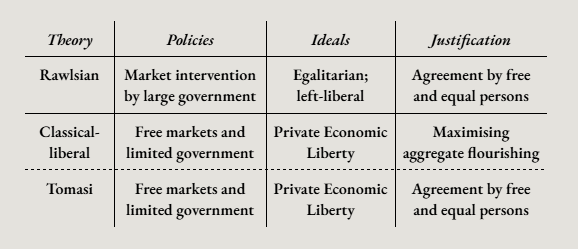
The first is a left-liberal social justice oriented economy which aims to secure the fair value of political liberty for all – equal influence, subject only to differences in talent and motivation, over the political process – in addition to fair equality of opportunity to attain positions in society, and seeks to maximise the lot of the worst-off in society. This involves heavy state intervention to distribute capital ownership as widely as possible, including by high inheritance taxes paired with capital grants (or, by nationalising the means of production and leasing it out to workers’ cooperatives). In addition, there would be extensive state-funded schooling and higher education, a large roster of public services would be provided, and there would be powerful anti-discrimination laws. As a result of these policies, inequalities of income and wealth would be minimal. The second is organised to achieve the classically-liberal and libertarian goal of protecting private economic liberty – laissez-faire freedom of contract, freedom from taxation of income, and the freedom to own and accumulate productive property. While the state would provide a minimal social safety net alongside limited public education, its role would be mostly limited to administering the justice system and providing for national defence. The economy would be instead organised around a free market and free choices of producers and consumers, with the subsequent distributions of income, wealth, and opportunities being quite unequal.
It may seem that your answer to this question depends on which philosophical theory of justice you find most convincing. The emblematic justification of the first economy and the values it instantiates is found within the work of the late John Rawls, professor at Harvard, and those who follow him – including Samuel Freeman, Professor of Philosophy at Pennsylvania, and Martin O’Neill, Professor of Philosophy at the University of York. It begins from the idea of finding fair terms for social cooperation, on which citizens regarding themselves as free and equal and possessing certain fundamental interests can find agreement. On the other hand, the emblematic justification of the second economy is found in classically-liberal political philosophies, such as from Adam Smith, David Hume, and much of neoclassical economics – which begin from the goal of implementing what will achieve the most happiness in society on aggregate (and libertarian thought from Robert Nozick) which begins from the idea that we ought to find an economic model which does not violate our natural rights to use our property as we see fit and enjoy the fruits of our labour. Viewed this way, the question of economic systems is really a question of bedrock philosophical commitments, with each side firmly entrenched in their justifications for their favoured policies.
But what if it were shown that you could endorse Rawls’ theory and still favour the second economy? That is, what if it turned out that a Rawlsian perspective really justifies a classically-liberal set of economic institutions? If true, it would rupture the dominant consensus that Rawlsian theory favours left-liberal conclusions. Yet this is precisely what John Tomasi, former Professor of Political Science and Director of the Political Theory Project at Brown University, argues in his book Free Market Fairness.
In what follows, I will show that Tomasi’s argument rests upon fundamental misunderstandings of Rawls’ theory. Tomasi claims that private economic liberty passes the Rawlsian test for considering a liberty basic, and is thus deserving of constitutional protection like the political and religious liberties. But Tomasi misunderstands the precise nature of that test and what guaranteeing a liberty must achieve in order to meet it. In short, Tomasi misses the distinction between the full exercise of the capacity to decide what matters to us and the achievement of outcomes which matter to us. Tomasi ought to demonstrate how enjoying private economic liberty aids the former, but instead merely demonstrates how enjoying it aids the latter. I show, therefore, that Tomasi’s Rawlsian case for classical liberalism contains a fatal equivocation. I then demonstrate that potential alterations of Tomasi’s argument to avoid this equivocation – proposing a different test which private economic liberty does pass, or trying to find a way in which private economic liberty passes Rawls’ test – do not succeed. All in all, then, the left-liberal position survives Tomasi’s challenge, unscathed.
§2. Tomasi’s argument, explained
Formally stated, Tomasi’s argument is:
- If a liberty’s provision creates the social and political conditions essential to the adequate development and full exercise of either of the two moral powers of some citizens, it is rightly considered basic in Rawls’ theory of justice. The second moral power, in Tomasi’s words, is to be the “full self-author” of your own life.
- Private economic liberty’s provision creates the social and political conditions for some citizens to be full self-authors (i.e. it is essential for the adequate development and full exercise of the second moral power).
- Therefore, private economic liberty is rightly considered a basic liberty.
- Rawls’ theory states all citizens are to be guaranteed enjoyment of the basic liberties.
- In classical liberal economic systems, all citizens enjoy private economic liberty; in left-liberal economic systems, they do not.
- Therefore the Rawlsian theory of justice should lead to a free market, classical liberal, economic system.
It is now worth examining exactly what each premise means, as well as Tomasi’s reasoning for them.
§2.1 Premises (4) and (5)
Premise (4) states Rawls’ theory’s commitment to the equal basic liberties principle and to its priority. This is the idea that, even if it comes at the cost of socioeconomic inequality or a reduction in aggregate wealth, all citizens should enjoy the following freedoms: the political liberties (guaranteed at their fair value), the freedom to own personal (nonproductive) property, freedom of association (including freedom of movement and of choice of occupation), freedom of conscience and thought, the freedoms specified by the liberty and integrity of the person, and the rights and liberties covered by the rule of law.
The crucial import of this idea for Tomasi’s argument is that if the private economic liberties are basic (as he claims) then policies aiming to reduce socioeconomic inequality which infringe them would be forbidden. Premise (5), then, highlights that left-liberal economic systems infringe private economic liberty to equalise opportunities and maximise the income and wealth of the worst-off. Most obviously, nationalising the means of production would violate the right to own productive property, but even strong inheritance taxes to disperse its private ownership would violate freedom from taxation and the freedom to accumulate productive property, and so would funding, via taxation, public services and education to aim to equalise opportunities.
§2.2. Premise (1)
Premise (1) is Tomasi’s reconstruction of the parts of Rawls’ theory relevant for his argument. Tomasi rightly identifies that if a liberty’s provision creates social and political conditions essential for the adequate development and full exercise of either of the two moral powers, it is considered basic in Rawls’ theory: this is the moral powers test. The idea behind the moral powers test is as follows. Rawls’ theory determines the requirements of justice by considering what persons considered free and equal would unanimously agree to as the rules governing society’s major institutions. Developing and exercising the two moral powers is said to be their “highest-order” interests; interests so fundamental that no amount of compensating advantages could outweigh their dissatisfaction. Thus, if a set of rules organised society in a way which did not enable those highest-order interests to be met by all citizens, they would not agree to it, so it would be unjust. This explains the significance of the moral powers test, as well as why the basic liberties enjoy their priority.
But what are the two moral powers? Rawls calls the second moral power the “capacity to have, to revise, and […] to pursue a conception of the good” (CotG) through a “plan of life”. A CotG, Rawls says, is “an ordered set of final ends and aims” representing “what is regarded as a fully worthwhile life”. Tomasi thus interprets citizens having the second moral power as possessing the ability to be “authors of their own lives”, and describes citizens’ self-authorship as “the capacity to […] assess the options before them and […] set standards for a life […] which each deems worth living”. The first moral power, less crucial to Tomasi’s argument, is the capacity for a sense of justice, the ability to “to understand, to apply, and to act from […] the principles of justice”.
In light of the set of basic liberties endorsed by Rawls, as discussed above, Tomasi insists it is sufficient, to show a liberty is basic, that it creates social and political conditions which are central to some citizens’ self-authorship. He says “to show that the right to [productive] property is a basic liberty, we need not claim that questions of property ownership are central to the lives of all reasonable citizens. It is enough to show that such questions are central to […] the life plans of many reasonable citizens”. Recall Rawls’ list of basic liberties – which either directly meet the moral powers test or are necessary to exercise those that do. Tomasi defends his interpretation by highlighting that not all these liberties are necessarily central to all citizens’ self-authorship. For example, not all citizens are interested in politicking or practicing a religious faith, for example – but these activities will be central for some citizens’ self-authorship. So, Tomasi concludes, this must be sufficient for considering them basic. Put formally (and for clarity), then, Tomasi highlights that:
- Rawls’ theory states that religious and political liberties are basic.
- The significant fact about the religious and political liberties is that the social and political conditions which they establish are required for some citizens (the devout, and the politically-engaged) to achieve the goals they judge as valuable.
And concludes that the moral powers test must, therefore, state that:
- If the social and political conditions established by a liberty are required to achieve the goals some citizens judge as valuable, it is rightly considered basic, in Rawls’ theory.
§2.3. Premise (2)
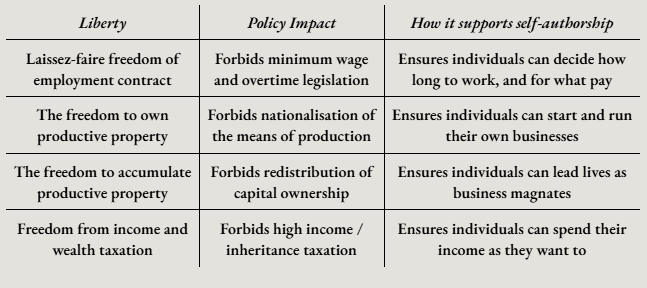
In light of this reconstruction of Rawls, Tomasi then argues that some citizens will not be able to fully self-author their lives without private economic liberty: their self-authorship would be “truncated”. This is how he supports premise (2). He presents similar arguments for all four parts of private economic liberty.
Regarding laissez-faire freedom of employment contract, Tomasi says not granting it would deny “individuals the right to make decisions regarding those aspects of their working experience” and therefore “would truncate the ability of those people to be responsible authors of their own lives”. Illustrating his point, Tomasi highlights how minimum-wage and overtime laws would prevent workers from working for very long hours if they want to: these workers would thus have to live a less-than-ideal life, one not fully self-authored – for example, where they work fewer hours.
Regarding ownership of productive property, Tomasi references how farmers identify with their fields, small business-owners/operators identify with their premises, and contrarians flourish through capitalistic entrepreneurship. Plausibly, a similar case can be made for the freedom to accumulate productive property, as preventing such accumulation prevents citizens from pursuing capitalistic life-plans as business magnates. Being permitted to own and accumulate private property, then, allows one to live the life one desires and thereby fully be a self-author.
Similarly, regarding freedom from taxation, Tomasi states that “tax rates and economic regulations can become so burdensome that they impinge upon the responsible self-authorship of citizens” by “hinder[ing] citizens seeking to carry out […] activities that are central to their life-plans”. As an example, imagine that you want to make a sizable bequest to your children, as you have a family-focused CotG. If you were not allowed to do this – facing high inheritance taxes – your self-authorship would be thus truncated.
Therefore, to ensure full self-authorship, private economic liberty must be considered basic: it meets the moral powers test, and thus Rawls’ theory ought to consider it basic. This is the crux of Tomasi’s argument.
§3. Tomasi’s misunderstandings of Rawls and subsequent equivocation
How, then, can Rawlsians respond – to prevent the rupture of left-liberalism? Well, as indicated, Tomasi has misunderstood the moral powers test. This means that premises (1) and (2) talk past each other. There is equivocation across the idea of self-authorship: what Tomasi calls self-authorship when summarising Rawls’ idea of adequately developing and fully exercising the second moral power is not what private economic liberty enables.
§3.1 The true meaning of the moral powers test
Tomasi misunderstands how religious and political liberties pass the moral powers test, and so misconstrues the burden of proof for doing so. In his reconstruction, he claims it is because they are merely important to some citizens’ goals as defined by their particular CotG, which suggests that supporting citizens’ achievement of their goals is sufficient for a liberty to be basic. But this misconstrues Rawls.
This is abundantly clear for political liberty: there is no direct connection between some citizens’ politicking desires, as defined by their particular CotG, and its basic status. In Rawls’ account, it passes the moral powers test because of its connection to the sense of justice, the first moral power. In short, Rawls’ argument is that the exercise of the sense of justice, the interest in living according to fair rules of social cooperation, is not possible without political liberty. For one, Rawls notes that political liberty’s guarantee is necessary to ensure society implements the principles of justice. So, its basic status is not granted because some citizens desire careers in politics, contra Tomasi. It is to realise the highest-order interest shared by all citizens: to develop and exercise the capacity for a sense of justice.
The justification of religious liberty reveals a similar problem for Tomasi. Rawls’ discussion of religious liberty’s basic status invokes how it protects citizens having, revising, and pursuing whatever CotG they may develop. For Rawls, for citizens to have a CotG they must first have a comprehensive doctrine, a set of value-judgements and normative beliefs akin to religious, philosophical, or moral convictions. It is in light of this comprehensive doctrine that citizens draw up their CotG, Rawls says. Hence, religious liberty protects citizens developing their CotG. It also enables them to revise, as well as freely affirm, their comprehensive doctrine and subsequent CotG, by forbidding punishment for apostasy and heresy. The significance of free affirmation is intuitive: if the point of a CotG is to give one’s life meaning, it being forced upon you would be disastrous, as Rawls himself notes. Therefore, religious liberty’s basic status is not in light of some citizens’ religious devotion, but because it is required for all citizens to make up their own minds: in other words, to develop and exercise their capacity to have, revise, and pursue a CotG. So, the justification of religious liberty is not based on religious devotion’s centrality to particular CotGs, contra Tomasi.
§3.2 The distinction between the highest-order and higher-order interests
Tomasi’s misunderstanding becomes clearer still when we consider how Rawls distinguishes two sorts of interests of idealised democratic citizens. The first is their highest-order interest – as discussed, the adequate development and full exercise of the capacity for a conception of the good and of the capacity of the sense of justice. The second sort, however, is the mere “higher-order interest” in “advancing their determinate conceptions of the good (defined by certain specific final ends and aspirations) that they have at any given time”.
To further reveal what Rawls means by advancing a determinate CotG, consider how this distinction is repeated in the different purposes of the different primary goods for citizens. Rawls describes the other primary goods besides the basic liberties (such as income and wealth, opportunities to attain positions in society, and the social bases of self-respect) as essential for supporting citizens to “achieve” and “advance” their goals. The idea here is quite intuitive: for example, if supporting my local football team is a part of my CotG, income helps me advance my goal of seeing them play every Saturday. Therefore, something being useful for advancing a determinate CotG means it allows citizens to live lives closer to their ideals. This further highlights that the advancement of citizens’ particular interests is separate to their adequate development and full exercise of the second moral power: these interests require different social conditions. Indeed, Rawls explicitly juxtaposes the two ideas, saying that his theory aims to “present a scheme […] which […] ensures for all citizens the adequate development and full exercise of their two moral powers and a fair share of the all-purpose means essential for advancing their determinate […] conceptions of the good”. If the latter was part of the former, this phrasing would be very odd indeed.
Rawls, therefore, draws a distinction between adequately developing and exercising the capacity to have, revise, and pursue a CotG, which includes a set of goals, and the achievement of those goals.
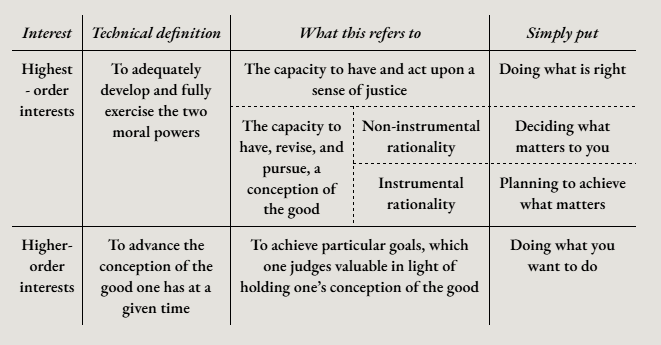
Now, it may appear that this distinction is not clear-cut because part of the second moral power is the capacity to pursue a CotG. Surely, pursuing your interests means achieving them. While it is not uncommon in the literature surrounding Rawls’ theory to talk of pursuing a CotG when one means achieving some goal, this misses that we are talking here about the capacity, as part of a “moral power”, to pursue a CotG. Rawls means the capacity to assess our options and make choices in light of what we find valuable, thereby drawing up a life-plan – that is, it is the ability to be instrumentally rational, to find the best means to our ends. Indeed, Rawls tends to say the second moral power includes not simply the capacity to pursue a CotG, but the capacity to “rationally” pursue a CotG, and even glosses the second moral power as the capacity to “be rational” and as “the capacity for reason, both theoretical and practical”. Of course, one is quite plainly not any less instrumentally rational if one simply does not have the means to achieve a certain goal. Rawls’ discussion of the concept of rationality does not endorse this absurd view either – it focuses on the effective choice of means. The point, then, is that the idea of the capacity to pursue a CotG simply means exercising instrumental rationality: this idea of the capacity to pursue a CotG does not imply the full exercise of the second moral power requires successful achievement of one’s goals.
§3.3 Tomasi’s equivocation
Let us draw together the preceding subsections. Tomasi’s premise (1) states Rawls’ moral powers test, which we now know (as shown in §3.1) means that: if a liberty’s provision creates the social or political conditions essential for citizens to either (a) draw up their view of a good life and plan how to achieve it – which Tomasi calls self-authorship – or (b) enables them to exercise their sense of justice, it is rightly considered a basic liberty. Crucially (as shown in §3.2), that a liberty’s provision creates social or political conditions which aid citizens in achieving certain goals is not grounds for it being considered basic. Indeed, this is not how Rawls shows religious or political liberty meets the moral powers test, contra Tomasi (as shown in §3.1). In Rawls’ theory, then, there is a sharp distinction between the value of having capacities which enable you to have goals and the value of achieving those goals, in line with the distinction between the highest-order and higher-order interests.
Now, consider again how Tomasi supports premise (2) – as discussed in §2.3. When discussing freedom of contract, freedom from taxation, and the freedoms to own and accumulate productive property, Tomasi argues that citizens are not able to be full self-authors if they cannot achieve certain goals which private economic liberty’s provision is essential to create the social and political conditions for – listing working longer hours, leaving bequests, and opening a small business or owning a conglomerate. But this means that Tomasi has not shown private economic liberty meets the burden of proof of the moral powers test: these enable citizens to achieve their mere higher-order interests. Shown graphically:
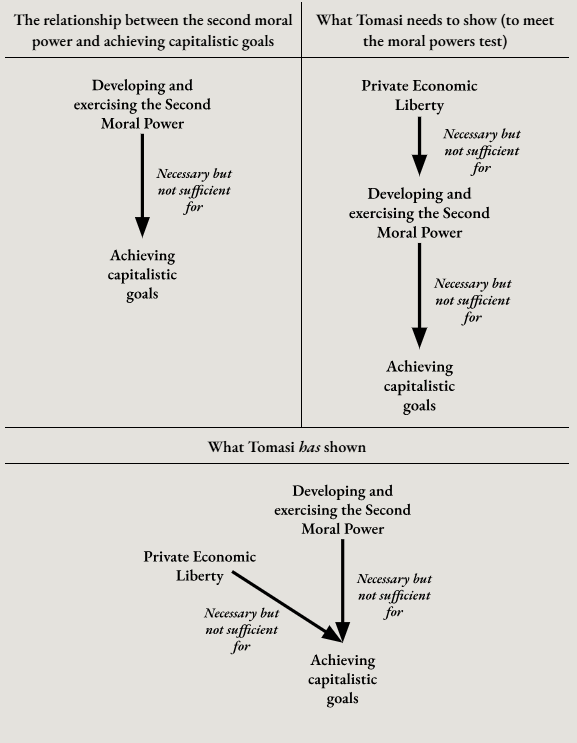
Put more formally, this means that while the term self-authorship is used in both premises (1) and (2), the concept it represents is different. Tomasi reads the concept of self-authorship into the moral powers test, i.e. premise (1). But this means the idea of self-authorship in premise (1) is not the same as that in premise (2). Self-authorship in premise (1), to be true to Rawls’ theory, must mean the highest-order interests being met – but this is explicitly distinguished from what self-authorship means in premise (2), i.e. the mere higher-order interests being met (achieving certain goals desired by those with capitalistic CotGs). Fix the meaning of self-authorship as its use in premise (1), and its use in premise (2) means something else; fix its meaning as its use in premise (2), and its meaning in premise (1) means something else.
This means Tomasi’s argument equivocates, and is thereby invalid. Thus, Tomasi has actually argued:
(1*) If a liberty’s provision creates the social and political conditions essential to meeting citizens’ highest-order interests, it is rightly considered basic (Rawls’ moral powers test).
(2*) Private economic liberty creates the social and political conditions essential to meeting citizens’ higher-order interests.
The inference that private economic liberty is rightly considered basic, Tomasi’s desired conclusion – premise (3) – plainly does not follow. Therefore, Tomasi’s argument fails: Rawls’ theory does not generate the conclusion that private economic liberty is to be considered basic, and thus classical liberalism should not follow.
§4. Could Tomasi escape the equivocation?
To escape the equivocation, Tomasi has to line up the two key premises of his argument – to make the term self-authorship mean the same concept in both. He therefore has two options. First, he could alter premise (1), i.e. propose a new test for considering liberties basic, which refers to citizens’ higher-order interest (advancing their CotG). Second, he could alter how he defends premise (2) to rest on the claim that private economic liberty supports some part of the (properly understood) adequate development and full exercise of the second moral power. I will now consider, and ultimately refute, these options.
§4.1 Three Tomasian tests for considering liberties basic
§4.1.1
Recall (from §2.2) that Tomasi believes something like:
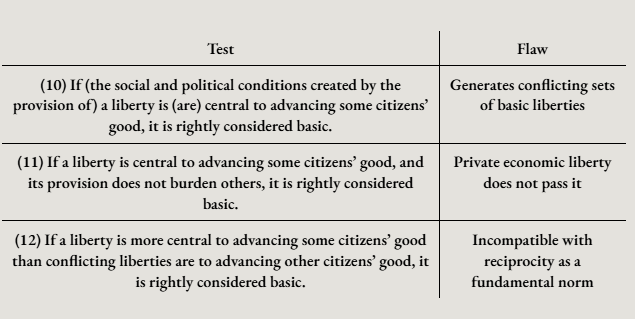
10. If (the social and political conditions created by the provision of) a liberty is (are) central to advancing some citizens’ good, it is rightly considered basic.
As shown (in §3), Rawls does not endorse (10). But could it be a good addition to Rawls’ theory? If so, Tomasi’s argument would be saved – he does indeed show that private economic liberty is central to advancing some citizens’ good, as discussed. The issue was not the truth of this claim, but its irrelevance to Rawls’ moral powers test.
The issue, however, is that (10) is deeply implausible. It generates a set of basic liberties which are both radically overinclusive and conflicting.
Imagine some citizens have a CotG based around car-racing. It is as if they are characters ripped from the music of Bruce Springsteen – they love nothing more than burning rubber. They contribute to society, of course, by working jobs to fund their purchases of the very best tyres, fuel, and engine parts. But every Friday night, they come home from work, wash up, and (want to) go racing in the street. So, boy-racer freedom of movement (BRFOM), allowing them to race on public roads, would be central to advancing their CotG. By (10), it ought to be a basic liberty.
But this is intuitively implausible: treating drag-racing on a par with religious freedom is not part of the history of democratic thought. (13), then, is radically overinclusive. Worse still, imagine the rest of society insists upon freedom from the burdens imposed by BRFOM – call this safe-driving freedom of movement (SDFOM) – is central to their CotG. Hence, by (10), both BFROM and SDFOM are considered basic, but their joint provision is impossible. Of course, many liberties conflict somewhat – for example, freedom of speech supports allowing incitement, but the right to the integrity of the person supports prohibiting it – but BRFOM and SDFOM are outright contradictory, in the troublesome sense that there is no way for both to be granted at once. A view generating entirely conflicting requirements as basic liberties is hardly plausible, so (10) fails as an alternative test.

§4.1.2
But, it could be said that Tomasi could shift to (11) to support making private economic liberty basic:
11. If a liberty is central to advancing some citizens’ good, and its provision does not burden others, it is rightly considered basic.
(11) is more plausible than (10), as under it BRFOM and SDFOM would not be considered basic because they burden others. Tomasi claims “a characteristic feature of the exercise of private economic liberty, under favorable circumstances, is that the exercise of such liberties expands the opportunities of others” so may believe it passes (11).
But private economic liberty’s provision does burden others. This point, however, is complicated by the “under favourable circumstances” proviso in Tomasi’s quote above. To explain: Rawls states that, for the purposes of deciding the justice of economic systems, we should ignore their feasibility and focus instead on whether they aim at justice – and assume they will succeed, for these evaluative purposes. In light of this, consider Samuel Freeman’s initial response to Tomasi. He argued that making laissez-faire freedom of contract basic burdens other workers by exposing them to risks of domination by allowing employers to demand employees work long hours. But consider: this can only happen when employers enjoy sufficient bargaining power over workers – otherwise, workers could simply refuse and walk out to work somewhere else (or not at all) – and Tomasi rightly states sufficiently high economic growth prevents this and notes free-market systems aim at such growth. Therefore, by the standards of Rawlsian institutional analysis – where economic systems are evaluated assuming they achieve their aims – Freeman’s objection fails. In short: it fails to acknowledge Tomasi’s thoroughly-Rawlsian “under favourable circumstances” proviso.
But consider two complementary examples. First, workplace democracy. As Freeman notes elsewhere, for many workers its provision would enable them to advance their CotG – it would enable them to exercise control over their working environments, for example. Tomasi himself acknowledges free-market systems, with private economic liberty considered basic, deliver workplace democracy to only a weak extent. Second, potential beneficiaries from tax income, which freedom from taxation prohibits the raising of: imagine people who really want the benefits of certain social programmes, such as to visit public museums. Hence, even under favourable circumstances, opportunities to live a fully self-authored life for democratically-minded workers and history-buffs would be less, just as not making private economic liberty basic inhibits workers with capitalist CotGs. Therefore, private economic liberty is like BRFOM: hence, it does not pass (11).
§4.1.3
It may be objected that the solution to the problems above – of generating contradictory sets of basic liberties, and that private economic liberty burdens other citizens – is to adopt the view that the liberty to be considered basic is the one which is desired more strongly. That is, to take to its conclusion (10)’s focus on the centrality of particular goals for particular CotGs. Hence, we have:
12. If a liberty is more central to advancing some citizens’ good than conflicting liberties are to advancing other citizens’ good, it is rightly considered basic.
But (12) is a very poor idea. Rawls himself was aware of this, noting that determining entitlements by strength of preferences would “likely lead to civil strife”, by encouraging strategic behaviour where all citizens over-state their need for goods to pursue their CotG – to guard themselves against others depriving them by making “exorbitant claims”. As such, Rawls writes “strong feelings and zealous aspirations for certain goals do not, as such, give people a claim to […] design public institutions to achieve these goals” and “desires and wants, however intense, are not by themselves reasons” for such purposes.
Indeed, it is in light of this that Rawls argues the appropriate principle for determining the distribution of the means of achieving one’s goals should be one reflecting reciprocity: where people gain more means to achieve their ends by contributing to others enjoying the same. This is the underpinning of the argument for distributing income and wealth to maximise the lot of the worst-off: the idea is that this means any inequalities in citizens’ achievement of their goals can be looked upon as still advantaging those with the least. “There is no social world without loss”, Rawls notes – some meaningful modes of living will not be achievable, due to the “limited space” of our “social world” (i.e. scarce resources). But the proper response to this, for Rawls, is distribution by a principle of reciprocity – not providing goods purely based on strength of desire. (10) and (12) run afoul of this fundamental Rawlsian idea, in attempting to distribute the means of achieving goals by how important those goals are to their pursuers, rather than by a principle of reciprocity.
So, the charge-sheet against alternative tests for considering liberties basic which private economic liberty would pass include not only their ability to generate absurd and contradictory sets of basic liberties, but severe misunderstanding of the Rawlsian approach to distributing the means of achieving citizens’ particular goals. This shows, definitively, that Tomasi’s argument could not be rescued by appeal to an alternative test for considering liberties basic.
§4.2 Defending (2) by reference to instrumental rationality
Alternatively, then, Tomasi could shift to claiming that private economic liberty supports the development of instrumental rationality, part of the second moral power. Tomasi suggests something like this when claiming that “economic liberty protects important aspects of self-authorship” including “long-term financial planning”, i.e. building up savings for retirement or choosing to save today to spend more in the future. Tomasi calls this an activity which “require[s] that people think seriously about the relation between the person […] at that moment to the person one will become […] in the future”. How, then, can we develop instrumental rationality, needed to draw up life-plans, without the opportunities for long-term thinking private economic liberty provides?
A foray into the history of Rawlsian discussion over expanding the set of basic liberties reveals this argument’s flaw. It faces the same issue which philosopher Martin O’Neill identified affecting arguments for considering workplace democracy (i.e. worker cooperatives) a basic right which invokes how making decisions in one’s workplace supports developing instrumental rationality. As he rightly noted, the fact that “there are many other venues (such as in civil society and in private associations) within which people can develop and exercise their two moral powers” means “one may plausibly deny that [economic democracy is] necessary […] for […] the ‘full and informed exercise’ of those two moral powers”.
The same problem bites for Tomasi, and for private economic liberty: free choice of occupation is likely sufficient to give opportunities to think long-term. Consider choosing between a training-heavy career, like a medical doctor, earning comparatively less at the start of one’s working life than the end, and a less training-heavy career like a car mechanic, earning comparatively higher at the start but lower at the end: is this not planning long-term? Thus, it seems highly unlikely that private economic liberty must be considered basic to secure sufficient opportunity to develop instrumental rationality. So, this alteration of the defence of (2) is not fruitful for Tomasi.
§5. Conclusion
In this article, I have considered the question of whether Rawls’ theory of justice, long believed to justify left-liberal egalitarian economic arrangements with heavy state intervention, really supports classical-liberalism. I have done so by tackling Tomasi’s argument in favour: that private economic liberty meets the test that liberties required for the adequate development and full exercise of either of the two moral powers are rightly considered basic. I have shown that Tomasi’s argument contains a subtle equivocation: developing and exercising the moral powers are highest-order interests, yet Tomasi’s argument that private economic liberty supports this invokes how it supports mere higher-order interests. The development and exercise of the second moral power means the capacity to devise, revise, and – understood as working out a plan to – pursue a CotG, but Tomasi merely shows private economic liberty supports some citizens’ advancement of their CotG. Hence, his main argument fails.
Then, I have considered how Tomasi might respond to this by shifting his argument to avoid this equivocation. Tomasi could propose a new test for considering liberties basic. While there are two alternative tests which private economic liberty passes, they generate highly implausible (and deeply anti-Rawlsian) conclusions, and private economic liberty fails a test modified to avoid such pitfalls. While Tomasi indicates private economic liberty is essential to the development of the power of the rational, this is not true: for the purposes Tomasi identifies (planning long-term), free choice of occupation is sufficient.
Left-liberals may rest safely, then.
References and Further reading
This article began as a coursework submission for the module “Theories of Social Justice” provided by the Department of Philosophy at the University of York. I am very grateful to Professor Martin O’Neill, that module’s tutor, for guidance and insightful feedback on earlier versions of the arguments presented above.
Tomasi
The full citation for Tomasi’s Free Market Fairness is: Tomasi, J. (2012). Free Market Fairness. Princeton: Princeton University Press. Tomasi’s main argument, as discussed in section 2, occurs in chapter 3 of Free Market Fairness. His interpretation of the two moral powers and the idea of self-authorship is found in chapters 2 and 3. His discussion of the institutions of Rawlsian classical liberalism can be found in chapter 4, along with how his work threatens to rupture left-liberalism (which he calls high liberalism).
Tomasi lays out his (potentially erroneous) interpretation of the moral powers test (specifically, the grounds for considering political and religious liberty basic) in: page 452 of Tomasi, J. (2014). Democratic Capitalism: A Reply to Critics. Critical Review, 26(3-4), pp.439-471; Tomasi, J. (2012b). Reply to Samuel Freeman: Thick Economic Liberty. 18 June 2012. Bleeding Heart Libertarians. [Online]. Available at: https://bleedingheartlibertarians.com/2012/06/reply-to-samuel-freeman/; and also page 81 of Free Market Fairness.
The specific example of overtime legislation inhibiting workers’ self-authorship is taken from Tomasi’s comments in: Tomasi, J. (2012c) Reply to Elizabeth Anderson: Part 2, Workplace Democracy. 20 June 2012. Bleeding Heart Libertarians. [Online]. Available at: https://bleedingheartlibertarians.com/2012/06/3321/. Other examples of how Tomasi substantiates premise (2) are taken from chapter 3 of Free Market Fairness.
Rawls
In line with the academic consensus on citing Rawls’ work:
- TJ refers to: Rawls, J. (1999a). A Theory of Justice: Revised Edition. Cambridge: Harvard University Press.
- CP refers to: Rawls, J. (1999b). Collected Papers. (Freeman, S., Ed.). Cambridge: Harvard University Press.
- JF refers to Rawls, J. (2001). Justice as Fairness: A Restatement. Cambridge: Harvard University Press.
- PL refers to: Rawls, J. (2005). Political Liberalism: Expanded Edition. New York: Columbia University Press.
Rawls’ discussion of the economic institutions can be found in, the preface for the revised edition, and §41-43 TJ, as well as part 4 of JF. The secondary literature is voluminous. As an introduction, however, I recommend OO’Neill, M. (2012). Free (and Fair) Markets without Capitalism: Political Values, Principles of Justice, and Property-Owning Democracy. In: O’Neill, M. and Williamson, T. (Eds.). Property-Owning Democracy: Rawls and Beyond. Newark: Wiley-Blackwell; as well as chapter 5 of Freeman, S. (2007). Rawls. Routledge: London.
Rawls’ discussion of the justification of the basic liberties can be found in lecture 8 of PL. These comments are summarised in §30 and 32 of JF.
As shown, the distinction between highest-order and higher-order interests runs throughout Rawls’ work. Explicit use of this distinction can be found on CP p.365. Other instances of the distinction, expressed when discussing the different roles of different primary goods, are: PL 187, and JF 58-59.
For the precise meaning of the second moral power, see JF p.29, PL p.302, PL pp.50-51, and TJ ch.7 (particularly §63-64).
The comments I draw upon in §4.1.3 can be found in: Lectures 5 and 8 of PL, §46 of Justice as Fairness, and ch.14 of Collected Papers.
Rawls’ intention-based approach to institutional theorising can be found on JF p.137.
Tomasi’s argument
Patten, A. (2014). Are the Economic Liberties Basic? Critical Review, 26(3-4), pp.362-374
von Platz, J. (2013). Are Economic Liberties Basic Rights? Politics, Philosophy & Economics, 13(1), pp.23–44.
von Platz, J. (2020). Rawls’ Underestimation of the Importance of Economic Agency and Economic Rights. In: Mandle, J., and Roberts-Cady, S., (Eds.). John Rawls: Debating the Major Questions. Oxford: Oxford University Press, pp.95-108.
Melenovsky, C. M., and Bernstein, J. (2015). Why Free Market Rights Are Not Basic
Liberties. Journal of Value Inquiry, 49(1-2), pp.47-68.
Freeman, S. (2012). Can Economic Liberties Be Basic Liberties? 13 June 2012. Bleeding Heart Libertarians. [Online]. Available at: https://bleedingheartlibertarians.com/2012/06/can-economic-liberties-be-basic-liberties/
Freeman, S. (2025). Neoliberalism: The Intersection of Classical Liberalism and Libertarianism. In: Freeman, S., and Brennan, J. (Eds.). Debating Libertarianism: What Makes Society Just? Oxford: Oxford University Press, pp.63-93.
O’Neill’s discussion of Rawlsian arguments for workplace democracy can be found in: O’Neill, M. (2008). Three Rawlsian Routes towards Economic Democracy. Revue de Philosophie Économique, 9(1), pp.29-55.






Leave a Reply