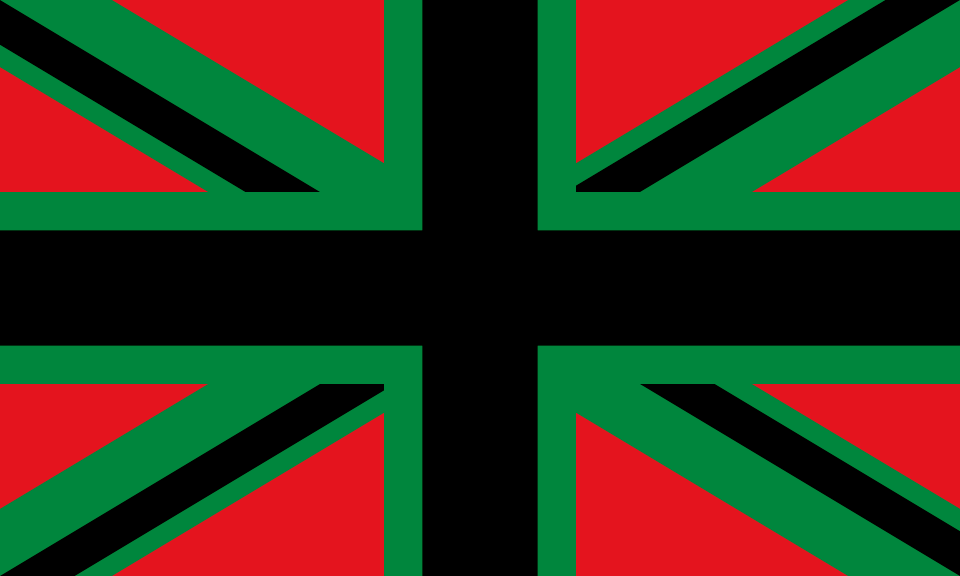
Image credit: Chris Ofili CC SA 4.0
By Onyeka Ofor
Onyeka Ofor is the Vice-President of the University of York’s, recently founded, Black Feminist Society which aims to emphasise intersectionality and curate a space that facilitates not just safety but also education. The society aims to remind black women at the University of York that it is still safe to exist and to be proud of their identity, whichever one they choose to have.
Something I have been pondering in recent months is whether it is truly possible to be black and British, especially as a woman. The conflict of my Igbo heritage, in which I take immense pride, with the colour of my passport and how I have been socialised is one thing I have struggled to navigate throughout my life. This is a challenge shared with almost every person of colour who is born and raised in post-colonial countries across the globe. Yet, their ethnicity is completely different from the majority – some choose to identify solely with the countries their parents hail from, whereas others believe they do not have sufficient cultural links to their mother country to claim it, and rather choose the country they live in.
Amongst both popular culture and underground creative scenes in which people of colour thrive, reclaiming UK citizenship is becoming popular again, with an embracing of a unique black British identity becoming evident amongst us. Union Jacks are being plastered over any garment or accessory once more and sported by black underground rappers and artists. This hearkens to Britain’s era of high cultural influence in the 90s and early 2000s, known as ‘Cool Brittannia’. The revival of this trend has created an undeniable sense of nostalgia for people in my generation, which has further accelerated its popularity. However, all revivals are born out of declines; the adversity that black people have faced in this country is what this subversive type of nationalism is born out of. This has successfully hindered the ability of black people to feel proud to be British-born at many points in modern history. Due to this adversity, it is arguably contradictory to claim to be proud of a place with a cosmic colonial past. Many events in recent years and history are sobering for black individuals trying to defend their stance on the matter.
After last year’s summer, I still vividly remember the dangerous racist riots that erupted across many cities and the collective fear that I, like many people of colour across the country, felt. It was extremely frustrating; fearing for my safety due to a hatred for my very existence and my rights to live and exist in this country. Moreover, being both black and a woman put me at an even greater physical risk of possibly defending myself against being assaulted in public. Another incident which made disdain for black people abundantly clear was the Euro football finals in 2021. The finals were lost by Bukayo Saka, a footballer of Nigerian descent, who missed his penalty goal. Following this, he was the subject of intense racist abuse online, which was then extended to black people generally and in physical form too. Videos of black individuals being publicly attacked went viral on various platforms. Through vivitrol and violence, it became obvious to most people that England’s loss was used as an excuse for racist uproar. However, as soon as a black public figure achieves something for the nation, the press celebrates, and citizens feel a sense of national pride. For instance, during the Euros’ semi-finals of last year’s summer, our England team beat Switzerland in the penalties. These were taken by all black or mixed race players – an ostensible coincidence – who were all successful. Saka, who was included in the lineup, had his moment of redemption, with widespread positive commentary of the game across social media and overwhelming praise and acceptance of black people as a whole. But for me, this was not flattering. I think a change of heart this drastic only sends one clear message to British-born people of colour: our acceptance is conditional, and only as long as we do things correctly, our right to claim this country remains.

Saka’s treatment was not a one-off. Regarding taking pride in nationality, fascism and extreme right ideology have been recently rising in the Western world. Ideas of homogeneity and traditional values are becoming popular once again amongst Generation Z and manifesting in various levels of society. I personally started to notice it when ultra-traditional perceptions of women’s roles in the household, rejection of intellectualism, and purity culture were gaining traction on social media platforms like TikTok. Moreover, disdain for foreigners and those who do not assimilate is exemplified by the infamous passing of the Safety of Rwanda (Asylum and Immigration) Act 2024. The act facilitated the UK government’s shipping of ‘illegal’ migrants who turned up at British shores straight to Rwanda, while costing taxpayers millions of pounds and violating several international human rights laws in the process. In a country governed like this, it can be seen as impossible to achieve a sense of belonging in a society that has proven to be allergic to those who bear foreign names, foreign skin, and foreign culture.
I have always had close friends of many races which is something I’m aware not many black non-Londoners can relate to. So, I do take into account that my experience of not belonging is very limited due to being a Londoner, born and bred in one of the most diverse cities in the world. I was put in a relatively diverse class in primary school, and attended a secondary school that also reflected the racial makeup of the city. However, the feeling of not belonging started creeping up on me when I started here at York for university in September 2023, a northern small city with a population that is above 90% white. But despite its status as the second safest city in Britain, it is in no way an outlier regarding racism. Many of my black friends and I have endured negative incidents due to our skin colour. Compounding this feeling growing in me was my reacknowledgement of my womanhood and the experiences that are attached to it, ranging from being undermined in professional and academic settings to sexual harassment and being catcalled in public by men.
Thankfully, towards the end of secondary school, whilst reading, I came across a term coined in the early 2000s, which named what all these things inflicted on women like me. The coupling of anti-black racism and misogyny intersects to create a type of discrimination called misogynoir, which perpetuates harmful stereotypes of black women. Historical perceptions of black women include being aggressive, overly masculine, combative, disrespectful, and ultimately undesirable. Due to these labels, many black women refrain from standing up for themselves against racially motivated malice to avoid being put in those categories and having their reputations unduly harmed as a result.
This prejudice has even become apparent in our Parliament – a testament to this is the treatment of and comments made on Diane Abbott, the first ever black female MP elected in 1987, on the sole basis of her being black and a woman. Early last year, she was refused permission to speak 76 times in a race row debate about her own experience being verbally attacked by Conservative donor Frank Hester. In 2023, he claimed that seeing Abbott made him “hate all black women” and asserted that she “should be shot”, showing blatant hostility to her – not due to her competence and government work, but instead her identity. Abbott has always been one of the very few members of Parliament who represent our section of the population, although this has improved with the MP Kemi Badenoch elected leader of the Conservative Party. Yet, this decision carries an astonishing amount of irony, with many people taking her position as entirely superficial and many black women refusing to recognise her as representative of our demographic. I would be lying if I said I disagree – a black female politician heading a party that has always backed the bigotry and bias against both ethnic minorities and women has not done much in making citizens like me feel that our voices are respected. Badenoch no longer identifying as Nigerian in order to be accepted as British only further adds to the idea that embracing two cultures simultaneously is not possible. Abbott is attacked unprovoked but Badenoch has seemingly managed to avoid criticism – for now. We can’t know if Badenoch said that statement simply in order to appease the press and in private she does indeed recognise she is Nigerian, but the fact she has felt the need to almost denounce her country of origin once again reflects how being British is conditional for women like her.

Moreover, one would assume theoretically that the mere fact of being labelled as a minority would result in a strong community amongst the Afro-Caribbean diaspora. Yet, black communities here and across the world face the issue of increasing gender polarisation – black men and women are pitted, or rather being pitted, against each other. From a sociological standpoint, black girls continuously misunderstand and are misunderstood by black men; many of us grow up in single-parent households, and our marriages fail at an exponential rate. In addition to this, we even end up stereotyping each other and holding the same external prejudices pushed on us. The main culprits are a desire for white validation and brainwashing by the media we consume. We see patriarchy still indeed thrives within our spaces as a vast proportion of black women do not feel safe nor protected by black men, and often feel rejected by them too. When we recognise that we are not protected, it is not empowering but rather isolating. Whether imposed or self-inflicted, a lot of us end up cocooning and being afraid to take up space – which looks like keeping our voices down and losing interest in being visible in certain spaces. It also manifests as coldness towards people, as well as even other black individuals, born out of defensiveness. It becomes a vicious cycle – not feeling represented makes us retreat, which decreases representation, which makes us retreat even more, and so on and so forth. Furthermore, the lack of representation in almost every university city outside of London proves to be a real hindrance to black students’ desire to take new opportunities. I have felt scared to branch out and enter certain academic or social spaces due to the colour of my skin and feeling like an outsider.
With this being said, I strongly believe we as a community should continue to push back against the concern of being ‘othered’. I came across a phrase called ‘Resistance through Existence’, the theme of the amazing annual Multicultural Fashion Show which is a testament to this belief. The show takes place every April and was set up to promote the many cultures brought to York by its student demographic. The hosts explained this idea beautifully, discussing how showing up and not backing down from pursuing your goals in itself is a political act and how every minority should never hesitate to show off their culture and values. I mention this phrase to say this: racial representation begins with every one of us. It begins with wanting to keep going to those netball socials after freshers’ week. It begins with sitting at the front of the lecture theatre – although calling for that one is hypocritical of me. It begins with having that unnecessary small talk with your flatmate in the kitchen. It begins with signing up for the careers open day. It begins with applying for that committee position. Being confident in yourself and making yourself known despite the odds is inherently inspirational, as I know that I would not have had the courage to apply to the teams I did without seeing other black women being in leadership roles, being organisers, and being on stage at events. Ultimately, representation begins with personal conviction of your own that overpowers the feeling of being very obviously outnumbered. Whilst we cannot control the discrimination that so many of us face regularly, we must try to make a stand.
The topic of British identity continues to be a divisive topic amongst the community, as it is true that there is a fine line between acceptance of one thing and rejection of another. With this being said, I do believe semantics hold weight in this debate – one can be ‘British’ without being ‘English’, and it is necessary to prevent conflating the two. For women who are black, an added pressure is the expectation to be the passers-down of culture when we reach motherhood. As for the question of whether I consider myself British, it is yet to be answered. Geographical context has become an important factor for how I perceive myself; when back home or in the north of the country, how I perceive myself changes. My mother, who had been raised in Nigeria from the age of 4, was born in Liverpool and thus has always been a British citizen by birthright, which I think boosts the connection I feel to this country. England is all I have known, I speak its language fluently, and align with many of its customs – I find it beautiful and would not hesitate to call it home. On the other hand, I also believe real-life implications of claiming a country with a colonial past have to be taken into account; I have no interest in putting myself under a label which could be revoked as soon as I am seen to have underperformed in any capacity. Of course, all of these assertions are a product of what has happened in contemporary society; I cannot wait to hear what stance the future generations of black British people take on where they feel they belong. Black women should not let fear of being labelled as too loud or too much stop them from speaking up in all situations, as this is how we claim our place not just in a room but in our country.


 The York Politics Review
Leave a reply to Anonymous Cancel reply