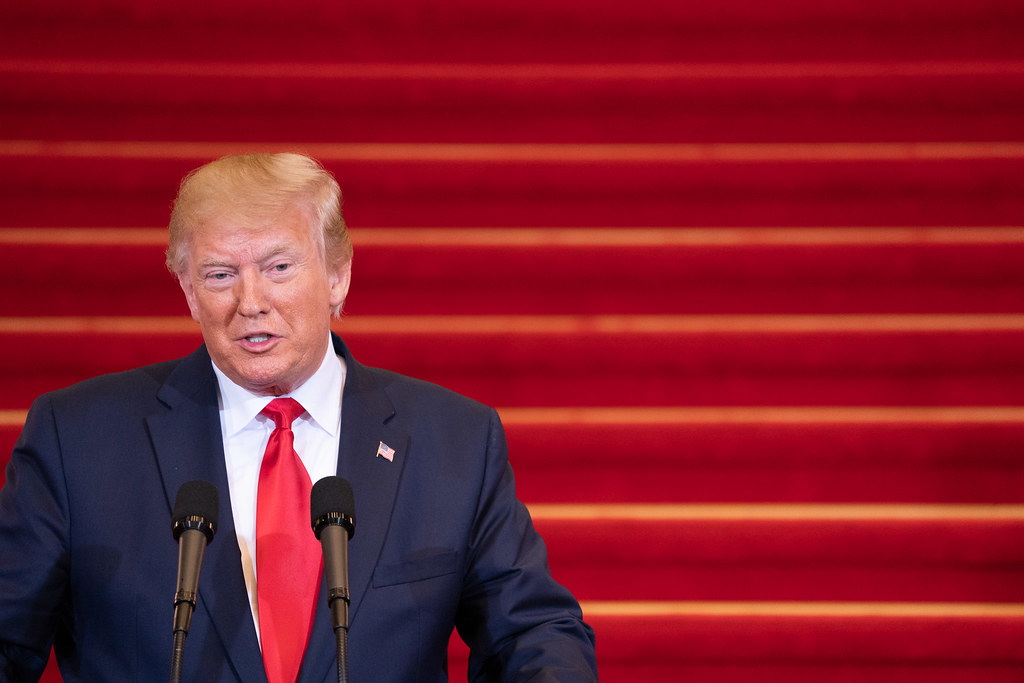
(Photo: CCL)
By Sam Chapman – Regular Contributor
“There are two types of vice president,” Kevin Spacey’s character says in House of Cards, “the
matadors, and the doormats.” Less lyrical, VEEP’s Armando Iannucci likens the job to being
“declawed, defanged, neutered and ball-gagged under two miles of human shit.” The status of the
vice president varies enormously, but the job may be more significant this coming election than ever
before. Why might this be, and who is likely to next hold the contentious post?
Historically, vice presidents have often received mid-term promotions. The most recent instance was
1974, when Richard Nixon resigned and Gerald Ford became president for two short years. Prior to
this, VP Johnson ascended in 1963 when John F. Kennedy found himself on the wrong side of a
grassy knoll. The most relevant example for the upcoming election occurred in 1945. President
Roosevelt had been re-elected for an historic fourth term, and died from a brain haemorrhage months
in. He had long suffered from polio and was wheelchair-bound, but great efforts were undertaken to
conceal Roosevelt’s frailty. The accession of VP Truman, therefore, came as a shock to the nation.
Today, such discretion does not exist: the public watches in real-time as politicians decay. If there
were ever an occasion where the vice president could expect a promotion, it will be after the
upcoming presidential election.
There is a chance incumbent VP Kamala Harris might inherit the Oval Office. With Biden’s age
showing and speech slowing, voters question the likelihood of him remaining until January 2029.
Harris’ entrenched unpopularity means she is unlikely to win an election in her own right, so a timely
death would be her golden ticket into the history books. However, this depends upon their re-election
chances, which – at present – look bleak. The Biden-Harris ticket is trailing by as many as seven
points in states which once delivered them the White House, and Washington DC is readying itself for
another Trump presidency. This is great news for careerists in the Republican Party. Trump’s early
campaigns have been a barrage of slurring and sweating, appearing with unexplained bruises and
bandages. Whoever may be sworn in beside him next January must only bide their time and await
their turn.
Let us pause a moment to reflect on the fate of Trump’s first vice president. Mike Pence spent his
four-year tenure perfecting the art of loitering, while throwing the occasional bone to Christian voters.
His relationship with Trump soured in the presidency’s dying days, when Pence refused to use his
honorary seat in Congress to block the certification of Biden’s victory. Trump encouraged his
supporters to take their grievances to Congress directly, where they erected gallows, broke inside, and
paraded through the corridors chanting “Hang Mike Pence.” It is unlikely, therefore, he will be invited
back.
Who, then, will receive the honour of being next in Trump’s noose? The only condition he has thus far
placed on the job is loyalty, and lots of it. Indeed, the Republican Party is teeming with lightweights
willing to debase themselves to Trump’s delight. The VP field, therefore, is a wide-open one, but there
are certain names appearing increasingly likely, and others which can be discarded.
From the viewpoint of a Republican victory, there are two obvious contenders. Ironically, these are
also the least likely. Although Trump will surely be the Republican candidate in November, there have
been challengers on the way. Chief among them were Florida Governor Ron DeSantis, and former
South Carolina Governor Nikki Haley. DeSantis was once hailed Trump’s heir-apparent: the man to
package Trumpism into a more respectable, electable form. Then, he launched a presidential bid, and
the public got to know him. He was weird, impersonable, quick to anger, and dropped out after taking
the hint.
Haley, Trump’s other challenger, remains in the race, futilely and for reasons unknown. Despite their
inability to topple Trump, either her or DeSantis would be a winning vice-president. It would fully
unite the Republicans, inject younger blood into the White House, and show Trump as willing to
compromise. The issue is: he’s not. Accepting DeSantis or Haley would be tantamount to admitting weakness. Trump would sooner snap the Republican Party than bend to meet it. So, vice-presidential
stock must be found in the wilds of Republican politics – and it’s rough out there.
The most likely candidate appears to be Congresswoman Elise Stefanik. A tumbleweed politician who
rolled her way to the top of the dung heap, Stefanik is currently Chairwoman of the Republican
Conference. In recent months her ambition has inflated, leaving no room left over for shame. Her
designs on the vice presidency are clear for all to see. In recent weeks, she declared that she would
vote to disqualify the 2024 election should Biden win; demanded pardons for those who attacked the
Capitol in January 2021, and described a woman suing Trump for sexual assault as a “vile liar.” Only
six years ago, Stefanik was among the most respectable bipartisans in Congress, but when these
morals stopped presenting good career prospects, she developed some new ones. Her chances at the
Veep slot are high on two counts: first, for the fealty just described. If Trump needs a stooge, she is
willing to play all three. The second reason is more important: she is impeachment insurance. Since
Trump would undoubtedly face attempts from Democrats to oust him during a second term, choosing
a vice president as unpopular as Stefanik would be a shield against his removal. Get rid of me, and
you’ll still be left with her, her appointment would say – and an effective message it would be.
Should the Stefanik nomination fall through, other lackies are available. Ohio Senator James David
Vance has kissed the ring sufficiently to warrant his name in the hat. Vance’s most prominent moment
in national politics came in February 2023, when an Ohio train came off its tracks, and the state’s
railways burned for three days, exposing tens of thousands to hazardous gases. In that time, he offered
no assistance and made no statement. An ability to avoid trainwrecks has put him on Trump’s radar,
but in his whole senatorial career, he has not written a single bill.
Another contender is Kari Lake, a former Fox TV host who ran for the Governorship of Arizona in 2022. She did not win, but claimed the election was rigged against her. In the modern Republican
Party, those are one and the same.
South Carolina Senator Lindsay Graham’s name has been teased. Graham has spoken in support of
Trump during his legal struggles more than almost any other politician. However, the Senator’s social
media shows a tweet from 2016 reading: “If we nominate Trump, we will get destroyed – and we will
deserve it.” Since being banned, Trump is no longer on Twitter; no doubt Graham hopes it stays that
way.
Senator Tim Scott, another from South Carolina, is attempting to flatter his way into the vice
presidency. He has had a low-key career in politics, but was recently criticised on a campaign trail for
being fifty-eight years-old and still unmarried. No matter – within weeks he had found a girlfriend,
and within three months they were engaged. The mystery fiancée has not been seen in public for some
time.
The connecting threads for these candidates are their inexperience, lack of renown, and track records
of ineffectiveness. This is a clear indicator that Trump wants no leadership rivals in a second term: he
is the principal actor, anyone else is replaceable. The wisdom of this strategy must be questioned. If
he fails to complete his term, and the Veep is called upon to govern, what can America expect from a
leader chosen solely for their loyalty to a dead man? In neglecting the few semi-viable options his
party has, and opting instead for vacuous yes-men, how would American fare?
It is unlikely these questions are being asked in the Trump campaign: it is not he who will live with
the consequences.

 The York Politics Review
Leave a reply to MichealSanborn Cancel reply