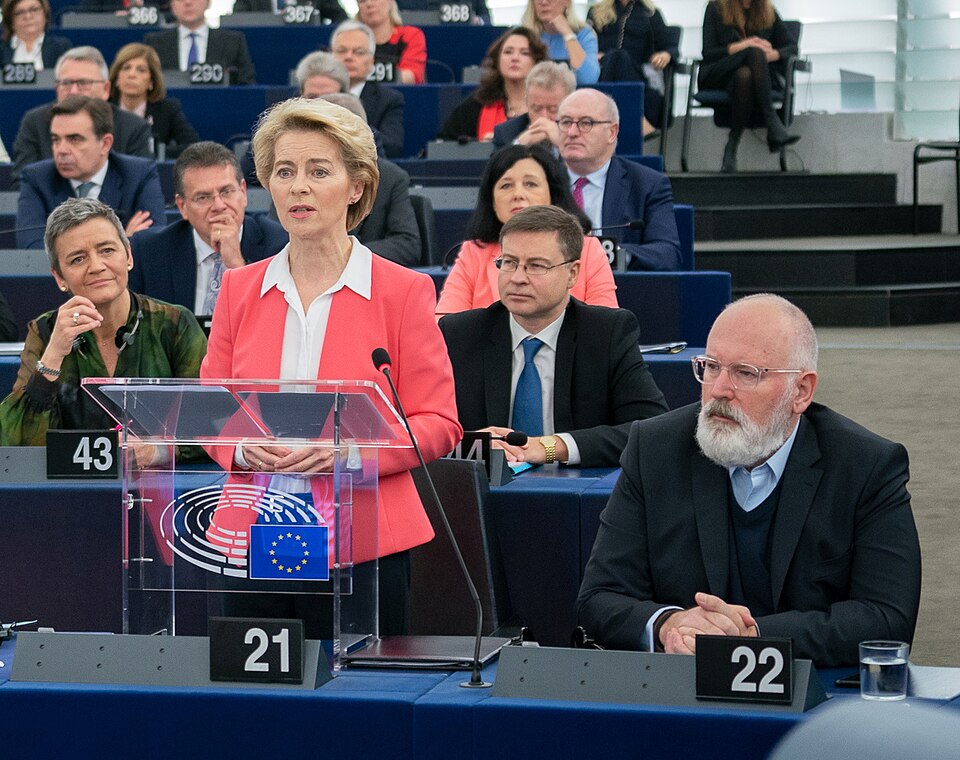
Image Credit: Robberd77 CC BY-SA 4.0.
By Marisha Landy
In 2019, the EU Commission President Ursula Von Der Leyen launched the European Green Deal (EGD). The EGD is an initiative that aims to reduce the EU’s carbon emissions by at least 55% by 2030 and bring the EU to carbon neutrality by 2050. The EGD covers eight key policy areas in the EU, such as energy, agriculture, and biodiversity, and also introduced the European Climate Law (ECL) in an attempt to bring more accountability to EU institutions and member states to work towards a carbon-neutral Union.
There is a lot of contestation over whether the EGD can be considered as ambitious climate action. Whilst some argue that the EGD provides a roadmap to a new, sustainable path for the EU with innovative policies, others claim this cannot be the case, as most of the policies were developed from existing ones, and the main motivations for the EGD are to mitigate the lasting effects of the 2008 financial and 2010 sovereign debt crises, restore the Commission’s reputation after COVID-19, and bring EU integration back after Brexit. In light of this, the best way to understand the EGD is as an ambitious climate policy, but not ambitious climate action.
Policy innovation
The EGD places carbon-neutrality at its core, which is a result of the EU recognising climate change as its biggest long-term threat. This means that the EGD brings a new sustainable outlook to the EU’s policy as well as its societal and economic goals. The EGD recognises that all areas of society are affected by the transition to decarbonisation, so its policies ensure that this process is just and inclusive. One such policy in the EGD is the Carbon Border Adjustment Mechanism (CBAM). One such policy in the EGD is the Carbon Border Adjustment Mechanism (CBAM), which aims to counter ‘carbon leakage’ – the increase in imports due to the relocation of industries to countries that don’t have carbon taxes to avoid the production costs in the EU. The CBAM introduces a cost for importers equivalent to the cost of production in the EU as a way to help the competitiveness of EU exporters. It was created to start with a transition period from 2023-2025, initially only applying to industries that are carbon-intensive and likely to suffer the most from carbon leakage, such as iron and steel, fertilisers, and electricity. The EU also introduced the Just Transition Mechanism (JTM), which exists to provide support for those working in carbon-intensive industries by helping them retrain. Clearly, the EGD is ambitiously committed to both taking climate change seriously and protecting those most affected by the decarbonisation process.
Some people hold the belief that the EGD cannot be classed as ambitious, because many of its policies are developed from preexisting ones that have been modified. Even the EGD’s objectives are developed from the Lisbon and Europe 2020 strategies on social and economic sustainability, and much of the ‘Fit for 55’ package proposed in 2021 was updated and adapted legislation that already existed. Similarly, it can be said that the EGD was just a natural next step for the EU’s sustainability and climate change policy, as before the EGD was proposed, the EU had brought forward both climate- and energy-related policies, but they acted as separate strategies. Over time, these strategies were developed and built on, becoming increasingly interlinked and eventually leading up to the EGD’s introduction, a strategy fully combining climate and energy policies. Therefore, some people argue that the EGD lacks ambition and innovation because it does not contain many new policies.
Whilst the EGD does indeed consist of a lot of preexisting policies, modified to fit new targets, this does not make it unambitious. In fact, it is unrealistic to expect the EU Commission to have created new policies for the whole EGD. This is because the Commission promised to address climate change concerns within its first 100 days in office, and the EU generally views itself as a leader in climate change response and promoting sustainable development. Therefore, if the Commission had tried to propose a climate strategy with entirely new policies, they would not have been able to address climate change within the deadline due to the amount of changes that would need to happen for the new policies to actually be enacted. This would have hurt the commission’s reputation among the people of the EU and in the international community when it comes to climate change initiatives.
Enforceability
The EGD’s ambition can also be seen in the introduction of the European Climate Law (ECL). The ECL makes the 55% reduction in carbon emissions (in comparison to 1990 levels) and carbon-neutrality goals legally binding. This is ambitious, as it is the first time the EU has made its emissions targets enforceable by law, highlighting the EU’s commitment to reaching its climate targets. The ECL is inclusive of the difficulty states may face in the transition to carbon neutrality: under it, member states and institutions have to increase mitigation strategies and implement adaptation measures by enhancing their capacity to adapt, strengthening their resilience and reducing vulnerability. This is to ensure that member states have the strategies needed to be able to decarbonise and follow the ECL without becoming overwhelmed.
The ECL can be linked to ‘procedural climate governance’. This is a process that covers the frameworks, instruments, and institutions influencing climate policies, consisting of functions such as implementation and enforcement, monitoring and evaluation, and target-setting. Use of this method of governance helps to set out a considerate path for member states to work towards their climate goals that can be adapted if the country begins to fall behind. The ECL also brings a new level of enforcement and accountability to the EU’s climate goals, a very ambitious feature given that Europe is one of the largest carbon emitters worldwide.
However, the ECL’s ambition is curbed by a lack of procedural climate governance measures necessary for the policy to be fully effective, including aspects of implementation and enforcement, monitoring and evaluation, and target-setting. The ECL states that if the Commission sees that the ECL’s objectives are not being sufficiently worked towards, it will take ‘necessary measures… in accordance with the treaties’, but the Commission has not specified what those necessary measures are, nor how the Commission actually intends to assess progress.
The ECL also provides no insight into how the EU plans to reach the 2050 net-zero goal. This creates a legitimacy problem for the EGD, as it cannot really be considered ambitious if the innovative law it brought about has no specification on how it will be enforced and what action, or lack thereof, would require intervention.
The EGD also has an issue of potentially insufficient reduction targets when taking into consideration fair levels of emissions reductions. If the rest of the world set mitigation targets on par with the EU, the global target of 1.5°C would likely be exceeded. In this case, the EU would have to set its 2030 reduction target to 93%. In the context of the ECL, this is an issue because enshrining these targets in law means that it would be difficult to increase them as needed, and could lead to more intense pushback from member states if they feel that the current goals are already too ambitious.
The ECL is an ambitious idea in theory, but in practice, it would require the European Commission to make changes to the goals and accountability mechanisms to ensure that it has fair-share climate targets and the necessary frameworks in place to make it effective.
A roadmap for the EU
The EGD pivots the EU to a more sustainable model for economics, energy, and climate policies, creating a roadmap to sustainable energy use with long-term goals for the EU to follow. An example of this new roadmap is the EU’s widening of sustainability considerations beyond the environmental, by combining it with a desire to improve the economic. Addressing economic sustainability will help the EU to reach its targets, as it ensures the organisation will look ahead to create long-term goals, not just quick-fix solutions that will only help the short-term consequences of climate change currently being felt. Historically, the EU has been good at long-term planning, but the EGD brings a new level of ambitious planning because it sets the EU towards improved sustainability and development. The commitment to this ambition was seen during the COVID-19 pandemic, when the EU chose to go ahead with the development of the EGD. During a crisis where short-term solutions were needed, the Commission chose to keep its long-term climate goals among its top priorities.
Some people argue that the EU’s commitment to the climate is purely a means to mitigate the lasting effects of the 2008 financial and 2010 sovereign debt crises, jump-start EU integration after Brexit, and restore the Commission’s reputation following the COVID-19 pandemic. Analysis shows that investing in green energy would provide a significant boost to the economy, and the investment would be nearly completely offset by the savings from reduced gas and oil imports. Investment in green energy would improve the Commission’s reputation twofold: through helping the economy, by avoiding environmental and climate costs, and listening to public concern about climate change. When it comes to EU integration, the EGD was proposed at a time when further integration was required, both because of the economic effects of the sovereign debt crisis and to curtail the possibility of disintegration in the fallout of Brexit. In terms of the COVID-19 pandemic, the Commission’s reputation was significantly hurt due to its response to the crisis. These factors, combined with the fact that climate change is the most important issue to the European people, suggest that the EGD was an attempt from the Commission to rebuild its reputation, rather than to start ambitious climate action. The political climate at the time of the EGD’s introduction placed a lot of pressure on the Commission’s shoulders, which would have been alleviated by the EGD.
Conclusion
Overall, it can be said that the European Green Deal is ambitious and shows a commitment from the European Commission to tackle climate change, but it significantly lacks the accountability mechanisms and frameworks that would be needed for it to be considered anything more than just an ambitious policy idea. It sets the EU on a new road to sustainability, containing innovative policy ideas such as the Just Transition Mechanism and European Climate Law, bringing a new sustainability outlook to the EU that is inclusive of everyone affected by decarbonisation. However, the legally binding aspect of the ECL becomes unenforceable due to a lack of specification on how to measure progress and what sanctions would look like if states are not working towards the 2030 and 2050 reduction goals. Furthermore, the new road for the EU could at least partially be a strategy to boost the Commission’s reputation, which would explain the lack of proper enforceability. Therefore, while there is ambition in the EGD, it is not ambitious climate action, and will not be able to be considered as such until there is true accountability and enforceability to ensure the EU follows the sustainable path.
References
Bongardt, A. and Torres, F. (2022). The European Green Deal: More than an Exit Strategy to the Pandemic Crisis, a Building Block of a Sustainable European Economic Model. Journal of Common Market Studies, 60(1), pp. 170-185. Available at: 10.1111/jcms.13264
Čavoški, A. (2020). An Ambitious and Climate-Focused Commission Agenda for Post-COVID-19 EU. Environmental Politics, 29(6), pp. 1112-1117. Available at: doi: 10.1080/09644016.2020.1784010
Erbach, G. (2021). EU Legislation in Progress. European Parliamentary Research Service, [Online] Available at: https://www.univiu.org/images/aauniviu2017/GP/co-curr/European_climate_law.pdf
European Commission (2025). Carbon Border Adjustment Mechanism. [Online]. European Commission. Available at: https://taxation-customs.ec.europa.eu/carbon-border-adjustment-mechanism_en
European Commission (2019). The European Green Deal. [online] European Commission. Available at: https://commission.europa.eu/strategy-and-policy/priorities-2019-2024/european-green-deal_en
European Commission (2021). Special Eurobarometer 513: Climate Change Report Summary. [Online]. European Commission. Available at: 7d075fa0-e128-4ed6-9272-43853646e009_en
Fetting, C. (2020). The European Green Deal. [online] ESDN. Vienna: ESDN Office. Available at: https://www.esdn.eu/fileadmin/ESDN_Reports/ESDN_Report_2_2020.pdf
Hainsch, K. et al. (2020). European Green Deal: Using Ambitious Climate Targets and Renewable Energy to Climb out of the Economic Crisis. DIW Weekly Report, [online], 10(28/29), pp. 303-310. Available at: https://doi.org/10.18723/diw_dwr:2020-28-1.
Hare, W. et al. Achieving the 1.5°C Limit of the Paris Agreement: An Assessment of the Adequacy of the Mitigation Measures and Targets of the Respondent States in Duarte Agostinho v Portugal and 32 Other States. [Online]. Available at: https://ca1-clm.edcdn.com/assets/final_report_ca_glan.pdf
Korpar, N. Larch, M. and Stollinger, R. (2022). The European Carbon Border Adjustment Mechanism: a Small Step in the Right Direction. International Economics and Economic Policy, 20, pp. 95-138. Available at: doi: 10.1007/s10368-022-00550-9
Kulovesi, K. et al. The European Climate Law: Strengthening EU Procedural Climate Governance? Journal of Environmental Law, 36(1), pp. 23-42. Available at: https://doi.org/10.1093/jel/eqad034
Moore, B. et al. (2023). Transformative Procedural Climate Governance: Mechanisms, Functions, and Assessment Criteria. [Online]. Available at: https://www.ecologic.eu/sites/default/files/publication/2023/33007-Report-2023-D5-1-Transformative-procedural-climate-governance.pdf
Nicolaidis, K. (2019). Sustainable Integration: The Silver Lining of a Democratically Challenged EU. Available at: https://www.bertelsmann-stiftung.de/en/publications/publication/did/sustainable-integration-the-silver-lining-of-a-democratically-challenged-eu/
Pirvu, E. (2020). The European Green Deal – a Feasible Ambitious Initiative? Journal of Danubian Studies and Research, 10(1), pp. 276-291. Available at: https://www.proquest.com/publiccontent/scholarly-journals/european-green-deal-feasible-ambitious-initiative/docview/2769619012/sem-2?accountid=15181
‘Regulation (EU) 2021/119 on Establishing the Framework for Achieving Climate Neutrality and Amending Regulations (EC) No 401/2009 and (EU) 2018/1999 Official’ (2021). Journal L243.
Rhinard, M. (2023). Crises and Challenges for the European Union. London: Bloomsbury Academic
Rivas, S. et al. (2021). Towards the EU Green Deal: Local Key Factors to Achieve Ambitious 2030 Climate Targets. Journal of Cleaner Production, 320, pp. 1-11. Available at: https://doi.org/10.1016/j.jclepro.2021.128878



 The York Politics Review
Leave a comment