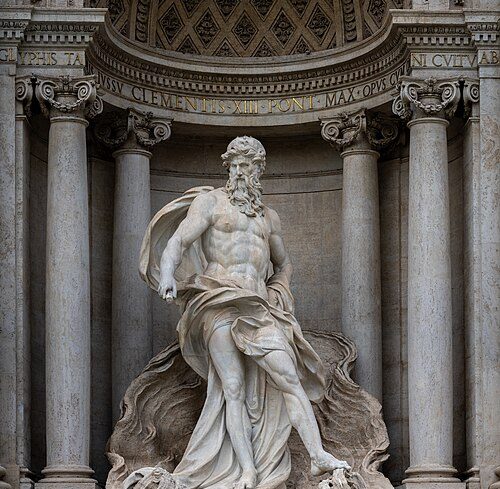
Image credit: Wilfredor CC1.0
“As Nietzsche said, “God is dead”. The gods die but the Titans gain power. Technology is just the clothes, the armour, of the Titans.” – Ernst Jünger
The age of the Titans, as the quote above suggests, is the age succeeding the age of the Gods. Gods, as meant in the Nietzschean sense, are defined as both the understanding of the physical God within the world, but also all the beliefs that tie into that, such as metaphysics, objective ethics, and concrete values as a whole. The age of the Titans therefore is the age without those things, and it cannot be separated from the age of the technological. These are the technologies of everyday life, such as computers and industrial machinery, but also the technologies of modern warfare. Through an examination of the lenses and perspectives provided by thinkers such as Jünger, Nietzsche, and Heidegger, we might recognise that we live in such an epoch, and glean a clearer insight at what our way of surviving in what is an age utterly opposed to the fullness of human existence.
Ernst Jünger (1895-1997) saw a changing world in a way few others did, due to the scale of the events of his 102-year life. In particular, he saw the world of technology evolve into what could be called its modern form, with it taking an ever-larger part of our lives. His first real exposure and understanding came during the First World War, when he saw battles no longer of chivalric individuals, but of industrial machinery. Jünger saw the War as a revolution of the entire world and of the human condition, and that the wheels of industry and accompanying dehumanisation would carry over into everyday life, where old values and modes of life had been pummelled by artillery fire. On the battlefields of Europe, traditional ideas of morality and theology were replaced with new versions subsumed with violence and impersonalism. In his musings on Jünger, de Benoist observes: “Technology imposes its own law, the law of impersonality and total war – a war simultaneously massive and abstract in its cruelty”. It is his experience here that starts his understanding of the age of the Titan, and its effects on the individual.

Individuals in this age, if they can even be called such, are defined by Nihilism. On the one hand this appears in the form of sickness; Nietzsche’s “Last Man”, the bourgeois and utilitarian person living the life without risk and therefore without real character. They have their entire being contained within the infrastructure of modern convenience and the virtues of technology looking to alleviate all suffering and change. But as Jünger and Heidegger both separately observe, it can also be seen within images of health. It can be represented by an endless marching on, by industrial workers tirelessly working themselves, just aimless in their direction or purpose. In either case, they lose all access to their individuality and become slaves to the systems above them.
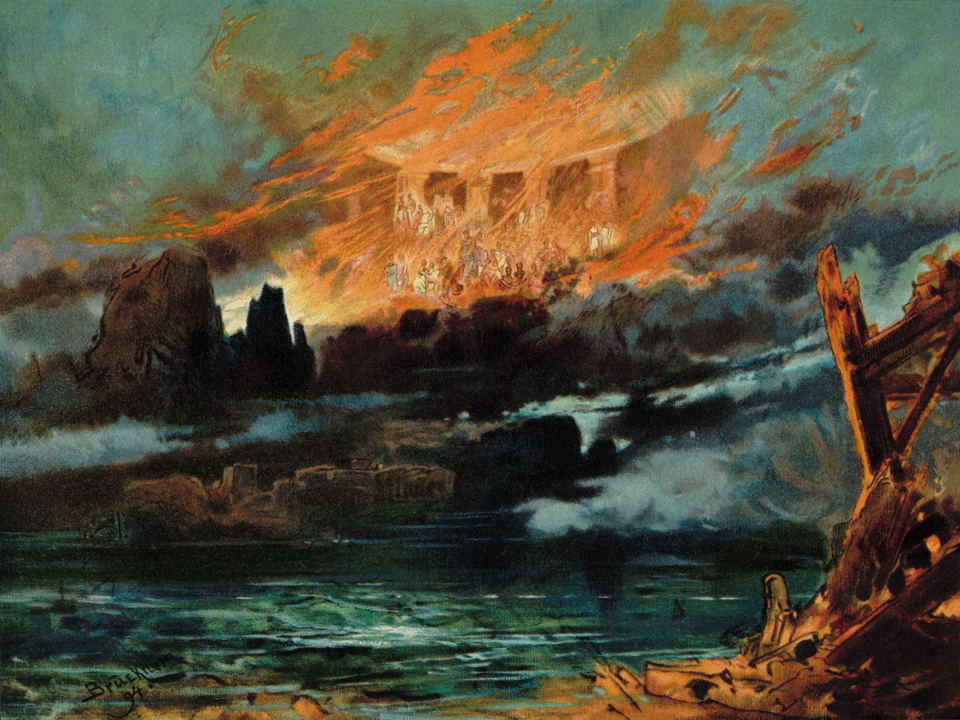
The Gods are those who ruled and led in the age still characterised by metaphysics and religion. As violent and callous as they were, were at least rooted within the concept of the eternal – of metaphysical truths and values set in stone. The Titan, on the other hand, must be acutely aware of his fleeting temporal nature. His values are those of the arbitrary and the callous, and the danger they pose is made ever more acute because of this. His consolidation of wealth and power therefore has an urgency unknown in the prior age, as beyond one’s life nothing holds weight. All that exists is the arbitrary, to be decided and acted upon, without the weight of the Old Gods of the concrete and the absolute. Yet in this age, with the only myth being that of mythlessness, myths of course still exist, and are used and created by those who seek to gain power from them.
One of the key forms of the Titan is the Political Caesar, a figure much akin to Carl Schmitt’s conception of the sovereign. To Schmitt, it is the Caesar who has the power and the capacity to declare exceptional circumstances outside of legal or political convention, to create enemies a society fights against, and ultimately to arbitrarily decide upon the supreme values that are to be imposed on people. In Jünger’s time, perhaps the most visible example of the Titan was the vain and corrupt glutton Hermann Göring, chief of the Luftwaffe. Within the arbitrary apparatus of the National Socialist State, and the pretence of the eternal, he greatly enriched himself with wealth and fine arts. Göring was never a head of state, but his power to act with an unrestrained callousness was undiminished. The fact that Göring commanded an Airforce exemplifies this, as it is composed of weapons that can be deployed over land far outside of one’s own area of control, and unlike infantry do not hold land; they simply destroy. In Jünger’s novel “On the Marble Cliffs” the character of the Head Forester is often seen as being a caricature of Göring (Göring was Reichsminister of Forestry), a man gleeful in the wanton destruction he engages in against the natural world and its values alongside his mindless followers. The Titan can use the state as the expression of their will, even if the state itself is a technological behemoth far outside of their own control: they manipulate what they can of it to benefit whom they choose, their political friends.

The technological infrastructure of the surveillance state creates a world where the category of observer is eradicated, replaced by a totality of the observed. This becomes even more pressing today, through tools such as AI and central databases, where even the Peter Thiels and Elon Musks of the world are not totally in control of the power held within their machines, when those machines can begin to think and act independently. When Jünger said that technology was the armour of the Titans, it is because unlike in prior ages the power of these individuals is based not on their ability to rally individuals to fight for them, or because of their deep personal convictions, but because they have tools and capital that instead make up for those values and that strength they would otherwise need. The bureaucracy that defines the modern state will be in conflict with these modern technocrats and the great juggernauts of their creations, because the modern state, also a Titanic construction, is seeking to take for itself all the power it can, and both groups therefore wish to devour the other. In the Trump administration there is a long game of chess being played between wealthy technology moguls and scheming statesmen, who are in public collaborating, but both are trying to foresee the future that guarantees either state or business more power, with each placing money and influence where it seeks to win and dominate, but ultimately purposelessly, as the victors have, in truth, nothing real to gain.
Jünger’s solution to this world for the individual is expressed within an archetype or form he refers to as the anarch. The anarch, as opposed to an anarchist, is not someone opposed to power or someone who seeks to abolish it, but rather someone who can live separate from it. They are capable of living within the world, whilst thoroughly distant from it in many ways. They don’t need to isolate themselves in order to live within the natural world and the world of sacred values, they are neither clinging to values long gone nor those who have given in the Titanic. Instead they are someone who is able to live the life of contemplation, who stand on the boundary of two worlds, one long gone, and one world that can simply offer nothing of any meaning. These individuals must use that contemplation for the chance to witness the slow process of Aletheia, the unconcealment of the world, and within that to develop a deeper understanding of their being. This anarch must also live a life thoroughly aware of death as the final point and defining point, that our being is rendered and understood as being-towards-death, as Heidegger described. A realisation of death as a perpetual possibility allows us to exist with grounded experiences and to make the most of our being. Fundamentally, to resist the Titans is to live a life of fullness and authenticity, which becomes an act of rebellion against a world that wishes to destroy the individual.
“Then shall the dust return to the earth as it was: and the spirit shall return unto God who gave it.” Ecclesiastes 12:7



 The York Politics Review
Leave a comment