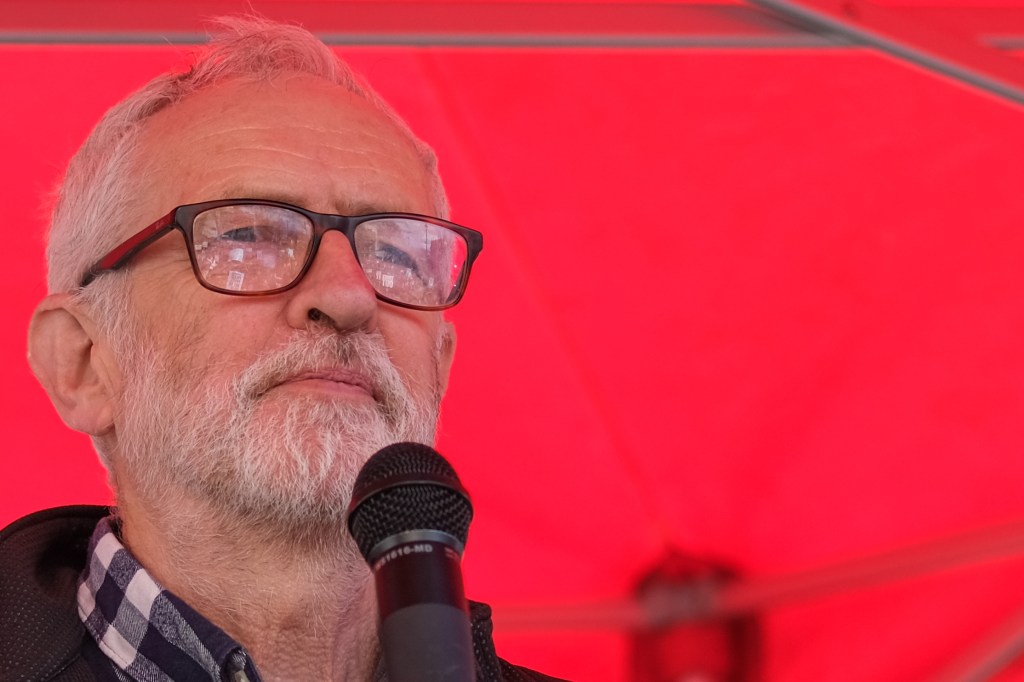
Image credit: Alisdaire Hickson, CC 2.0
By Oscar Hilder
If they want to avoid splitting the left-wing vote – and indeed unite the left behind them – Your Party should take a lesson from the 1980s.
Left-wing politics in the United Kingdom have been rocked in recent weeks by the launching of a new political party, provisionally named “Your Party”, by two (ex-Labour) MPs Jeremy Corbyn and Zarah Sultana. In line with the pair’s long-held views, the party is defined overall by an emphasis on left-wing economic populism (including initiatives to tackle wealth inequality and poverty), and far greater support for the Palestinian people suffering under Israel’s devastating invasion of the Gaza Strip. The launch of Your Party has generated renewed enthusiasm amongst the political left in the UK – since its launch, well over 700,000 people have signed up to play a part in its inaugural conference, far outstripping the membership sizes of all other parties in the UK. Given the dissatisfaction many have with Keir Starmer’s centrist leadership of the Labour Party (and the country), the promise of a new, grassroots-based party, led by the standard-bearers of the British left, was always going to generate excitement.
Corbyn and Sultana claim to represent the answer to the right-wing populism offered by Nigel Farage’s Reform UK – rather than seeking to appease Reform by taking more right-wing views on immigration and social issues, as Starmer’s government has done, Your Party instead focuses on the economic problems that they believe have led to Reform’s successes in the polls, such as inequality, poverty and lack of government spending. This may well draw voters away from both Farage and Starmer, but in doing so risks worsening that ever-pertinent issue within UK politics – vote splitting.
Vote splitting is the process by which two parties of a similar ideology compete for the same bloc of voters in an election, and in doing so divide their support, often to the detriment of both parties. This is particularly pertinent in the UK’s First Past The Post electoral system, where the winner-takes-all nature of individual constituency races means that vote splitting decreases the chances of either parties winning seats. Part of the reason why the Conservative Party’s loss last year was so catastrophic was due to the presence of Reform, which split the right-wing vote in numerous constituencies, allowing Labour to carve out a massive parliamentary majority with only one third of the votes. To avoid a Reform victory, vote splitting with Labour is a concern. But to guarantee any success for the fledgling party at all, vote splitting with another political party is even more of an issue – the Green Party. The points in this article are primarily focussing on the Green Party of England and Wales, but could also apply to a wider left-wing coalition with the Scottish Greens as well.
In many ways, the issues touted by Your Party – tackling economic inequality, greater help for the Palestinians, concern for the environment and climate, etc.– have long been pillars of the Green Party’s ideology, at least at a national level. Indeed, the Greens are already in the position of a more left-wing alternative to Labour, as seen by their victory in Bristol Central last year, where they overturned a large Labour majority with a swing of almost 30%. Furthermore, this year’s recent party leadership election saw deputy leader Zack Polanski emerge victorious, with his more eco-populist style of politics likely to bring the Greens even closer to Corbyn and Sultana. Vote splitting between the two would be disastrous for both- polling data from More in Common already suggests that the presence of Your Party in elections could cut the Green vote by almost half, an effect exacerbated by Polanski’s victory, as his leadership is likely to steer the Greens closer to Your Party in terms of ideology. Whilst the Greens are the more established party, Corbyn and Sultana are better known politicians and arguably inspire more enthusiasm, meaning there is a strong likelihood the two will do equal amounts of damage to each other. In effect, the UK’s new left may risk tearing itself to pieces before it even gets going.

Given how pertinent the issue of vote splitting is within UK politics, many have suggested an electoral alliance between the two parties – meaning they will not run candidates against each other, and may sit as a united voting bloc in Westminster. Polanski himself has expressed interest in the idea, but Corbyn has opposed it. For Corbyn’s part, this is understandable- whilst the Greens do contain economic populists like himself, they are also composed of more small-c conservative environmentalists, who stereotypically would be more concerned with local green issues than wider issues of economic inequality. This supporter base contrasts heavily with that of Polanski’s and Corbyn’s – young, urban, educated progressives, who view the solutions to the issues of climate change and wealth inequality as inextricably linked. Now Polanski has won the leadership election, it would be very unwise of Corbyn to not try and forge some sort of alliance to prevent vote-splitting- otherwise, the hopes of both parties to bring about truly left-wing influence in Westminster will be dashed.
The Your Party-Greens situation bears numerous similarities to the circumstances of two parties in the early 1980s: the Social Democratic Party (SDP) and the Liberals. In 1981, dissatisfied with the leadership of Labour leader Michael Foot, a number of moderate Labour MPs, led by former Chancellor and Home Secretary Roy Jenkins, broke away from the party to form the Social Democratic Party – a centre-left party with moderate social democratic policies, advocating for a mixed economy, greater integration into the EU and electoral and constitutional reform. These ideas were strikingly similar to those held by the Liberal Party, which had long espoused a social liberalism that called for very similar proposals. Recognising these similarities, the two parties were quick to form the SDP-Liberal Alliance, which at the subsequent general election in 1983 garnered over one-quarter of the vote share – less than one million votes less than Labour’s result. (but, due to the nature of First Past The Post, only 23 out of 650seats). Following a similar result in 1987, the two parties formally merged to form the Social and Liberal Democrats, later shortened to just the Liberal Democrats.
Despite never winning an election, the SDP-Liberal Alliance, and the Liberal Democrat Party that subsequently succeeded it, were both arguably relatively successful. While the Liberal Democrats have never won an election on their own, they have established a template for success which other newcomer parties can emulate. The SDP and the Liberals, recognising their ideological kinship, acted quickly to ensure they would not have to compete against each other in elections, resulting in the formation of a stable, ideologically cohesive party that has firmly established itself as the third force in UK politics. Eventually, following the 2010 election, the Liberal Democrats were even able to enter government- a clear demonstration that the alliance between, and merger of, the two parties was a success, as it was able to break the entrenched two party system to directly influence policy. It allowed the parties to claim the centre ground of UK politics at a time when Labour and the Conservatives were moving away from it, and to share it between them; since then, even when the other parties have tried to claim this territory, such as Labour under Blair in the 1990s and 2000s, the Liberal Democrats have not lost it.

There are pertinent similarities between this situation and the relationship between the Greens and Your Party. Much like Roy Jenkins, Jeremy Corbyn is a high-profile politician once in a leading position within Labour, but who has since become disillusioned with the party’s leadership. The Greens, meanwhile, represent the old Liberal Party – a more established political party with a small number of seats, occupying a designated space on the political spectrum – in this case, sitting to the left of Labour, whereas the Liberals were thought of as being to its right. Like the SDP, Corbyn and Sultana established Your Party to appeal to a subset of the population who feel betrayed or abandoned by Labour – for the SDP, this was moderate voters, but for Corbyn, it’s the left. And, with Polanski now the new leader of the Greens, the two parties are likely to share a similar ideology both economically and socially – very much like the SDP and the Liberals did. The success of the SDP-Liberal Alliance is in reach for both Your Party and the Greens – but only if they work together.
Currently, both Labour and the Conservatives are being squeezed out by rivals new and old. Reform is currently proving successful in winning over both traditional Labour and Tory voters, and is now in a position to become the dominant party of the right. The Liberal Democrats, meanwhile, have kept their polling numbers steady since the election, and have been successful in winning over more affluent Labour and Conservative supporters, particularly in the south; though arguably to the left of Labour in terms of policy, they are still regarded by the public as occupying the middle ground between the two. As seen in this year’s local elections, Reform won councils in former heartlands of both Labour (Doncaster) and the Conservatives (Lincolnshire and Kent); the Liberal Democrats, meanwhile, won councils in more affluent areas that had previously been more Tory supporting, such as Oxfordshire and Cambridgeshire. What is evident from these results is that both Labour and the Conservatives are left with increasingly waning numbers of core supporters, a predicament the Greens and Your Party could easily exploit for their own benefit.
If Corbyn and Sultana want their left-wing alternative to both Reform and Labour to be successful, they have to be the clear place for disaffected voters to the left. An alliance with the Greens would give them a monopoly on left-wing politics in the country, not just in terms of ideology, but in terms of image. Whilst it is unlikely any remaining Tory supporter would ever vote for Your Party or the Greens under Polanski, the two parties do have an opportunity to establish themselves as the party of the left- a position Labour would find it difficult to reclaim. After all, Labour under Starmer have chosen to make themselves the party of the centre, or even of the centre-right, something that has frustrated their core supporters and alienated the left-wing voter demographic. Both Your Party and the Green Party are already viewed as viable left-wing alternatives to Starmer’s Labour by many progressive voters, but their position as small, marginal parties is what makes them so vulnerable to vote-splitting. To avoid the Greens’s support collapsing, and Your Party being strangled at birth, it would be best for both of them to work together; to not recognise and act on this would be a grave misjudgement.
Of course, such an alliance would not be without challenges, not least the potential alienation of the non-populist support base of the Greens. These voters – predominantly rural/suburban, educated, and often NIMBYish – are unlikely to show much enthusiasm for the Green Party’s rebranding as an economically populist party, with many probably moving towards another party, most likely the Liberal Democrats or even the Conservatives. The reality for the Greens is that they have two bases of support – the rural, small-c conservative environmentalists, and the urban, progressive leftists. This is reflected in the four seats they hold in Westminster – two are in rural areas (North Hertfordshire and Waveney Valley) and two are in urban areas (Brighton Pavilion and Bristol Centre). Currently, the latter camp is growing in size and in influence, embodied by Polanski’s ambitious – and successful – bid for the leadership; now he has won, the party should embrace its new image as a left-wing, eco-populist party. Much of the public already regards them in this way, as seen by their victory in Bristol Centre; furthermore, the scale of Polanski’s victory (84.6%) demonstrates the overwhelming support amongst the membership for the eco-populist faction. The support they may lose from the other wing would be offset by the gains apparent from working with Corbyn and Sultana, the darlings of the left, whose supporters would add to their number. Furthermore, much like the Greens, the old Liberal Party was also formed of a split voter base, its support largely coming from both affluent suburban voters and those of the “Celtic fringe” in Cornwall, Wales, and Scotland; the merger with the SDP did little to impact this arrangement, which still persists today. This suggests that there is even a chance the Greens could keep their divided voter base united behind them.

Other challenges may include tension between the three leaders of the alliance – Corbyn, Sultana, and Polanski. Whilst the three would undoubtedly claim to be sharing the leadership, given the disagreement that is already apparent between Corbyn and Sultana, throwing Polanski – someone who Corbyn has expressed reluctance to work with previously – into the mix may lead to irreconcilable tension. Again, however, the example of the SDP-Liberal Alliance, which saw considerable friction between Liberal leader David Steel and SDP leaders Roy Jenkins and David Owen, demonstrates that, given time, initial leadership rivalries can be smoothed out. Corbyn’s frequently unfavourable treatment by the national media may also deter the Greens, though the maxim of any publicity is good publicity – especially at a time when the Greens are lacking coverage – may prove beneficial. Indeed, in the case of the SDP-Liberal Alliance, it was the more popular leadership of David Steel that aided Jenkins’ nascent party, resulting in a higher level of press coverage for the Liberal leader; the advantage of having multiple figureheads means it is possible to prioritise those who are most media-savvy and personally popular. Fundamentally, any political alliance will prove to be messy at first – it will require willpower and perseverance, as well as a commitment to working together, in order for it to be successful. SDP-Liberal Alliance leaders bickered endlessly over who should take the media spotlight and who would become Prime Minister in the event of an election victory. This led them to realise the Alliance was not good enough to prevent division, and unified into the Liberal Democrats under the single leadership of Paddy Ashdown; his leadership stabilised the party and firmly established it as the third force in the UK’s politics. Initial disagreements between Corbyn, Sultana and Polanski could eventually be remembered as nothing more than early bumps on the road, as a new consensus for single leadership emerges.
Furthermore, the ability for political alliances to be successful is not just something that could only occur in the 1980s – the model of alliance used by the SDP and the Liberals is something Precedence from abroad also demonstrates the advantages of an alliance. In France, the success of the far-right National Rally in 2024’s European Parliament elections prompted numerous left-wing parties to fight the subsequent snap legislative election as part of an electoral alliance – the Nouveau Front Populaire, or New Popular Front. The Alliance proved successful, winning a plurality of seats in the National Assembly, denying both the National Rally and the centrist Ensemble coalition a victory. The NFP was able to present themselves to the French people as a united left-wing front, working together to present a common message and direction for the country. This ties back to the idea of the Greens and Your Party presenting themselves as the natural party of the left, in place of Labour – they have the ability to present a clear, united, unequivocally left-wing message, one that has the potential to make them a formidable force in UK politics.
Overall, an alliance between Your Party and the Green Party would be beneficial for both as it would prevent vote splitting, present the public with one coherent left-wing policy platform, and establish a clear left-wing alternative to Labour. Polanski has been wise to express interest in such a merger, and now that he has been successful in his bid for the leadership of the Greens, Corbyn and Sultana would be foolish not to consider it. The example of the SDP-Liberal Alliance clearly demonstrates that two parties of similar ideologies uniting allows them to consolidate their position in UK politics, and even provides them with an opportunity to enter government at some stage. Working together in Parliament, or not running candidates against each other, is not enough to realise Corbyn’s, Sultana’s, and Polanski’s ambitions for a new, left-wing populist party with broad appeal across the country. If they truly want to compete with Labour and Reform, an electoral alliance would go a long way in realising this dream, representing a fresh new populist party with an unshakable emphasis on resolving economic inequality, properly addressing the plight of the Palestinians, and tackling climate change. The only thing that is needed is the willpower to make it happen.




 The York Politics Review
Leave a comment