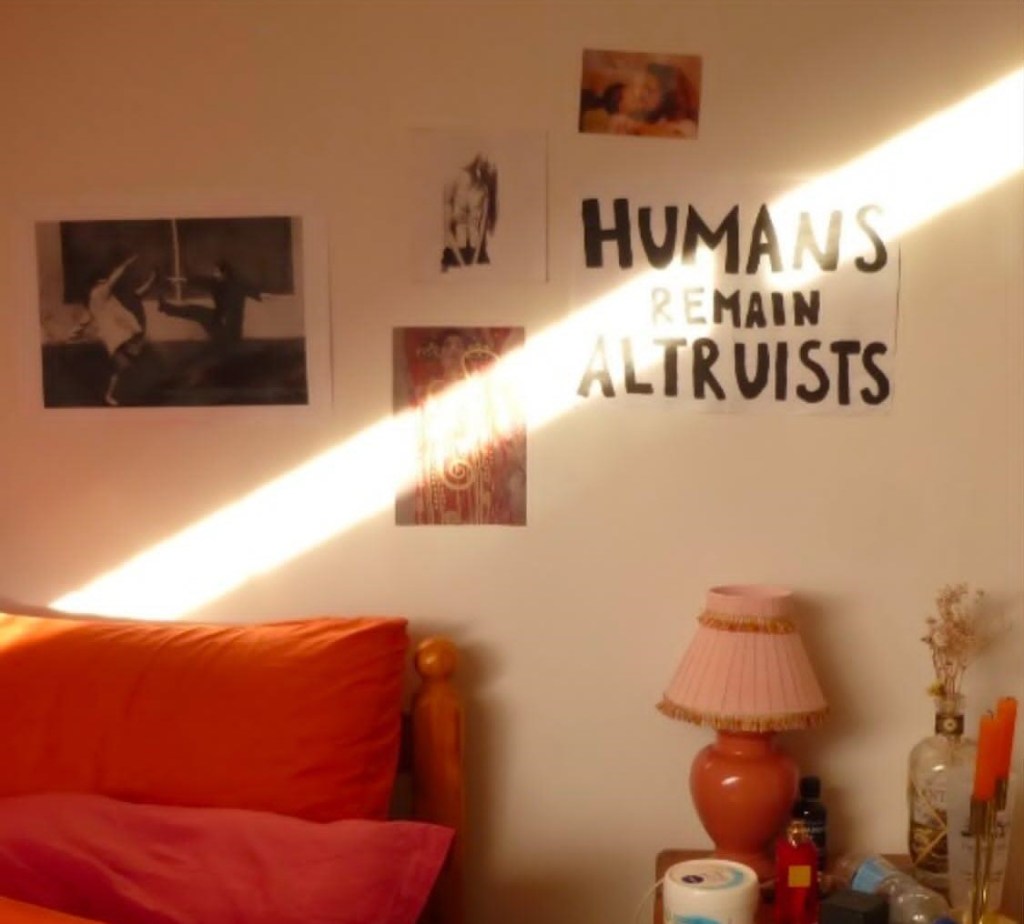
In a World of Hurt, Altruism can Empower us as Consumers and Activists
By EMMA TITMAS
“Love has never been a popular movement. And no one’s ever wanted, really, to be free. The world is held together, really it is held together, by the love and the passion of a very few people. Otherwise, of course, you can despair. Walk down the street of any city, any afternoon, and look around you. What you’ve got to remember is what you’re looking at is also you. Everyone you’re looking at is also you. You could be that person. You could be that monster, you could be that cop. And you have to decide, in yourself, not to be.”
James Baldwin, 1970.
Baldwin’s wisdom is unbeatable, his cynicism works in symbiosis with a rhythmic conviction to his writing that conducts your attention. 54 years on, it’s still true that we have to choose to be good; acting in ways that require sacrifice rather than a passive acceptance of ‘the way things are’, acting as altruists.
Though the world has always been wrecked by destruction, through the many reigns of dictators and bloody wars, today it can seem that little has changed at all, consider the US election, consider Gaza, consider climate change. Despite all of this, I think that we remain altruists. Unfortunately I have to disagree with Baldwin, because the world is held together by the love and passion of many more people than just a few. Hope and altruism make up the power most of us will yield, realising and mobilising this has the potential to achieve immutable good, motivating our behaviour as consumers and activists.
The Status-Quo
I will paint a small picture of our current qualms, from which to build off.
Consider the political momentum towards the far-right over the world. As the traditional parties lose favour and competence, a lack of imagination in providing alternatives has led to the formation of a gap, quickly filled by far-right populists, announcing themselves as the alternative. Unfortunately, many disillusioned voters have fallen for their proposition, vulnerable to believing the false promises, and welcoming the ready-made scapegoats, whom they can blame everything on.
Then, consider the rise in conflict, in Eastern Europe, and over the Middle East, whereby the murder of thousands of innocent civilians, predominantly children, is orchestrated callously through targeted and inescapable violence. All the while, the ‘peace-seeking’ nations arm one side, justifying their violence, and denounce the other. Theoretically these nations cease providing arms when the extent of international condemnation becomes disadvantageous, not because the violence is now ‘unjustifiable’. Sadly, this withdrawal is not always guaranteed.
Perhaps most saliently, consider the fact that at current rates of soil degradation, we have just 60 years of harvests left. Amidst that, more extreme weather events, which will reduce the availability of resources and unsettle communities further, making migration a greater necessity.
COP29 provides an excellent example of how dire the climate situation is. Despite thirty years of climate conferences, emissions are still rising and on track to reach a 1.5 degree increase, missing the target of the 2015 Paris Agreement, only 10 years on. All this, whilst the US president who previously withdrew from the agreement continues to deny the threat of climate change as he retakes the White House. While much of the world bears witness and victim to the future of climate change, through suffering huge destruction, look to Spain this season, or Pakistan two years prior; we simultaneously observe the fundamental lack of action on the side of governments or big businesses. As tackling climate change isn’t good for business, changing their practices would reduce profits and trade. For governments, economic practices have always endlessly pursued growth, though continuing to pursue it will no doubt cause mindless destruction.
Having painted a small picture of the issues we face, I want to reiterate that hope remains, there is huge potential to make a difference, as both individuals, and in organised groups. The human norm is one of selflessness and altruism, not blind ignorance. This is shown by the resilient efforts of communities who come together to rebuild after natural disasters, putting their differences aside in the pursuit of a common good; and the silenced majority who do not vote for political demagogues.
The Case for Altruism
Altruism has long-been exhibited in our behaviour, evolutionary biologists propose the idea of kin selection, a behaviour where we make self-sacrificing actions which benefit our own family. This is a fairly intuitive instinct to possess, one which we now apply even to strangers when we do something self-sacrificial which helps another. I would argue that protest and, in most instances, the practice of charity, are ways we demonstrate our natural ability for altruism.

But it would be remiss not to briefly address some obvious objections here. To the numerous world leaders who defy altruism by acting cruelly; and to a Hobbesian view of human nature where we are self-seeking creatures, who seek to better their own lives at the cost of others. To the first objection I would say that anomalies should be expected in any large population, people who treat others poorly are apparent in everyday life, but they are nearly always the minority. Unfortunately some of that minority seek power. Perhaps a fundamental flaw in their desire to have power, is that it presumes that they see themselves as more worthy and superior to others. This attitude intercepts the ability to equally respect others, and is what differentiates altruists from those anomalies. It becomes our duty to maintain that virtue of respect, by not electing unvirtuous candidates, to do so would be disrespectful to ourselves.
To the second objection, I would argue that the Hobbesian perspective is at-first convincing, I have believed it myself before and when events occur that demonstrate cruelty or blind selfishness, it feels like proven fact. And though it is hard to argue, it isn’t all as dire as the Hobbesian perspective makes it appear. We have a built-in tendency to recognise the danger around us, in order to avoid it, therefore we are more prone to acknowledging the bad than the good. What else could explain random acts of kindness, organised demonstrations, or the principle of charity, but natural altruism. Maybe cynically, they are motivated by economic or social gains to be had. But the majority of those participating can’t expect to become rich or socially adored, if they did, this would surely make them unvirtuous to begin with, and unlikely to pursue a good beyond themselves. In other words if this is their sole motivation, they are not altruists, but fit into the category of the anomalies.
Motivating Altruism and Hope
Motivating altruism is the difficult part, for despair is such an easy mindset to slip back into. Contrasted with the loud voices of misery, the politics of hope is usually quiet, or moreso drowned out by the former. But notably, over the last hundred years, millions of people have been lifted out of poverty, becoming more able to lead healthier lives and receive an education, a massively positive progression, though it has been achieved sometimes by harmful means. Of course, in pockets of time, this progress has been counterweighted by regressions. Take the regression of women’s rights in Afghanistan over the last thirty years, from having full educational rights, to being denied even the right to speak outside of their houses.
Though recent regressions in society inspire pessimism, how we speak matters. If we speak so often of despair, it consumes our reality and ability to find a solution. Instead, Jean Boulton’s metaphor of world systems is an optimistic way to look at the world. Boulton proposes that world systems function like a forest. Going through cycles of growth, collapse, regeneration and new growth. This metaphor can easily be applied to our world, and provides us an optimistic view towards the future. Most saliently, it does not facilitate the belief that we should give up trying at the point of collapse.
Altruism is a practice in hope, it is motivated by the faith that being good has power in itself and can be a means to the end of change. Rather than sitting and watching the collapse, we can take action to focus on prevention, regeneration and new growth. One step is to build alliances between groups typically disconnected, or holding social grudges. Fundamentally, humans have the altruistic capacity for empathy and amidst social hierarchy we can respect people but not like them. When the problem is bigger than social grudges, temporary and atypical alliances can form to pursue a common end.
Crucially, ‘utopianistic’ thought practice is essential to re-motivating altruism. If we don’t think of alternatives to the current state of things, we can end up believing there is no alternative. As William Morris and others demonstrated, capitalist structures rob you of alternatives, of being able to see beyond the status quo. Now that our media is owned by billionaires, our means of communication and ideas are especially thwarted and controlled by elite private interests. Therefore, we must remain hopeful. Where apathy is to make no effort to preserve or progress causes you believe in, as though you have no virtues yourself, hope is radical.
“I don’t make a difference”
We often disregard responsibility, by saying our part doesn’t make a difference to the state of things. When we do this, we rid ourselves of having to try, and the fear of failing if we do. Like a defense mechanism, shedding responsibility alleviates the guilt we find in our complicity. But each of us contributes to how things are, through voting, or how we consume.
Excellently portrayed by George Monbiot, in Out of the Wreckage: A New Politics for an Age of Crisis, the dire state of consumerism can be surmised below:
“For this ingenious rubbish (wigs for babies, fridge egg tray which syncs with your phone, pre peeled bananas wrapped in plastic), which is never used and whose primary purpose is to trigger an impulsive reflex among bored consumers – we have exchanged a world of natural wonders…For this junk we have reduced our chances of survival”
Reflecting on our harmful behaviours is an important way to re-enlighten our natural altruism. The attitude of big business, which callously pursues its ends by putting profit before people and the planet, has proven contagious to the general populace. We have become more competitive. Forced to be, if we want to ‘win’ jobs or friends. But competition has led to disconnection not fulfillment, we lead selfish lives, where as long as our desires are fulfilled, that’s all that matters.
However, if we want the benefits of community, we do have communal responsibilities. In the case of climate change, understanding how your behaviour matters comes first from accepting that if you alone simply recycle or take fewer flights, this will not prevent climate collapse. Clearly the scale of emissions created by businesses and foreign nations causes significant harm. Once you accept this you can discard it as unimportant, it will always be a true fact that could always dismiss your responsibility, though dismissal is fanciful to alleviate a guilty conscience. But we can help to bring about a positive rather than a negative outcome, and when the bad outcome of a situation is so extreme, the argument to behave with moral responsibility as consumers is wholly convincing. We should be considering how the small pleasure we may derive from purchases, negatively affects millions of people, and generations to come.
As consumers, many of us would blame ‘fast fashion’ for being unsustainable and polluting, but we directly facilitate its ability to do so, by consuming in an ignorant way. Every unsold garment produced, or worn once and thrown away, isn’t recycled into a new thing. It gets moved somewhere else, again and again to finally end up unused, probably on a pile of things the same, and now harmful to the environment it finds itself in. We could change the practices of businesses. If as a collective, we boycotted by purchasing less often, businesses would be forced to change their standards in order to still generate profit. This reflection only works as a collective, if one person dismisses their responsibility, it leaves others to carry their share of the burden, making the task harder and less sustainable.
Beyond acting morally as consumers, another expression of human altruism is protest. Protest movements and civil disobedience have been integral to positive change over the last 80 years, mostly unpopular at the time and responded to with repression at first, but subsequent gradual reform. The millions of people who spend their lives fighting for freedom, whether or not that freedom is something we prescribe to, proves that at the very least we are commonly altruistic because we sacrifice our time and money to pursue an interest bigger than ourselves. At protests, strangers come together in the pursuit of a cause which directly impacts people they don’t know, sometimes in countries to which they have never travelled, they inspire hope.
In sum, political apathy is becoming the social norm, to combat this we must realise we are altruists by nature, and that we have far more to gain from behaving as such. As altruists, we must behave as responsible consumers, and make protest an efficient means to the ends we pursue.

Further Reading
James Baldwin, Conversations with James Baldwin
Duncan Green, How Change Happens
George Monbiot, This Can’t Be Happening and Out of the Wreckage
Julia Nefsky, Helping Without Making a Difference



 The York Politics Review
Leave a comment