Russia’s encroachment into Africa threatens governments and compromises democracy
By Leila Magner
Photo Credit: Kremlin
In a striking echo of Cold War tactics, Russia has surged to the forefront of foreign influence in Africa, eclipsing other external players in recent years. From tightening alliances in North Africa to intensifying its foothold in the Central African Republic, Moscow’s strategy across the continent bears an unmistakable resemblance to the Soviet-era playbook.
Unlike other nations with interests in Africa, Russia’s approach often bypasses traditional diplomacy. Instead, it leans heavily on irregular methods to expand its reach. Key tools in Moscow’s arsenal include the deployment of mercenaries, orchestrated disinformation campaigns, interference in elections, support for military coups, and arms-for-resources deals. This low-cost, high-impact strategy contrasts sharply with the rules-based, democratic governance aspirations held by many Africans.
Russia’s interventions are not merely reshaping alliances; they are signalling a challenge to the democratic and transparent political frameworks championed by the international community. The ramifications of Russia’s deepening role in Africa will be felt across governance, security, and development sectors all over the continent.
But how did this occur? The answer to that takes a trip down memory lane to the Cold War period. In this time the USSR contributed to decolonization efforts, military assistance and training, economic and infrastructural aid, and ideological propagation. Through these factors the foothold they have on Africa is still felt today.
The USSR backed numerous liberation movements across the continent, notably in Angola, Mozambique and South Africa providing arms and logistical support. Through this support, Russia was able to gain influence into multiple African militaries, contributing to tactical decision making, and furthering the bond between Russia and African countries.
Economic aid has also been a large part of the relationship between Russia and Africa. Economic aid is therefore a central part of how the symbiotic relationship between countries is able to remain effective. During the Cold War period, in a strategy designed to win over African people, the USSR funded infrastructure projects, educational programs, and health initiatives. This resulted in an estimated 50,000 people attending Soviet universities and gaining a wider education because of the USSR’s economic aid.
When the Soviet Union collapsed this created a vacuum between Russia and Africa. Without Soviet support, some African governments lost their primary source of aid and military assistance, resulting in instability. Countries like Angola and Mozambique, which had relied heavily on Soviet support, had to seek new alliances or adapt their policies. Thus, the global order shifted and the relationship between Russia and Africa was no longer central to Africa’s success.
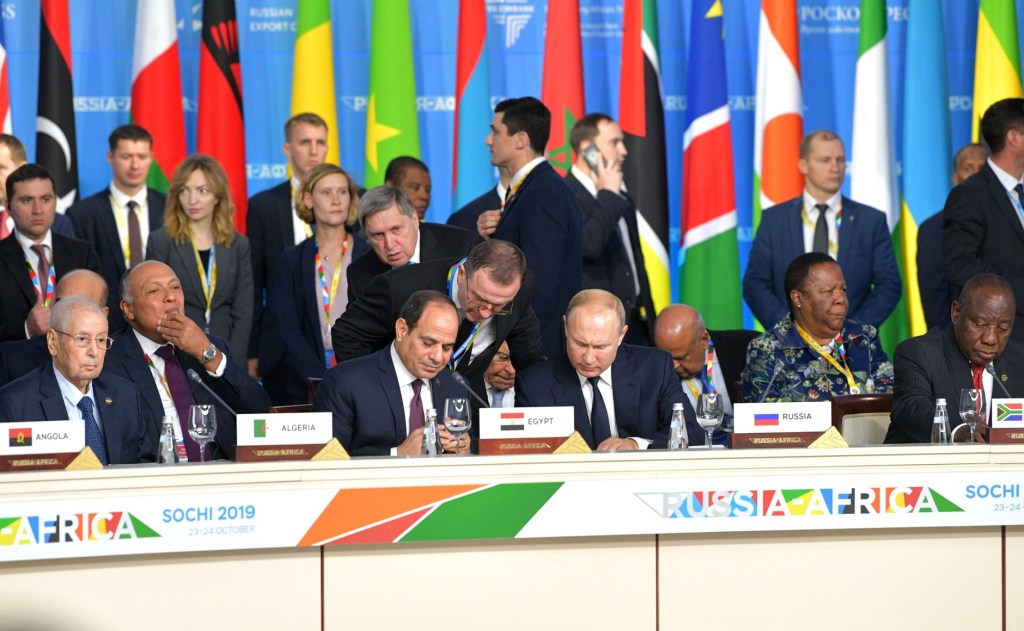
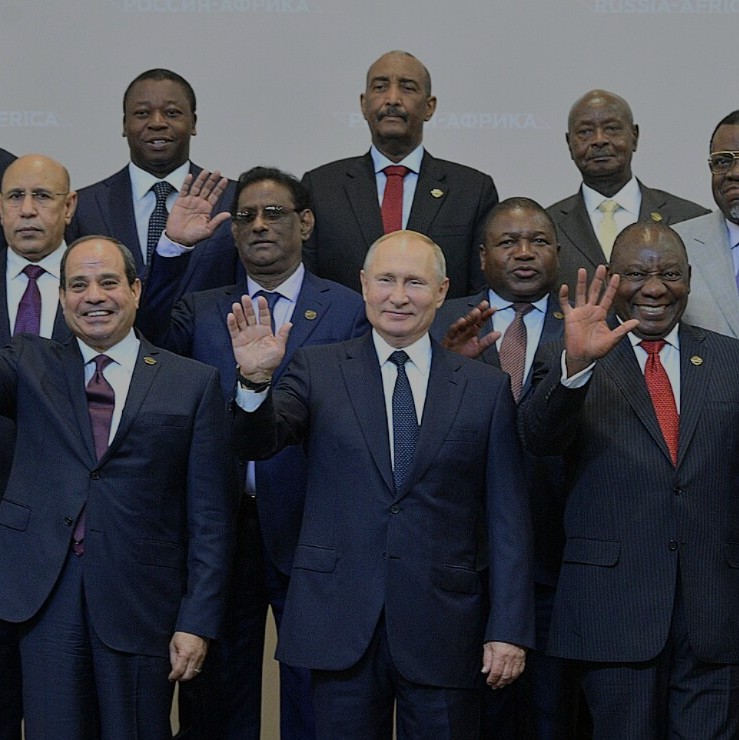
Back to the present day, since 2000, Russia has been gradually expanding both their interest and engagement in the African continent. Highlighting this, in 2019 Russia hosted the first-ever Russia-Africa Summit, suggesting a commitment to continue deepening ties. The event, held in Sochi, attracted leaders from over 40 African countries and highlighted Russian ambitions to play a larger role on the continent.
In recent times, the Russian invasion of Ukraine has struck a heavy blow to Africa’s economic and food security landscape, intensifying vulnerabilities across the continent. Africa’s dependence on Russian and Ukrainian exports of wheat, maize, and fertilisers has rendered many nations susceptible to supply disruptions and price shocks. In 2020, 15 African countries relied on these two countries for over half of their wheat imports. In nations like Eritrea, Egypt, Benin, Sudan, Djibouti, and Tanzania, this figure exceeded 70%. Since the conflict began, the ripple effects have been severe. According to the International Monetary Fund, staple food prices across Africa surged by an average of 23.9% from 2020 to 2022, marking the steepest increase since the 2008 global financial crisis. With disruptions in grain exports and shortages of sunflower oil, food inflation has spiralled, affecting not only the price of essential staples but also increasing the cost of livestock feed. The economic strain has compounded existing challenges, with rising poverty and GDP declines threatening stability. This suggests that the influence of Russia on Africa’s food system is enormous and therefore the war in Ukraine has put Africa in a series of impossible situations. Africa can benefit from these two countries but equally this relationship can cause great detriment as Russia remains a law unto itself.
(Credit: Kremlin)
Russia’s economic relationship with Africa has become a cornerstone of its global strategy, driven by a deepening reliance on the continent’s vast natural resources. In countries like Angola, South Africa, and Zimbabwe, Russia has pursued investments in oil, gas, minerals, and precious metals, building a partnership that is mutually advantageous. For Africa, Russia’s involvement brings essential investments in energy and infrastructure, notably through nuclear energy projects and mining ventures. These engagements provide much-needed economic growth, job opportunities, and technological transfer, enabling African nations to capitalise on their resource wealth.
For Russia, Africa’s resources play a crucial role in maintaining its energy and mineral supply chains. The continent’s reserves of oil and gas, as well as its abundance of diamonds and rare minerals, are indispensable for Russia’s economic stability, especially given the challenges it faces in sustaining resource extraction within its own borders due to geographic and environmental limitations. Africa’s resources feed directly into Russia’s industrial and technological sectors, allowing it to uphold its influence in the global energy market and secure raw materials vital for its defence and tech industries.
Should Russia lose this strategic partnership, the impact would resonate across its economy. The loss of African resources could weaken Russia’s standing in global energy and mineral markets, constricting its access to vital materials that bolster its economic and military strength. In a world increasingly divided along geopolitical lines, Africa’s resource wealth represents a lifeline for Moscow—a connection that, if severed, would be a significant blow to Russia’s aspirations for global influence.
Most of this article has looked at Africa as a whole, but Russia has stronger relations with certain African countries due to the resources they can provide. Russian enterprises have deepened ties with Angola, focusing on energy, mining, and infrastructure projects that align with Angola’s economic priorities. The trade imbalance between the two nations underscores Russia’s significant export role: in 2021, exports from Russia to Angola totalled $567.9 million, while Angolan exports to Russia were a modest $14.9 million. This stark difference illustrates Russia’s export-driven influence in Angola, providing the African nation with essential imports, often in oil, machinery, and industrial goods, that are critical for Angola’s growing infrastructure needs.
Russia’s ties with Angola extend beyond economics; they represent a strategic foothold in southern Africa that benefits the region more widely. As Angola’s economy grows, its partnership with Russia offers a level of diversification, enabling Angola to rely on multiple international players rather than exclusively Western partnerships. Additionally, Russian investments in sectors like energy and mining boost local employment and support Angola’s aim to reduce poverty and improve living standards.
Beyond bilateral benefits, this relationship has implications for Africa’s collective bargaining power. By maintaining strong ties with Russia, Angola and other African nations can potentially leverage more competitive trading deals, balancing relationships with Western, Asian, and Russian interests. However, the lack of some trade details hidden behind ‘confidential files’ by the Kremlin highlights the complexity of this partnership. As Russia seeks to counterbalance Western influence in Africa, its relationship with Angola serves as a valuable asset, strengthening its position in a region rich in resources and eager for diversified development options.
The Kremlin’s ambitions in Africa serve as a stark reminder that Russia’s partnership comes not as a gift, but as a strategic foothold that could leave African nations more entangled in foreign power plays than ever before.
Angola is not the only country in Africa central to Russia’s influence. With shared interests in challenging Western dominance, Russia and Zimbabwe have reinforced their strategic alignment in recent years. Zimbabwe’s government has openly praised Russia’s role as a reliable partner in contrast to major Western opinion. In a recent statement, Zimbabwe’s Ministry of Foreign Affairs remarked, “Russia stood with us in our liberation struggle, and today they stand with us in our pursuit of economic independence,” suggesting the enduring nature of their partnership.
This partnership is particularly visible in Zimbabwe’s mining sector, where Russian companies are heavily involved in the extraction of platinum, diamonds, and gold, which are essential to Zimbabwe’s economy. The collaboration also extends to defence, with Russia providing military training and equipment to Zimbabwe, bolstering the nation’s security capabilities amid international sanctions. Zimbabwean officials have described Russia’s investments as “vital” to the nation’s development, citing Russia’s “willingness to work with us on equal terms”. This highlights Zimbabwe’s preference for relationships between countries that focus on equality and less on aid, unlike much of their relationships with the West. Furthermore, this relationship not only boosts Zimbabwe’s economic growth but also strengthens Russia’s influence in Southern Africa, allowing Moscow a strategic presence in a region rich in resources and aligned with their political view. Russia’s aggressive expansion into Africa marks a calculated play for power on the global stage, positioning Moscow as a dominant force across the continent. Through investments in critical sectors like mining, oil, and security, as well as through strategic alliances in countries like Zimbabwe and Angola, Russia has secured both resources and influence, strengthening its hand in global geopolitics. This partnership offers some immediate benefits to African nations, such as job creation, infrastructure development, and, in some cases, a reprieve from the strings attached approach of Western aid. The Kremlin’s “no-strings” approach, relying on mercenaries, arms deals, and back door meetings, grants Russia extraordinary leverage, enabling it to shape African policy to align with its own interests. This unchecked influence risks undermining Africa’s autonomy and compromising the continent’s long-term governance and stability. As Moscow tightens its grip, it could destabilise the regional balance of power, emboldening autocratic regimes and threatening democratic movements. Russia’s expansion in Africa offers it the power to disrupt Western interests, shake the global order, and expand its sphere of influence far beyond its borders. The Kremlin’s ambitions in Africa serve as a stark reminder that Russia’s partnership comes not as a gift, but as a strategic foothold that could leave African nations more entangled in foreign power plays than ever before.


 The York Politics Review
Leave a comment