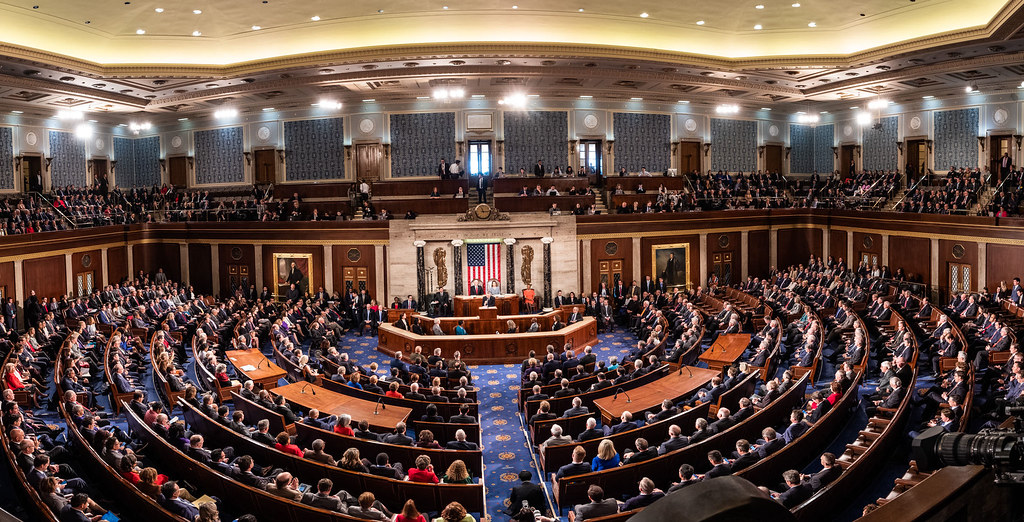
(Photo: CCL)
By Sam Chapman – Regular Contributor
After three weeks with no Speaker, Republicans in the US House of Representatives let go of each other’s throats for long enough to cast their ballots. After many unsuccessful campaigns from now-disgraced Republicans, the title was given to Mike Johnson, Congressman for Louisiana and Deputy Chief Whip. Few knew this man’s name at the beginning of the week, as he was nobody’s first choice to take the gavel. Here is an accounting of all the men who attempted to become Speaker, their leadership bids recollected with as little derision as possible.
Contender No.1 – Patrick McHenry
Although recent turmoil suggests otherwise, the Speaker of the House is an important job to hold, and somebody has to hold it. The Speaker is second in the line of presidential succession and sets the legislative agenda for the entire House. For this reason, the Speaker’s chair cannot be left to gather dust, and so every time a Speaker is appointed, they select a deputy. This deputy is chosen (for national security reasons) in secret, and their identity only goes public if the true Speaker has been ousted, assassinated, or otherwise disposed of.
Thus, when Speaker Kevin McCarthy was removed in early October, the ‘Speaker-pro-tempore’ (Temporary Speaker) came forward. His name was Patrick McHenry, and Washington was underwhelmed. Famed among the House of Representatives for his eye-catching bow-ties and eye-catching height of five-foot-five, McHenry spent his short stint with the gavel looking perpetually annoyed.
Since he was only ever supposed to be a deputy, McHenry did not have the authority to pass any legislation, but he did achieve two things: firstly, he ordered former Speaker Nancy Pelosi to move out of her current office and into an older, much smaller one. Then, after seeing media discussion regarding his height, he ordered the Speaker’s Chair to be downsized to look more impressive standing before it. This proved unnecessary, as when the suggestion was put to Republican members whether to promote McHenry to a full-time Speaker, he was laughed at. McHenry was not to stay.
Contender No.2 – Donald Trump
Into every Republican vacuum will eventually arrive Donald Trump. When the Speaker’s Chair had been vacant for a few days, ultra-conservatives in the Republican Party began to float the former president’s name to take over the job, on a temporary and short-term basis to allow for his re-election campaign. Trump expressed his gratitude at being nominated, and said he would consider, but later was informed that the Speakership comes with twelve-hour working days, and the requirement to read all House legislation. After that, he allowed his name to disappear from circulation.
It was probably for the best, as his calendar has since filled up with court dates.
Contender No.3 – Steve Scalise
A professional ‘Adult In The Room’, Scalise was destined to be unpopular with the louder voices in the Republican Party. Once the reality set in that the Republicans would have to find a new leader, an internal ballot was conducted on 11 October and two names emerged as favourite contenders. The first was House Majority Leader Steve Scalise, who secured the backing of 113 colleagues, and the second was Judiciary Committee Chairman Jim Jordan, receiving only 99. Scalise became the ‘Speaker Designate’ and the stage was set for a whole-House vote.
However, Donald Trump and his lackeys had other plans. The ever-present spectre in Mar-a-Lago had already backed Jim Jordan, and although Scalise had more backers, the Trump endorsement was enough to bridge that gap. Hardliners fell in line behind Jordan, and after twelve hours of national spotlight, Scalise swallowed his pride, dropped out of the race, and backed Jordan for Speaker.
Contender No.4 – Jim Jordan
This should have been the end: Jordan’s only opponent had conceded and pledged to support him. However, underestimating Jordan’s ability to disappoint proved fatal for his party.
Jim Jordan’s character has often been discussed, and rarely positively: his professional life began as an assistant wrestling coach, where it has been widely speculated that he denied knowledge of 177 proven sexual assaults committed by a colleague. Across his 16 years as a Congressman, Jordan has neither written nor endorsed a single piece of legislation, and in 2020 he led the charge to overthrow the results of the presidential election. That last charge made him exceptionally popular in the Republican Party, and for a few hours the future of the American Congress looked certain.
At this stage, the debacle over choosing a new Speaker appeared especially embarrassing as the crisis in the Middle East racked up a horrifying death toll, and in this context it dawned on Republicans that Jordan was the wrong man to have backed.
The entire House of Representatives – 222 Republicans and 212 Democrats – was given the chance to vote. With these numbers, Jordan could not become Speaker if just five Republicans voted against him. On 17 October, he suffered twenty rebellions.
The next day he tried again, and suffered twenty-one.
Unperturbed, Jordan carried on and scheduled a third vote for that weekend. He was convinced to cancel that vote, as nobody was sure how many Republicans would come to work on a Saturday, and too many Republican absences might accidentally result in electing a Democrat Speaker. The vote was pushed back until the week after, where twenty-five Republicans refused to support Jordan.
Shortly thereafter a secret ballot was held, a motion of no confidence in his leadership was held. His rise had been far from meteoric, but his crash back down was suitably catastrophic.
Contender No.5 – Tom Emmer
Initially Chief Whip Tom Emmer was nominated as a joke. His name was balloted by a colleague who later said he only voted for Emmer because he disliked the man and thought he would struggle as Speaker. Emmer then allowed everyone to partake in this joke, as he officially put his name in the running for the job Jordan failed. Another internal vote was held and Emmer received the nomination.
At midday on 24 October, Emmer proudly accepted the title of Speaker Designate.
At roughly 12.30pm, Trump posted online: “I have many wonderful friends wanting to be Speaker of the House… Tom Emmer is not one of them.”
At little after 4.00pm, Emmer dropped out of the race after failing to get enough support in his party.
“I killed him,” Trump allegedly told an aide on his way out of court.
Contender No.6 – The Victor – Mike Johnson
Nobody remained.
This nobody was called Mike Johnson, and in the dim lights of the Capitol building backrooms, he was the messiah. He promised he could be all things to all people, and his colleagues gave him a chance. The key for nominating Johnson was speed. The man enjoyed a certain anonymity, and this was enough to get him through the party nomination process and onto the floor before anyone could ramp up enough opposition to topple him. On 25 October he received 220 votes and became the 56th Speaker of the House of Representatives. Ending the 22-day reign of chaos, he injected some optimism into his party, if not the country.
In the few days he has been in post, back-catalogue footage of his career has come to light. Perhaps this should have been studied beforehand, but few Republicans have commented on Johnson’s opposition to gay marriage, his Christian fundamentalism, and his opposition to supporting Ukraine. To many, these are part of the charm.
Removing Speaker McCarthy opened an enormous can of worms, and Republicans have spent the last three weeks guzzling them down. Because of this, Johnson is for the moment untouchable. But if there is one lesson a Republican should have learned, it is this: in the end nobody is indispensable, and anyone can be replaced.



 The York Politics Review
Leave a comment