(Photo: CCL)
By Sam Chapman – Contributor
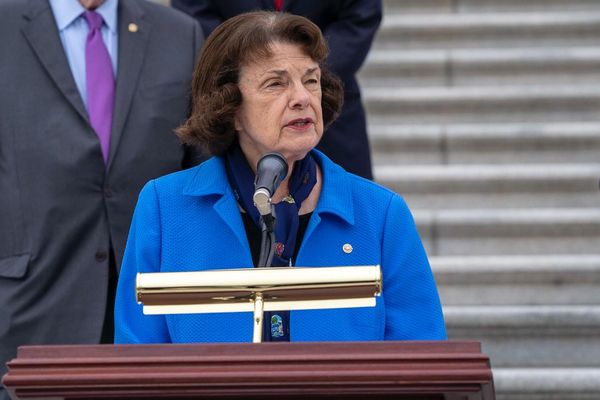
An idealist may look back on the decades-long career of California’s senior senator as a triumph in progressive politics. A right-minded observer, however, will question what a 90-year-old woman was doing serving in the United States Congress anyway, and worry over what her unsurprising but unfortunately-timed demise might mean for the Biden presidency.
In May of this year, California’s then-89-year-old senator Dianne Feinstein was asked for her opinion on Congress’ new slate of legislation regarding Washington DC police. Keen and eager, she responded “I’ve been here and I’ve been voting,” It was a nice statement, but an incorrect one. She had not been there, and she had not been voting. She had, in fact, been in hospital, where she was treated for a swollen brain, shingles, and nerve damage in the face and limbs. Most concerningly, upon her return, she possessed no recollection of this absence. Despite this she resumed her committee placements and voted through a military budget to the tune of $820 billion.
Since her death on 28 September, tributes have poured in from mainstream politicians of all stripes, and with good reason. For example, it is right to highlight, as both California Governor Newsom and former President Obama have, Feinstein’s consistent championing of women’s rights and gun control across her 30-year senatorial career. Her life in California politics was evidently a busy one: she was involved in efforts to capture the ‘California Night Stalker’ serial killer in the 1980s, and survived an assassination attempt while running for Mayor of San Fransisco.
In the later years of this illustrious career, however, Feinstein began to tarnish her own reputation by clinging to power far beyond the limits of her popularity and her health. In 2018, Feinstein’s fourth six-year term in the Senate ended, and Californians were eager for a fresher, younger face to represent the Golden State. Despite this, she refused to retire and became the oldest member of the US Congress.
Feinstein’s death comes at an especially unfortunate time for her Democratic Party, as an already razor-thin majority is being pulled apart with only a year before a presidential election. President Biden has made it no secret that he wishes the Senate would pass bolder legislation to improve his chances of electoral success next year, such as a sweeping infrastructure bill and protections on abortion rights, but he simply does not have the numbers.
Of the 100 Senators, 49 are Republican, and largely vote down Biden’s bills by default. More frustratingly, however, his own party are hardly proving any more helpful. Senator Bob Menendez, a Democrat from New Jersey, has recently been indicted on federal bribery charges, and is under such immense pressure to resign that he has simply stopped showing up to work. That’s one fewer vote for Biden to count on. Senator Kyrsten Sinema, from Arizona, was elected as a Democrat in 2018 but has since received so much Big Oil funding that in December she left the party and now identifies as Independent. One fewer vote for Biden to count on. Pennsylvania Senator John Fetterman has been in and out of hospital in the last few months due to an ongoing battle with depression, and thus has not been consistently in the Capitol. One fewer vote for Biden to count on.
It stands to reason, then, that if any meaningful laws are going to be passed to help Democrats keep the White House, the senators present must be relied upon to show initiative. Dying on the job is a further setback they do not need. Thus, by clinging to her power on the Intelligence and Defence Committees for one final term, Feinstein has potentially jeopardised the party’s chances of staving off a second Trump presidency, and helped relegate Biden to a lame-duck even as he actively campaigns for re-election.
Beyond this immediate turmoil, there is a broader question which must be asked of why America is being disproportionately governed by older-age people. In 2020, Supreme Court legend Ruth Bader Ginsberg passed away, and Trump was permitted to replace her with a much younger Justice who quickly set about overturning Roe v. Wade’s protections on abortions, and will sit on the Supreme Court for decades to come. Six years prior, Obama had pressured Ginsberg to resign while a Democrat could choose her replacement, but she declined and remained in post until she died. Next year, President Joe Biden will stand for a second term despite already being the oldest president in history. The idea of Biden remaining in the White House until 2029 seems increasingly unlikely, but nobody in his party stands a serious chance of challenging him. Senate Minority Leader Mitch McConnell has, in recent weeks, suffered two embarrassing stroke-like incidents at public press conferences, which made for uncomfortable viewing and invited serious questions into his mental capacity.
Evidence of a ‘gerontocracy’ – rule-by-the-elderly – has never been more apparent, and its ultimate effect is the alienation of younger generations from mainstream politics even as their problems become more immediately pressing. There has been some acknowledgment of this issue, seen in 83-year-old Nancy Pelosi’s decision to step down as Democratic Leader in the House of Representatives, but even she has refused to fully retire from politics. The old, it seems, are a problem that just will not go away.
So, while it is important to commemorate Dianne Feinstein’s life of public service, it must also be asked whether the public would now be better off if she had her service stopped a little earlier. History will remember her as the longest-serving female senator in US history. And also, perhaps, as a reminder that in an ideal world America’s political system would be built on somewhat stronger foundations than the weak pulses of the old and decrepit.




 The York Politics Review
Leave a comment