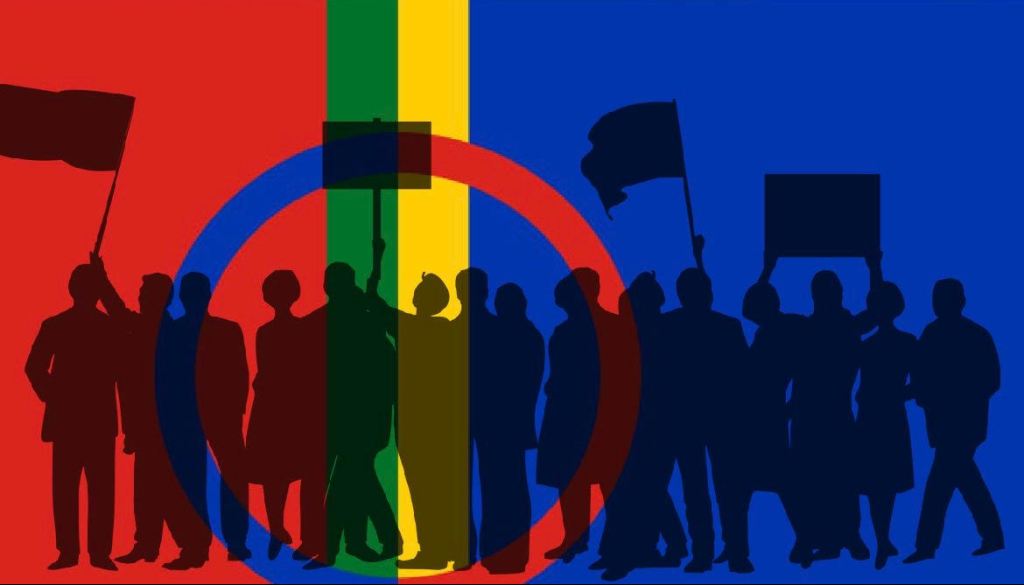
(Photo: CCL)
By Emilie Petterøe – Contributor
Norway has consistently been ranked globally as a pioneer in democratic integrity, freedom and human rights. However, there exists a darker side to Norwegian politics that is often ignored—the Norwegian state’s repeated human rights violations against its indigenous minority, the Sámi. The most recent case of abuse has been the large-scale construction of wind farms built on culturally significant grounds for the Sámi people. It has been almost two years since the supreme court in Norway ruled that two large wind farms have been built illegally, yet no meaningful action has been taken.
Storheia and Roan, the two wind farms in question, together constitute the largest onshore wind power project in Europe to date. Tensions between the Norwegian state and the Sámi people ignited when reindeer herders expressed dissatisfaction over the wind turbines disrupting their grazing area, the lifeblood of traditional Sámi culture. This violation of UN-protected indigenous people’s cultural rights further intensifies an already delicate situation.
Last February, the Norwegian Sámi National Confederation (NSR) and members of Nature and Youth (NU) campaigned against the wind turbines, still standing 500 days after the supreme court ruled in their favour. To understand the next steps between the Norwegian state and the Sámi, it must be mentioned that the supreme court ruled in favour of the indigenous people. Yet this ruling did not make any demands requiring the state to demolish the wind turbines or facilitate the cultural needs of the Sámi. The supreme court ruling simply concluded that the existence of reindeer husbandry is threatened by long-term wind farm construction, a token action highlighting the typical lack of respect towards Sámi issues.
The state interprets the sentence’s phrasing, “threatened in the long term”, to mean that the wind farms do not constitute an ongoing violation of human rights. However, the Sámi and their allies demand that the wind farms be shut down immediately. For the Norwegian government, “long term” means responsibility for a future government; for the Sámi, this is an immediate threat to their current lifestyle. While the Norwegian state has time to plan its next steps, Sámi communities are left in the dark.
Opponents of the Sàmi protests argue that demolishing the wind farms will significantly boost the economy and the electrical supply for Norwegian households. Fosen wind produces enough power to supply 170,000 homes. The wind farms cost around £800 million/11 billion NOK to construct. With such a large price tag funded through taxpayer money, removing or moving the turbines could be seen by many citizens as an expensive waste. Opponents further argue that the herders can still use the land for grazing as male reindeer may not care about turbine disruption, thus allowing them to mate and graze regardless. Studies have shown, on the other hand, however, that the vast majority of the reindeer, especially the females, will avoid the turbines within a three to twenty-kilometre distance.
This is not the first time the Norwegian state and the Sámi have conflicted. The current situation regarding Fosen echoes back to the Alta Controversy of the 70s and 80s. The Alta Controversy was a political conflict from 1968 to 1982 where Sámis and environmental activists went against large-scale hydropower developments in inner Finnmark. This conflict resulted in significant law reforms, further protecting indigenous people. In addition to its great political significance, it was also the culmination of an extensive debate regarding Norwegian power development that had been happening since the late 1960s.
The current Norwegian prime minister, Jonas Gahr Støre, is in rough waters with mounting criticism from multiple members of parliament. The Socialist Left Party demands that the Labour government takes greater responsibility and mobilises towards a solution. The Mayor of Tromsø, a municipality with one of the largest Sámi populations, has publicly stated that this situation is unacceptable and that the turbines must be removed.
The state has also been criticised for removing protesters; they were removed around 3 am, raising questions about the reasoning for state action in the early hours of the morning, leading to the conclusion that the state wishes to draw as little attention to them and the case as possible. Torbjørn Bongo, a long-time politician for the Labor Party and Norwegian Officers’ and Specialists’ Association, labelled the government as “cowards”, despite his own disagreements with the case. He has publicly stated that:
“This is not how a state should treat people that use their voices. You should meet them, listen and converse, even though it does not necessarily lead to an agreement. I am severely disappointed in how they canceled their demonstration. You do not do it in secret, like it’s been done now”.
What the next move from the state would be is hard to tell, but the Sámi protesters are planning a large protest for the 700-day anniversary on September 11th. This date also happens to be regional election day in Norway; cultural issues have become interwoven with politics, and the Sámi hopes to use this to their advantage. Member of NSR youth, Elle Rávdná Näkkäläjärvi, has stated that they will be reminding the people of the ongoing human rights violations and “since it is the same day as the election day, everyone in the country has the opportunity to make a change”. The possible impact the protesters could have may very well be in the hands of the people rather than the government if the conversation towards a solution does not occur soon.
What might the next steps towards a solution be? Some alternatives could provide a possible fix. One is that parts of the wind farm, or the entirety of it, are demolished. The second could be that the reindeer owners get offered access to alternative grazing areas and economic compensation, a compromise for both parties. However, herders in Fosen have already expressed that this alternative is out of the question, and the only solution to the problem is to give the land back to the Sámi. It seems that this deadlock between the state and Sámi is not disappearing any time soon.




 The York Politics Review
Leave a comment