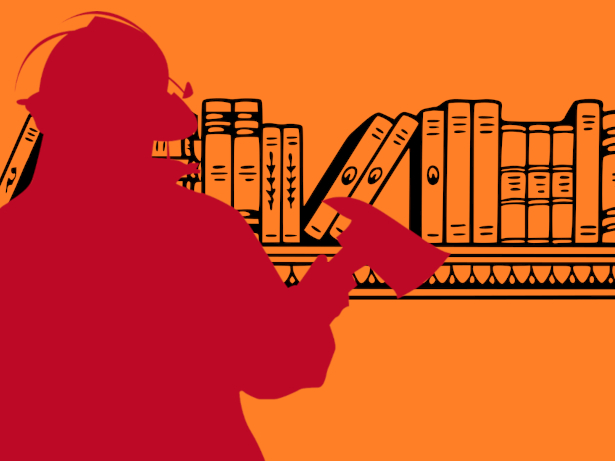
(Photo: CCL)
By Eliza Gill – Contributor
“It was a pleasure to burn”, begins Fahrenheit 451, Ray Bradbury’s dystopian depiction of America, in which books are seen as dangerous, and so incinerated. Bradbury’s novel came in the aftermath of the Second World War, which saw the Nazis burn books which opposed their ideology in Germany and Austria. Book banning is certainly nothing new, but it is nothing old either. In 2022, the American Library Association saw a 38% increase in censorship demands as opposed to 2021. 58% of these book challenges targeted books in school libraries. The majority of the books targeted were written by people of colour and members of the LGBTQ+ community. Naturally, this issue has become deeply interwoven with political ideology. As of 2022, six states have passed laws which will allow for parents to regulate what is in school libraries. One bill in particular will see lists of books that children check out of school libraries sent to their parents. Another bill in Nebraska will require that parents sign a permission slip for their children’s library books. As stated by John Chrastka, executive director of EveryLibrary, “this is a state-sponsored purging of ideas and identities that has no precedent in the United States of America.”
Censorship and book regulation are not distinct to one end of the spectrum, but both. A poll showed that Americans across the political spectrum oppose book bans. In America, the majority of banned books explore sex education, and themes of gender, race, and sexuality. Whilst in the United Kingdom, language is contested for its portrayal of characters in a seemingly illiberal light. As stated by Adrian Jawort of The Daily Montanan, whether it’s “right-wing fascists, totalitarian leftists, or theocracies”, the first thing that a totalitarian regime will target is literature and art. Historically, book banning has been used when literature has directly opposed the government. A shift took place, however, when Philip Pullman’s 1990s children’s series His Dark Materials was banned. The apparent atheist worldview taken in this series was highly contested by a vocal minority in America, and pressed by the Catholic League. The banning of His Dark Materials could be seen as a precursor for book banning or censoring on religious and ‘moral’ grounds.
Censorship is alive and well in the publishing industry in the UK, as well as in America. In February of this year, there was an extensive debate over the rewriting of Roald Dahl’s books, to remove his offensive language. In changes made by publisher Puffin, the word “fat” was removed from all books, including the description of Charlie and the Chocolate Factory’s character, Augustus Gloop. It was swapped out for “enormous”. The word “black” was removed from the description of tractors in The Fabulous Mr Fox. In James and the Giant Peach, the ‘cloud-men’ have been rebranded as ‘cloud-people’. Suzanne Nossel, chief executive of PEN America, asserted in a tweet that “if we start down the path of trying to correct for perceived slights instead of allowing readers to receive and react to books as written, we risk distorting the work of great authors and clouding the essential lens that literature offers on society”.
Why could banning and censoring children’s books be seen as more detrimental to society than the banning of adult books? Books shape how children see the world; they underpin their expectations of society, and inform their understanding of history. The past, in particular, is of great concern in the book censorship debate. By censoring Roald Dahl’s books, are we pretending that the past did not happen? Could we learn from the books and show children that this is how far we have come? Of course, the safety of children is of utmost importance; questions surrounding sheltering are intertwined with the censorship debate.
Indeed, the waters of censorship are murky, regardless of which end of the political spectrum you sit at. The censoring of language is the censoring of thought, and as such, depictions of historical and modern societies can become inaccurate.
There is a dark underbelly to censorship. It is no surprise that book burning, banning, and censoring is common in dystopian literature. Perhaps the most pertinent example is the one previously mentioned, Ray Bradbury’s Fahrenheit 451. In an attempt to create an ignorant and less volatile society, books are burned by firefighters. The theme of free speech is heavily examined in Bradbury’s work; potential controversy in ideas is the main cause of the burning. The war against free speech is a common building block in a dystopian society; Orwell’s 1984 is the most well known example of such. Freedom of thought underpins the freedom of speech. And, as Orwell states, “if liberty means anything at all it means the right to tell people what they do not want to hear”. What Orwell points to is eerily relevant to modern society. What truth can there be if books born throughout history are being rewritten to appeal to modern sensibilities? The same can be said for modern, more progressive books. Here, an Orwellian quote is most fitting:
“Every record has been destroyed or falsified, every book rewritten, every picture has been repainted, every statue and street building has been renamed, every date has been altered. And the process is continuing day by day and minute by minute. History has stopped. Nothing exists except an endless present in which the Party is always right.” ― George Orwell, 1984

 The York Politics Review
Leave a comment